
Your factory-fitted alarm is essentially silent against a thief armed with a simple circuit board and access to your headlight wiring. This isn’t a scene from a movie; it’s the reality of what is CAN injection theft, a sophisticated method that bypasses your car’s security by speaking directly to its internal brain. In 2025, California alone recorded 136,988 vehicle thefts, proving that even the most modern factory systems remain vulnerable to high-tech exploitation.
You likely feel a deep sense of frustration that a ‘secure’ driveway no longer guarantees your car will be there in the morning. It’s confusing when standard alarms fail to trigger, but you aren’t powerless. This article ensures you understand exactly how CAN injection works and reveals the professional security measures required to safeguard your asset. We’ll preview the most effective solutions, from the Ghost 2 Immobiliser to Thatcham approved S5 tracking systems, so you know which upgrades actually work. You’ll gain the technical knowledge to move from a state of vulnerability to total resolution and lasting peace of mind.
Key Takeaways
- Discover what is CAN injection theft and how criminals use digital tools to mimic legitimate signals, bypassing your car’s internal security network.
- Identify the hidden physical vulnerabilities in modern vehicles, such as headlight wiring and bumper sensors, that serve as gateways for high-tech thieves.
- Learn why traditional deterrents like Faraday pouches fail to stop these attacks and why factory-fitted immobilisers often offer little resistance.
- Explore how a layered security approach using the Ghost 2 Immobiliser and Thatcham approved S5 tracking provides the ultimate protection for your asset.
- Understand the critical role of professional, mobile installation in ensuring your security hardware is correctly integrated into complex vehicle wiring.
Defining CAN Injection: The New Frontier of Vehicle Theft
The era of the smashed window and the snapped steering column is fading. Modern criminals don’t need a heavy hammer; they need a specialized circuit board and a few seconds of access to your wiring. Understanding what is CAN injection theft is the first step in defending your vehicle against this high-tech threat. Unlike relay theft, which tricks the car into thinking the key is nearby, CAN injection bypasses the key entirely. It acts as a digital crowbar, forcing entry into the car’s internal software by injecting malicious commands directly into the communication lines.
This method is a sophisticated form of Automotive hacking that targets the physical wiring of the vehicle. By tapping into a wire, usually behind a headlight or bumper sensor, a thief sends fake commands to the car’s brain. This is fundamentally different from traditional ‘hotwiring’ because it doesn’t just bypass the ignition cylinder. It manipulates the electronic signals that manage the door locks and the engine immobiliser. Because the thief is ‘speaking’ the car’s own language, the vehicle has no reason to suspect a crime is in progress.
What is the CAN Bus?
The Controller Area Network (CAN) bus is the central nervous system of your vehicle. It’s a high-speed communication network that allows different Electronic Control Units (ECUs) to talk to one another. Your engine, brakes, and security systems all use this ‘bus’ to share data in real time. The core vulnerability is simple: the system was designed for efficiency, not security. When an ECU receives a message to ‘Unlock Doors’ or ‘Deactivate Immobiliser,’ it assumes the message is legitimate and obeys immediately. There’s no verification process to check if the command came from the key or a thief’s device. Understanding what is CAN injection theft means recognizing that your car’s greatest strength, its connectivity, is also its primary weakness.
Why CAN Injection is Rising in 2026
As we move through 2026, the rise of software-defined vehicles has created more digital entry points than ever. Modern cars are essentially computers on wheels, and this complexity offers more opportunities for exploitation. Criminals no longer need advanced engineering degrees to pull this off. Ready-made injection kits are now widely available on the dark web, allowing even low-level thieves to perform sophisticated attacks with minimal training. CAN injection is a physical-to-digital bridge used by criminals to gain total control over a vehicle’s security protocols without ever touching the key fob.
The Anatomy of a CAN Injection Attack: From Headlights to Ignition
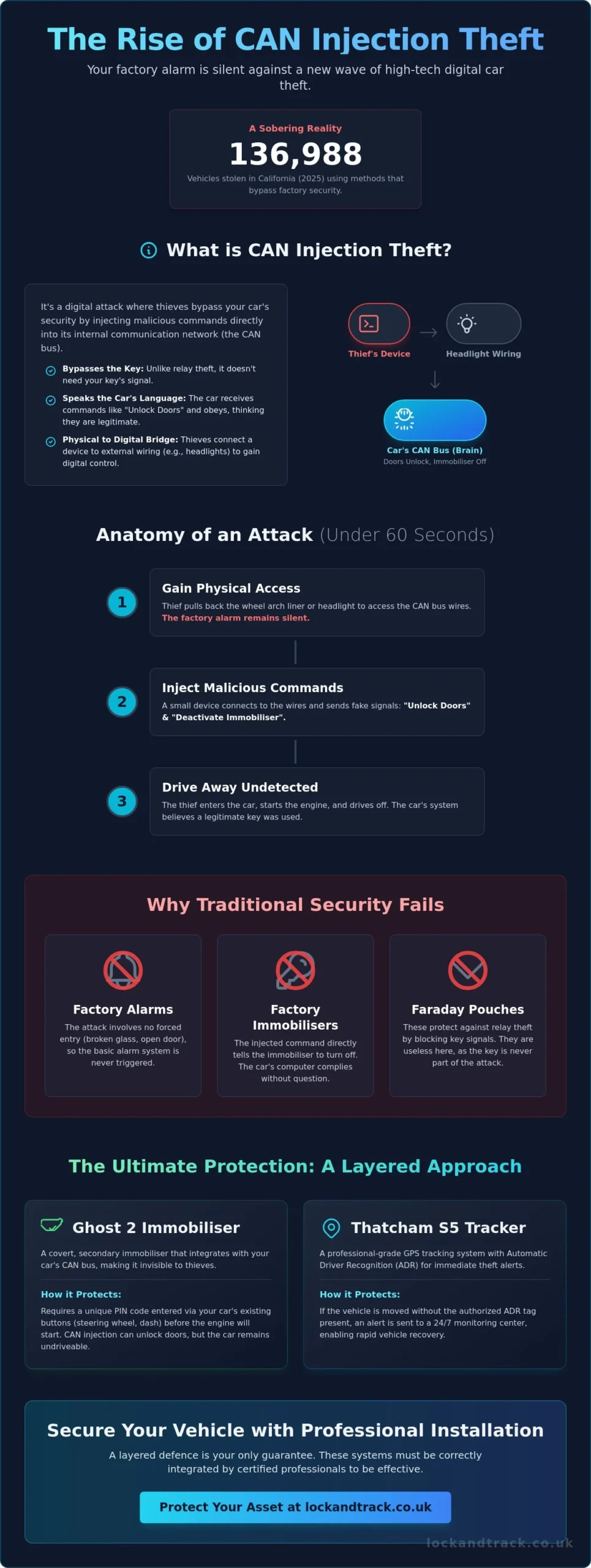
A typical CAN injection attack is a surgical operation that requires zero physical damage to the vehicle’s cabin. Thieves have moved away from the steering column and now focus on external access points. By targeting peripheral components like headlights or radar sensors, they gain a direct gateway to the car’s internal communication lines. This method is incredibly efficient; a prepared criminal can often compromise a vehicle and be driving away in under 60 seconds. Understanding the mechanical steps of what is CAN injection theft reveals why standard security measures are no longer sufficient.
The device used in these attacks is often small and inconspicuous, sometimes disguised as a common Bluetooth speaker or a power bank. It contains a specialized chip programmed to “speak” the vehicle’s specific language. Once connected, it doesn’t just listen to the car’s data; it takes over the conversation. This allows the thief to bypass the central gateway that usually filters out unauthorized commands. By the time the thief opens the driver’s door, the car’s brain already believes a legitimate key is present.
Step 1: Gaining Physical Access
The attack begins with the thief approaching a vulnerable area, usually the front wheel arch or the headlight assembly. On many luxury models, the wiring for the smart lighting system is part of the broader CAN bus network. A thief simply pulls back the wheel arch liner or pops a headlight unit out of its housing. This gives them immediate access to the “CAN High” and “CAN Low” wires. Because this action doesn’t involve breaking glass or opening a door, the factory alarm remains silent. The car’s security system hasn’t been breached yet; it’s simply being spoken to from the outside.
Step 2: Injecting the ‘Unlock’ Command
Once the wires are exposed, the thief connects their hardware. The device immediately begins a CAN injection attack by flooding the network with high-priority messages. These messages mimic the signal sent by a legitimate key fob. Through a process called ‘message collision,’ the thief’s device overrides the legitimate traffic on the bus. The car’s Electronic Control Unit (ECU) becomes overwhelmed and accepts the injected ‘Unlock’ command as authentic. The doors click open, and the factory immobiliser is deactivated instantly.
With the digital gateway wide open, the thief simply enters the vehicle and presses the start button. The car’s brain believes the owner is present, so it allows the engine to fire up without resistance. This seamless bypass is why owners often wake up to find their driveway empty with no signs of a struggle. To prevent this, you need a system that requires a secondary layer of authentication before the engine can start. You can view our range of advanced immobilisers to see how we block these digital intruders at the source.
Why Traditional Security Fails Against CAN Injection
Many owners believe they are protected because they keep their keys in a Faraday pouch. While this is effective against relay theft, it offers zero resistance to a CAN injection attack. This is because the thief isn’t trying to intercept a radio signal from your key. They are physically connecting to the car’s nervous system. When you understand what is CAN injection theft, you realize that your key’s location is irrelevant to the criminal. The attack happens at the wiring level, making signal blockers completely redundant.
The threat is often invisible until the moment your car leaves the driveway. Because there is no broken glass and no alarm siren, neighbors and passersby won’t suspect a thing. Factory security systems are designed with a fundamental flaw: they assume the internal network is a safe zone. Once a thief taps into the wiring, the car’s computer accepts their commands as legitimate. This vulnerability is exactly what the method exposes in connected vehicles; a lack of internal authentication that allows malicious devices to masquerade as trusted components.
CAN Injection vs. Relay Theft
The primary difference between these methods is proximity and hardware. Relay theft requires the thief to stand near your front door to ‘catch’ a signal from your key fob. CAN injection does not. This makes it significantly more dangerous for vehicles parked in public car parks or away from the home. While relay thieves use signal amplifiers, CAN injectors use specialized circuit boards that plug directly into the vehicle’s “CAN High” and “CAN Low” communication lines. This direct physical-to-digital bypass is why high-tech theft remains a primary concern for luxury car owners in 2026.
The Problem with Factory-Fitted Alarms
Standard factory alarms are programmed to monitor physical triggers. They look for doors opening without a key or movement inside the cabin. They do not monitor the internal data bus for suspicious traffic. A thief can ‘silence’ the car’s communication before it even has the chance to trigger an alert. Factory security assumes that if a command comes from the internal network, it must be valid. This misplaced trust allows criminals to deactivate the immobiliser and unlock the steering lock without ever triggering a siren.
Even the most advanced Thatcham approved vehicle trackers UK owners rely on are primarily recovery tools. While they are essential for locating a stolen asset, they don’t always prevent the initial drive-away. To stop a CAN injection attack, you need an active layer of prevention that requires a unique PIN or driver tag before the engine will fire. Relying solely on ‘built-in’ security leaves your vehicle vulnerable to anyone with a £40 injection kit and a few seconds of privacy.
How to Protect Your Vehicle from CAN Injection Attacks
Defending against high-tech criminals requires a layered strategy. While understanding what is CAN injection theft highlights the vulnerability of your car’s wiring, the solution lies in adding barriers the thief cannot bypass with a circuit board. You must move beyond the factory security and implement a defense-in-depth approach. This means combining physical deterrents with advanced digital safeguards to ensure your vehicle remains exactly where you left it.
Old-school physical barriers still play a vital role in 2026. A high-quality steering lock serves as an immediate visual warning that your vehicle is not an easy target. It forces a digital thief to use loud, physical tools, which significantly increases their risk of being spotted. For owners of specific models like Toyota and Lexus, specialized hardware such as the Miller CAT CAN Bus Anti-Theft Shield, priced at $40.00 as of early 2026, provides a physical cover for vulnerable wiring points. These measures buy you time, but the real protection happens at the software level.
The Power of the Ghost Immobiliser
The most effective way to stop a thief in their tracks is aftermarket immobilisation. By installing a Ghost 2 Immobiliser, you introduce a secondary layer of protection that operates directly on the CAN bus. Unlike the factory system, which can be tricked by an injection device, the Ghost 2 requires a unique PIN code sequence entered via the vehicle’s existing steering wheel or dashboard buttons. Even if a criminal successfully bypasses the door locks, they cannot start the engine. The device is completely silent and emits no radio signals, making it invisible to the scanning tools used in modern car crime.
Adding a High-Level Tracker for Recovery
For ultimate peace of mind, you should pair your immobiliser with an S5 car tracker. These Thatcham-approved devices are the gold standard for recovery in the UK. They utilize Driver Recognition Tags (DRTs) to identify authorized users. If the vehicle moves without a tag present, an immediate alert is sent to a 24/7 monitoring centre. This proactive approach ensures that even if a thief manages to tow the vehicle, the recovery process begins in seconds. In 2025, vehicle thefts in the U.S. saw a 23% decrease due to better technology and owner awareness; adopting these professional standards is the best way to safeguard your asset.
Professional installation is non-negotiable for maintaining your vehicle’s integrity. Modern wiring is incredibly complex, and a DIY attempt can void your manufacturer’s warranty or damage sensitive Electronic Control Units. Our Thatcham-approved engineers provide a nationwide mobile service, ensuring your security hardware is integrated perfectly. Secure your asset today by choosing a professional Thatcham-approved security package.
Professional Security Solutions: Safeguarding Your Vehicle with Lock and Track
Modern vehicle wiring is a delicate ecosystem. Attempting to install security hardware yourself is a significant risk that could lead to electrical failure or a voided manufacturer warranty. When you consider the technical complexity of what is CAN injection theft, it’s clear that defending against it requires surgical precision. Our engineers are trained to work with the intricate CAN bus layouts of high-end vehicles. We don’t just fit a box; we integrate a digital shield that protects your car’s brain from unauthorized intrusion.
Lock and Track provides a comprehensive response to the evolving tactics of car thieves. By combining advanced immobilisation with real-time tracking, we move your vehicle from a state of vulnerability to a state of absolute resolution. Our goal is to provide more than just hardware. We deliver the peace of mind that comes from knowing your asset is safeguarded by the best in the industry. Every installation we perform is designed to meet the highest standards of the UK security industry.
Nationwide Installation You Can Trust
We understand that your time is valuable. That’s why our Thatcham-approved engineers operate a nationwide mobile installation service. Whether you’re at home or at your workplace anywhere in the UK, we come to you. Our specialists have a deep understanding of luxury brands and their specific digital vulnerabilities. Before we leave, we provide a full demonstration of your new security system. You’ll know exactly how to use your secure PIN or driver tags, ensuring you feel confident in your new protective layer from the moment we finish.
Take the First Step Toward Total Security
The rise in high-tech crime means that factory security is no longer the gold standard. Don’t wait for a thief to exploit your headlight wiring before you take action. Proactive protection is the only way to ensure your car stays in your possession. You can explore our full range of car immobiliser solutions online to find the right fit for your specific make and model. Our systems are engineered to counter exactly what is CAN injection theft by requiring physical authentication that a digital device simply cannot replicate.
Identifying your vehicle’s specific weak points is the first step toward a secure driveway. Contact our team for a professional consultation today. We help you build a custom package that combines the Ghost 2 Immobiliser with an S5 tracking system for ultimate protection. Secure your vehicle today with Lock and Track and let us be the guardian of your peace of mind.
Secure Your Vehicle Against the Next Generation of Car Crime
Modern thieves don’t need your keys; they need sixty seconds and a circuit board. Understanding what is CAN injection theft is the first step toward reclaiming control over your vehicle’s security. Factory systems are no longer a sufficient barrier against criminals who can bypass immobilisers through a headlight wire. You need a proactive defense that identifies the owner through physical interaction, not just a digital signal. Relying on outdated security leaves your asset vulnerable to the high-tech tactics becoming common in 2026.
Lock and Track provides the expertise needed to outpace these evolving threats. Our Thatcham Approved Installers provide expert integration to ensure your vehicle’s complex electronics are handled correctly. With nationwide mobile fitting, we bring professional protection directly to your home or workplace. Should the unthinkable occur, our UK-wide recovery support adds an essential layer of proactive heroism to your security strategy. We’re the partner that watches so you don’t have to.
Protect your vehicle from CAN injection with a Ghost 2 Immobiliser. Don’t leave your asset’s safety to chance when a professional solution is a single booking away. Secure your peace of mind today and ensure your vehicle remains exactly where you parked it.
Frequently Asked Questions
Can CAN injection be done remotely without touching the car?
No, CAN injection cannot be performed remotely. A thief must have physical access to your vehicle’s wiring to execute the attack. Unlike relay theft, which intercepts radio signals from a distance, this method involves tapping into a communication wire, typically behind a headlight or a wheel arch liner. It is a physical-to-digital breach that requires a direct connection to the vehicle’s internal nervous system.
Which car models are most vulnerable to CAN injection theft?
Various Toyota and Lexus models have been identified as high-risk targets for this specific exploit due to the accessibility of their external wiring. While any modern vehicle using a CAN bus is theoretically susceptible, luxury SUVs are the primary focus for criminals in 2026. Owners of these brands should consider professional security upgrades to address the known vulnerabilities in their factory-fitted communication networks.
Will a steering wheel lock stop a CAN injection attack?
A steering wheel lock will not prevent the digital injection itself, but it will stop the thief from driving the car away. It serves as a vital physical deterrent that forces a high-tech criminal to use loud, time-consuming cutting tools. While the thief might unlock the doors and start the engine digitally, the physical lock remains an effective secondary layer. Combining physical barriers with digital immobilisation provides the ultimate protection.
Does a Ghost Immobiliser prevent CAN injection?
The Ghost 2 Immobiliser is highly effective because it prevents the engine from starting even if the digital security is bypassed. It sits directly on the data network and blocks unauthorized commands. Because it requires a unique PIN code entered via physical buttons, a thief’s injection device cannot ‘spoof’ the authorization. This makes it a premier solution for countering what is CAN injection theft in 2026.
Can I detect if someone has tried to inject code into my car?
You can sometimes detect an attempted attack by checking for unusual fault codes in the vehicle’s onboard computer. If a thief has attempted to inject code, you may see a ‘Check Engine’ light or communication errors between different Electronic Control Units. However, most owners only realize they’ve been targeted when the vehicle is already gone. Routine diagnostic scans can identify if the wiring has been disturbed or if the network has logged suspicious traffic.
Is CAN injection covered by standard UK car insurance?
Standard UK car insurance typically covers theft via CAN injection, provided you have taken reasonable care to secure the vehicle. However, many insurers now mandate the installation of a Thatcham-approved S5 tracker or immobiliser for high-value models to maintain coverage. Having professional security often leads to lower premiums and faster claim processing. Always check your policy to ensure your hardware meets your insurer’s specific requirements for 2026.
How long does a CAN injection attack take to execute?
A prepared thief can execute a CAN injection attack in under 60 seconds. This brief window includes the time needed to access the wiring, connect the device, and send the malicious unlock command. The speed and silence of this method make it significantly more dangerous than traditional theft. Because there is no glass to break and no alarm to trigger, the process is often completed before the owner is even aware of a threat.
Does fitting an aftermarket immobiliser void my car’s warranty?
Fitting a Thatcham-approved immobiliser through a professional installer like Lock and Track does not void your vehicle’s warranty. Our engineers are trained to integrate security hardware without damaging the existing electrical architecture. Under UK consumer law, a manufacturer cannot void a warranty simply because an aftermarket part was fitted, provided the installation is performed to professional standards. It is a safe and effective way to safeguard your asset.