
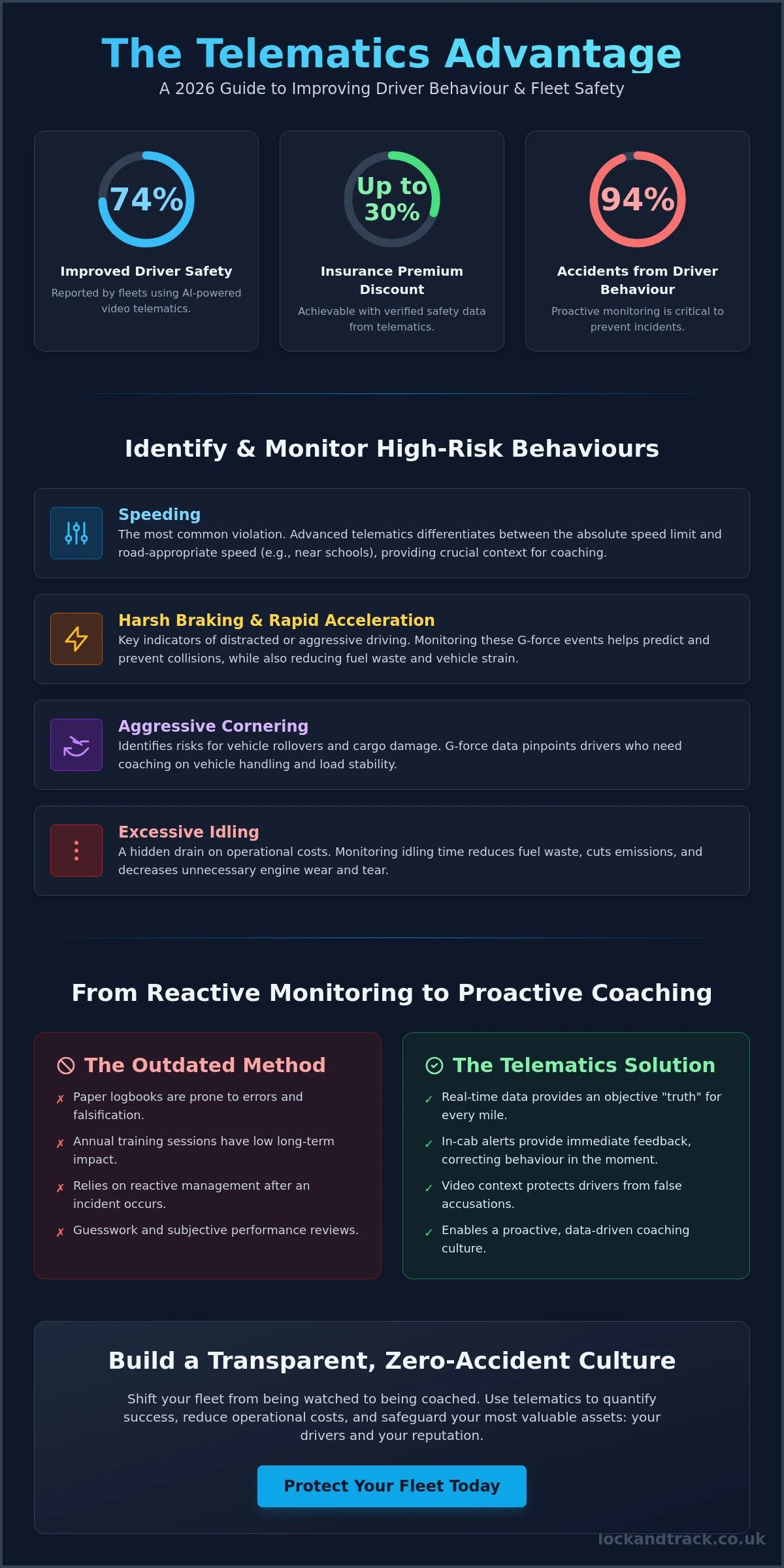
74% of fleets using AI-powered video telematics report improved driver safety according to February 2026 data from Verizon Connect. Despite these impressive figures, many fleet managers still face daily resistance from drivers who view GPS tracking as “Big Brother” surveillance rather than a professional safety tool. You likely already know that aggressive driving habits and idling are inflating your insurance premiums; which can now be discounted by up to 30% if you provide verified safety data. Learning how to improve driver behaviour with telematics is the most effective way to bridge the gap between technical monitoring and genuine driver engagement.
It’s frustrating to watch fuel waste and maintenance costs climb while your team feels micromanaged. This 2026 guide will show you how to use telematics data to coach, protect, and reward your drivers instead of just watching them. We’ll break down the latest FMCSA regulatory changes, including the overhauled CSA scoring model, and provide a clear framework for building a transparent, zero-accident culture that safeguards your assets and your reputation. You’ll discover how to transform raw data into a proactive coaching strategy that delivers peace of mind for you and your team.
Key Takeaways
- Learn how real-time telematics data eliminates guesswork by identifying high-risk habits like speeding and harsh braking before they lead to costly accidents.
- Discover a proven engagement strategy on how to improve driver behaviour with telematics through transparent communication and collaborative KPI setting.
- Understand the technical requirements for fleet protection, specifically why Thatcham-approved S5 trackers are critical for UK insurance compliance and asset security.
- Quantify your operational success by tracking precise fuel savings and reduced wear-and-tear on essential components like tyres, brakes, and clutches.
- Shift your fleet from reactive monitoring to a proactive zero-accident culture that rewards professional driving and safeguards your commercial reputation.
Understanding the Link Between Telematics and Driver Performance
Telematics technology is the powerful integration of telecommunications and informatics. It gives you a direct window into the cab of every vehicle in your fleet. For years, fleet managers relied on gut feeling or retrospective reports to judge performance. That “guessing game” is over. Real-time data provides an unfiltered view of how your assets are being handled on the road. This shift is critical because industry data suggests that 94% of road accidents stem from driver attitude and behaviour. When you see the data, you can stop a collision before it happens.
UK business owners hold a strict Duty of Care for their staff and the public. You’re legally responsible for the safety of your drivers while they’re on the clock. Relying on reactive accident management is no longer a viable strategy in 2026. Instead, you must focus on proactive risk prevention. By monitoring patterns like persistent speeding or idling, you identify the red flags of a future incident. This isn’t just about saving money; it’s about safeguarding lives and protecting your commercial reputation from the fallout of a preventable crash.
The Psychology of Real-Time Feedback
Behavioural change happens fastest when the feedback is immediate. In-cab alerts, such as small beeps or verbal warnings for harsh braking, modify a driver’s actions in the moment. This phenomenon is known as the Hawthorne Effect. It suggests that individuals improve their performance simply because they know they’re being monitored. It’s not about “spying”; it’s about creating an environment of professional accountability. We define telematics-based coaching as a continuous feedback loop that uses live data to reinforce positive driving habits every single day.
Why Traditional Monitoring is No Longer Enough
Old-school logbooks and annual training sessions are no longer sufficient to manage a modern fleet. Paper records are easily falsified, and as of February 2026, the FMCSA has significantly increased fines for such inaccuracies. Transitioning to advanced fleet tracking solutions UK ensures you have an objective “truth” for every mile driven. Annual training often fails because the lessons fade after a few weeks. Telematics provides the daily evidence needed for how to improve driver behaviour with telematics. When an incident is disputed, you have the GPS and accelerometer data to prove exactly what happened, protecting your drivers from false accusations and your business from unjustified insurance claims.
Identifying and Monitoring High-Risk Driving Behaviours
Identifying risks is the foundation of how to improve driver behaviour with telematics. You can’t fix what you can’t measure. Speeding remains the most common violation, but smart managers look deeper. There’s a vital difference between absolute speed and road-appropriate speed. A driver might stay under 60mph on a dual carriageway but drive dangerously at 25mph past a school. Advanced telematics filters these nuances, allowing you to address specific risks rather than just broad statistics.
Harsh braking and rapid acceleration are often the first signs of a distracted or aggressive driver. These events suggest that the driver isn’t looking far enough ahead. According to a FMCSA study on telematics, monitoring these specific triggers leads to a significant reduction in safety-critical events. Beyond safety, G-force data from aggressive cornering identifies risks for vehicle rollovers or damaged cargo. Even when the engine is stationary, idling costs you. It’s a hidden drain on fuel and increases engine wear, directly affecting your vehicle longevity. Identifying these patterns early is the only way to safeguard your assets.
The Role of Video Telematics in Behaviour Analysis
Data points only tell half the story. Integrating dashcam video telematics provides the necessary context for “harsh” events. A sudden swerve might be flagged as reckless by a basic tracker, but video footage could reveal the driver was avoiding a road hazard or a cyclist. This clarity allows for evidence-based driver debriefs. It turns a potential disciplinary meeting into a constructive safety discussion. You protect your drivers from unfair blame while reinforcing high standards across the fleet.
Setting Benchmarks for Your Fleet
You must establish a baseline before implementing new rules. Use the first 30 days of data to see where your fleet stands. Group your drivers into Red, Amber, and Green categories based on their safety scores. This allows you to focus your coaching where it’s needed most. Effective benchmarking must always account for vehicle type and route complexity to remain fair and transparent. If you’re ready to secure your fleet, consider a professional fleet tracking audit to identify your highest risk areas today.
Implementing an Effective Driver Engagement Strategy
Introducing new technology often triggers immediate pushback from experienced staff. You can avoid this by using a “carrot” approach rather than a “stick”. Implementation must start with transparent communication. Explain that telematics is a tool for business survival and driver safety, not a mechanism for punishment. You should involve your drivers in selecting the KPIs they’ll be measured against. When a driver helps define what “good” looks like, they’re far more likely to hit those targets. This collaborative approach is the most effective way to learn how to improve driver behaviour with telematics without damaging morale.
A pilot programme provides the proof your team needs. Launch the system with a small group of trusted drivers first. This allows you to gather real-world examples of how the technology protects them. If a driver is exonerated in a “he-said-she-said” road incident, share that success story with the wider fleet. Following best practices for driver coaching involves moving away from the dreaded annual review. Instead, use weekly or fortnightly feedback loops. These sessions should be short, informal, and focused on specific data points from the previous few days to keep safety at the forefront of every journey.
Gamification: Turning Safety into a Competition
Gamification turns safety into a healthy competition. Driver league tables allow your team to see where they rank compared to their peers in real-time. It’s vital to reward the “most improved” driver alongside your top performer. This ensures that drivers on difficult, high-traffic urban routes don’t feel penalised compared to those on easier motorway runs. Small, tangible rewards like “Driver of the Month” vouchers or public recognition create a positive culture where safety is celebrated rather than just enforced. This peer-driven motivation often proves more effective than any management directive.
Overcoming the “Big Brother” Stigma
You must tackle the “Big Brother” stigma by reframing the technology as a “digital witness”. Focus on how modern car trackers and fleet hardware safeguard the individual from false accusations. Clear privacy policies regarding out-of-hours vehicle use are essential for building long-term trust. If a driver knows their privacy is respected when the clock stops, they’re more likely to accept monitoring during the working day. Positioning the tech as a guardian ensures everyone understands that how to improve driver behaviour with telematics is fundamentally about protecting their professional licence and their life on the road.
Selecting the Right Telematics Hardware for Your Fleet
Choosing the correct hardware is just as important as the data it produces. A basic GPS tracker tells you where a vehicle is, but it won’t tell you why a driver had to brake suddenly. Advanced telematics systems integrate sensors that monitor G-force, engine diagnostics, and idling times. For UK operators, Thatcham-approved devices are the gold standard. These units meet rigorous security criteria, ensuring your hardware is recognised by major insurers. High-quality hardware is the backbone of how to improve driver behaviour with telematics because it provides the precision needed for fair coaching.
Security and behaviour monitoring should work in tandem. Integrating a professional car immobiliser with your tracking system provides ultimate asset protection. If a vehicle is moved without authorisation, you don’t just get an alert; you have the power to prevent the engine from starting. This dual-purpose approach safeguards your fleet from theft while simultaneously collecting the driving data you need. For businesses with vehicles spread across the country, opting for nationwide installation ensures consistency. Every van or truck in your fleet should have identical hardware to ensure your safety benchmarks remain accurate and comparable.
- S5 Trackers: The highest level of security with integrated driver recognition.
- S7 Trackers: Reliable tracking for standard insurance and recovery requirements.
- Video Telematics: Real-time visual evidence to provide context for driving events.
S5 Trackers and Driver Identification
Professional S5 trackers often include driver ID tags. These small fobs automate the behaviour logging process. When a driver enters the cab, the system recognises them immediately. This prevents unauthorised use and ensures the correct person receives credit for their safe driving scores. It eliminates the administrative nightmare of manually assigning trips to drivers. Most importantly, if a vehicle is stolen without the ID tag present, an immediate alert is sent to a 24/7 monitoring centre, triggering a high-tech recovery process.
Hardwired vs Plug-and-Play Devices
Reliability is non-negotiable for fleet management. While plug-and-play OBD dongles are easy to install, they’re also easy for disgruntled drivers to unplug or tamper with. Professional, hardwired installations are hidden deep within the vehicle’s dashboard. This makes them significantly harder to bypass. Tamper detection is a critical feature for maintaining the integrity of your behaviour data. If a device is disconnected, you need to know instantly. Choosing robust, hardwired hardware allows your system to scale from a single van to a national fleet without losing data accuracy. Ready to upgrade your fleet’s security and performance? Enquire about our S5 fleet tracking solutions today.
Measuring Success: ROI and Long-Term Safety Culture
True success in fleet management isn’t just about the absence of accidents. It’s about the presence of a measurable return on investment. In 2026, fleet managers using telematics report average cost decreases of 11% to 19% across fuel, maintenance, and accident-related expenses. These figures represent a fundamental shift in operational efficiency. By mastering how to improve driver behaviour with telematics, you move from a reactive stance to a proactive one. You stop paying for the mistakes of the past and start investing in the future of your assets.
Reducing aggressive driving habits directly impacts your bottom line. Smoother acceleration and braking patterns significantly lower the wear-and-tear on essential components like tyres, brakes, and clutches. This extends the service life of your vehicles and reduces the frequency of unscheduled workshop visits. The impact on insurance is also substantial. Commercial auto insurance policies in 2026 offer discounts between 5% and 30% for fleets that provide verified telematics data. This makes the technology a self-funding security measure for any modern business.
The Financial Impact of Improved Behaviour
Fuel is often the largest variable cost for any fleet. Data from early 2026 confirms that a 10% reduction in aggressive driving can yield significant fuel savings by improving engine efficiency and reducing wasted energy. You also eliminate the “hidden costs” associated with vehicle downtime. When a van is off the road due to a preventable accident, you lose the revenue that vehicle should have generated. Using telematics data allows you to present a “safe fleet” profile to UK insurers. This gives you the leverage to negotiate lower premiums based on proven performance rather than industry averages.
Beyond the Data: Creating a Permanent Safety Culture
The ultimate goal is to move beyond simple monitoring. You want to create an ingrained company value where safety is a priority for every staff member. Long-term data analysis helps you identify specific training gaps for new hires before they become a liability. It transforms your brand reputation into one of reliability and professionalism. When your drivers know they’re supported by the best technology, they stay with the business longer. This reduces recruitment costs and builds a more experienced, loyal workforce. Protect your business and your team today. Contact Lock and Track for a bespoke fleet consultation to see how we can transform your operations.
Future-Proof Your Fleet with Actionable Insights
The transition from simple tracking to a comprehensive safety culture is the most effective way to secure your business assets in 2026. By focusing on how to improve driver behaviour with telematics, you unlock average cost reductions of 11% to 19% across your entire operation. You’ve seen that transparent communication and professional-grade hardware are the keys to long-term success. These tools don’t just monitor; they protect your drivers from false claims and ensure your fleet remains compliant with UK insurance standards.
Lock and Track provides the technical expertise and vigilance needed to safeguard your reputation. Whether you manage a single van or a national fleet of 10,000 vehicles, our nationwide Thatcham-approved installation team ensures consistency and reliability. We offer expert UK-based support and recovery assistance to give you absolute peace of mind. Take the first step toward a zero-accident culture today. Protect your fleet and improve performance with Lock and Track solutions. Your journey toward a safer, more efficient fleet starts here.
Frequently Asked Questions
Is it legal to monitor driver behaviour with telematics in the UK?
Yes, it is legal to monitor your staff as long as you comply with the Data Protection Act 2018 and GDPR. You must have a legitimate business interest, such as safety or asset protection, and you’re required to inform drivers through a clear privacy policy. Transparency is the key to maintaining trust while fulfilling your duty of care obligations.
How much can telematics actually reduce my fleet fuel costs?
Fleet managers report average fuel and maintenance cost decreases of 11% to 19% according to February 2026 industry data. These savings come from eliminating excessive idling and reducing aggressive driving habits like rapid acceleration. Smoother driving doesn’t just save fuel; it also extends the life of your tyres and brakes, reducing long-term overheads.
Will my drivers resent the introduction of tracking technology?
Resistance is common at first, but 74% of fleets using AI-powered video telematics report improved driver safety, which helps win over the team. When you frame the technology as a tool for driver protection and exoneration, the “Big Brother” stigma fades. Drivers often appreciate the objective data when it proves they weren’t at fault in a road incident.
Can telematics data be used as evidence in a UK court after an accident?
Yes, telematics data is widely accepted as objective evidence in UK courts and by insurance providers. It provides an indisputable record of speed, location, and impact force at the exact time of a collision. This data protects your business from fraudulent “crash for cash” claims and ensures a fair resolution in disputed cases where witnesses may be unreliable.
Does driver behaviour monitoring lower my insurance premiums?
Commercial auto insurance policies in 2026 offer discounts ranging from 5% to 30% for fleets that actively use data to reduce risk. This is a primary reason why managers search for how to improve driver behaviour with telematics. Proving a commitment to safety through verified reports makes your business a much lower risk for insurers to cover and helps lower your annual costs.
What is the difference between a standard car tracker and a telematics system?
A standard car tracker is primarily designed for location monitoring and theft recovery. In contrast, a comprehensive telematics system integrates vehicle diagnostics with driver performance analysis. While both can be Thatcham approved, telematics provides the deep insights into harsh braking and cornering needed to coach your team effectively. It turns a security device into a management tool.
How do I choose the right KPIs for my drivers?
Select KPIs that directly impact safety and operational costs, such as speeding, harsh braking, and idling. It’s best to use a Red, Amber, and Green scoring system to make the data easy for drivers to understand at a glance. Involving your team in the selection of these metrics ensures the programme feels fair and achievable for everyone involved.
Can I track driver behaviour in electric vehicles (EVs)?
Yes, modern telematics platforms are fully compatible with electric and mixed fleets. You can monitor EV-specific metrics like regenerative braking efficiency and battery state-of-charge alongside traditional safety data. This helps you optimise charging schedules and ensure your drivers are handling electric assets as efficiently as possible to maximise range and battery health.