
What if your fleet insurance premium wasn’t a fixed overhead, but a variable cost you could actively drive down through data? Understanding how fleet telematics can lower insurance is now essential for UK businesses facing skyrocketing premiums and a lack of visibility into driver behaviour. You likely feel the pressure of rising costs and the high price of “at-fault” claims where evidence is missing. It’s a common frustration that leaves fleet managers feeling vulnerable to market fluctuations.
This guide explains how to transform your vehicles from unpredictable liabilities into transparent assets. You’ll learn to leverage advanced data to slash premiums and build a superior risk profile that insurers trust. We will examine the specific hardware required, including S5 trackers and dashcam video telematics, to provide a defensible data trail and improve fleet safety. By the end of this 2026 guide, you’ll have a clear roadmap to measurable savings and total operational security. It’s time to take control of your fleet’s protection and your bottom line.
Key Takeaways
- Understand why UK insurers are moving away from traditional risk assessments and why data visibility is now a requirement for competitive rates.
- Learn exactly how fleet telematics can lower insurance by creating a transparent digital risk profile that proves driver safety to your provider.
- Identify the specific advantages of Thatcham-approved S5 trackers and dashcam video telematics in reducing at-fault claim costs.
- Discover a five-step roadmap to auditing your current fleet risk and implementing hardware that generates a defensible data trail for every incident.
- Gain insights into why professional nationwide installation ensures your fleet remains compliant with the highest industry security standards.
The 2026 Fleet Insurance Landscape: Why Telematics is No Longer Optional
The UK fleet insurance market has entered a period of intense scrutiny. As we move through 2026, insurers are dealing with restricted capacity and a heightened sensitivity to risk. Traditional methods of policy pricing, which relied on broad demographics and historical averages, are being phased out in favour of granular, real-time insights. This shift is the primary reason why understanding how fleet telematics can lower insurance is now a prerequisite for any business operating a vehicle fleet. Without the ability to provide hard data on vehicle usage and driver safety, firms are being forced to accept significantly higher premiums as a form of uncertainty tax.
By integrating a comprehensive Fleet telematics system, a business transforms its vehicles from opaque liabilities into transparent assets. The ROI of such a system is no longer just about recovery after a theft; it’s about the long-term reduction in policy costs. While the initial installation of hardware represents an upfront investment, the cumulative savings from lower premiums and reduced incident frequency far outweigh these costs. Insurers are now actively looking for partners who use technology to mitigate risk before an accident occurs.
The Rise of Data-Driven Underwriting
Underwriters are increasingly moving toward data-integrated policy management. They now use specific metrics to calculate individual fleet risk scores rather than relying on industry-wide trends. This evolution from retrospective analysis to real-time monitoring means that your premium is directly tied to your daily operational standards. In this new landscape, having no data is often interpreted as being high risk. Modern insurers want to see evidence of active management, and telematics provides the necessary digital footprint to prove your commitment to safety. It allows you to demonstrate how fleet telematics can lower insurance through consistent, verifiable safe driving habits.
SME vs. Enterprise: The Universal Need for Tracking
Smaller UK businesses are currently bearing the brunt of premium hikes. Unlike larger enterprises with dedicated risk departments, SMEs often struggle to defend their safety records. Telematics levels the playing field by providing smaller fleets with the same high-level visibility and defensible data as global logistics firms. Professional installation by a trusted partner like Lock and Track is essential here. When hardware is fitted by Thatcham-approved engineers at your premises, it provides the insurer with the validation they need to trust your data. This professional oversight is a key factor in securing the best possible rates for smaller operators who need to protect their bottom line.
The Mechanics of Risk: How Telematics Data Lowers Your Insurance Profile
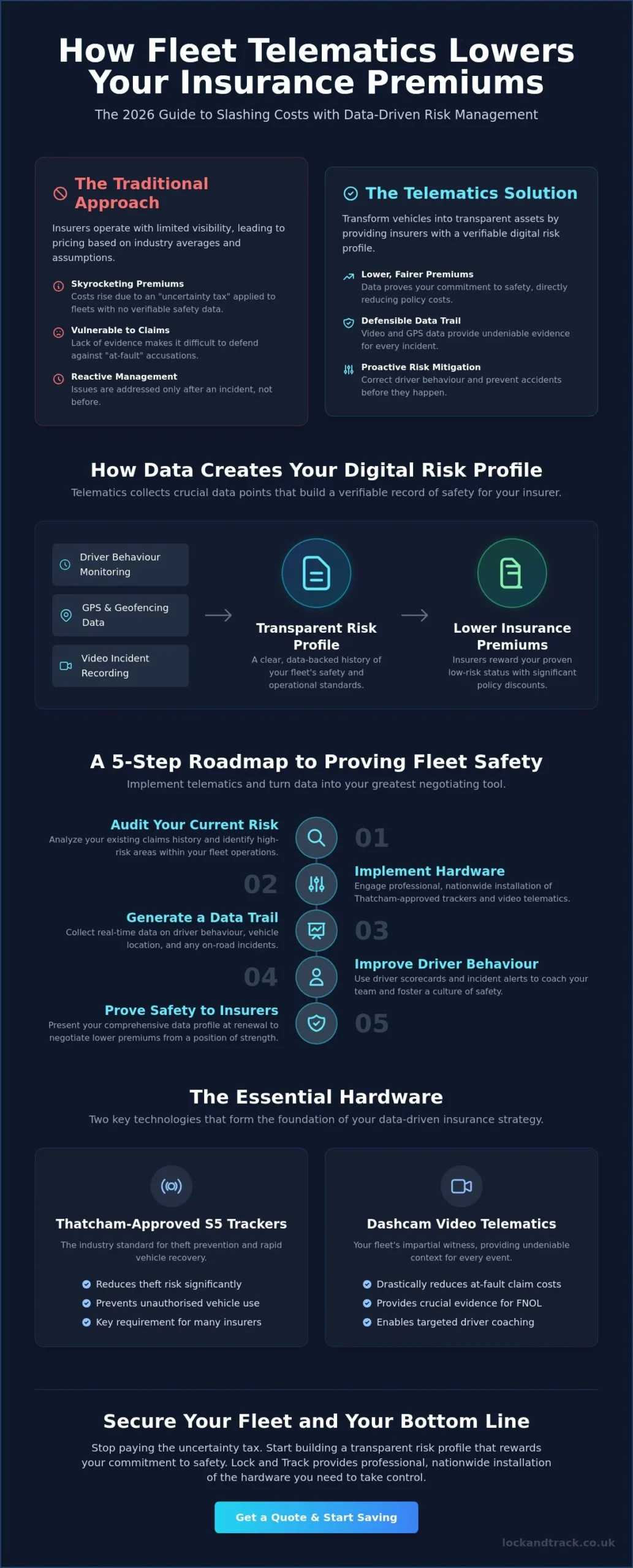
A digital risk profile is more than just a collection of GPS coordinates. It’s a comprehensive data set that proves your commitment to operational safety. Insurers view this as a proactive management strategy rather than a reactive one. This is exactly how fleet telematics can lower insurance; it shifts the burden of proof from the insurer’s guesswork to your verified data. Geofencing adds a vital layer of security by alerting you if a vehicle leaves a predefined area or operates outside of authorised hours. This prevents unauthorised usage and significantly reduces the recovery time if a theft occurs. By demonstrating this level of granular control, you reduce insurance premiums through verified risk mitigation.
Insurers are increasingly wary of “blind” risks where they have no visibility into how a vehicle is actually driven. When you provide them with a clear history of safe operation, you become a much more attractive prospect for lower rates. It’s about building a partnership with your underwriter based on transparency and accountability. This transparency is a powerful tool during policy renewals, allowing you to negotiate from a position of strength backed by hard evidence.
Correcting Driver Behaviour and Reducing At-Fault Accidents
High-risk driving habits are the primary cause of rising insurance costs. Monitoring metrics like harsh braking, rapid acceleration, and sharp cornering gives you the power to intervene before a habit becomes a claim. You can use driver scorecards to create a competitive culture of safety within your team. Targeted training programmes based on this data ensure that your drivers are constantly improving their roadcraft. These safety improvements lead to a direct reduction in both the frequency and the severity of accidents. Implementing professional Fleet Tracking solutions provides the necessary infrastructure to turn these safety insights into long-term financial savings.
Claims Defensibility and Speed of Notification
Claims defensibility is a major factor in how fleet telematics can lower insurance. When an accident occurs, the total cost of the claim is often determined by how quickly it’s handled. Instant impact alerts from your telematics hardware ensure you’re never the last to know about an incident. FNOL is the critical window between a collision occurring and the insurer being notified, where proactive management can significantly reduce third-party costs. By reporting an incident within minutes rather than days, you prevent third parties from incurring excessive credit hire or legal fees. Dashcam Video Telematics provides the visual proof required to settle disputes instantly, protecting your business from fraudulent “crash for cash” schemes and split-liability decisions.
Hardware Selection: Thatcham Approved Trackers vs. Video Telematics
Choosing the right hardware is not just a matter of functionality; it’s a requirement for compliance. In the UK, Thatcham Research sets the gold standard for vehicle security. If your hardware lacks Thatcham certification, many insurers will refuse to offer premium reductions. This certification is a critical factor in how fleet telematics can lower insurance. You need hardware that the insurance industry trusts to perform when an asset is at risk. Professional, nationwide installation is often a mandatory policy condition. It ensures the device is correctly hidden and integrated into the vehicle’s electrical systems, providing the psychological reassurance that your protection is absolute.
Understanding the tiers of hardware is essential to seeing how fleet telematics can lower insurance for your specific vehicle types. Different assets require different levels of vigilance. A standard van may only require basic tracking, while high-value plant machinery or luxury vehicles often demand advanced driver recognition systems to satisfy underwriters.
Understanding Thatcham Categories: S5 and S7 Explained
The distinction between categories is defined by the level of security provided. S7 Trackers, such as the Scorpion S7 Tracker, serve as the baseline for theft recovery. They provide essential GPS location data and movement alerts. S5 Trackers, including the Scorpion S5 Tracker or Metatrak s5, offer a higher tier of protection through Automatic Driver Recognition (ADR). ADR requires the driver to carry a small tag; if the vehicle moves without it, an alert is instantly triggered. Insurers typically mandate S5 hardware for high-value assets or vehicles frequently targeted by key cloning and relay theft.
The Power of Video Telematics for Liability Protection
Video telematics adds a visual dimension to your digital risk profile. Dashcam Video Telematics provides irrefutable evidence during a claim. It’s the most effective tool for combating “crash for cash” fraud, where third parties intentionally cause accidents to claim compensation. By integrating video data with GPS tracking, you create a complete incident picture that removes all ambiguity. Insurers often offer their most significant discounts to fleets that deploy both tracking and video. This combination ensures that liability is settled quickly and accurately, protecting your business from the high costs of split-liability decisions and fraudulent third-party claims.
Maximising ROI: A 5-Step Guide to Proving Fleet Safety to Insurers
Lowering your premiums requires more than just installing hardware. It requires a strategic presentation of your safety data to the people who set your rates. This is how fleet telematics can lower insurance in a measurable way. You must transform raw data into a narrative of risk reduction that an underwriter can’t ignore. By following a structured framework, you move from being a passive policyholder to a proactive risk manager. This process ensures your investment in security hardware translates directly into bottom-line savings.
- Step 1: Audit. Begin by identifying your high-risk drivers and problematic routes using baseline data. Knowing your vulnerabilities is the first step toward fixing them.
- Step 2: Implement. Deploy Thatcham-approved hardware across your entire fleet. Standardising your security with S5 or S7 trackers ensures consistency in data collection and insurer compliance.
- Step 3: Feedback. Establish a feedback loop where drivers receive telematics-led coaching. Use real-time alerts to correct dangerous habits before they lead to accidents.
- Step 4: Report. Generate comprehensive quarterly risk reports. These documents should highlight your safety protocols and the active monitoring of your assets.
- Step 5: Negotiate. Use your proven safety improvements to negotiate your renewal. Hard evidence of reduced risk is your most powerful leverage.
Creating a ‘Culture of Safety’ That Insurers Value
Insurers look for businesses that take safety seriously at every level. You can incentivise safe driving through gamification and rewards for the highest-scoring drivers. This turns safety into a team goal rather than a management mandate. Using telematics data to standardise safety protocols ensures every driver meets the same high standard. A documented safety policy, backed by real-world data, provides the psychological reassurance underwriters need to offer lower rates. It shows you have a superior response to potential threats on the road.
Presenting Your Data to the Insurance Broker
When it’s time for renewal, your broker needs more than just a verbal assurance. They want to see specific reports on harsh braking, speeding incidents, and overall driver scores. Showing improvement over time is particularly persuasive. It proves that your management interventions are working. Comprehensive fleet tracking solutions uk provide the foundational data required for these reports. Underwriters are more likely to offer discounts when they see a clear downward trend in high-risk events. Secure your fleet today through Lock and Track to start building the data trail that will slash your next insurance premium.
Securing Your Fleet and Your Bottom Line with Lock and Track
Lock and Track stands as the UK’s trusted partner for businesses seeking to bridge the gap between advanced security and financial efficiency. We understand that the 2026 insurance market demands more than just hardware; it requires a validated security posture. Our expertise ensures that your vehicles are equipped with the exact technology insurers want to see. This professional implementation is how fleet telematics can lower insurance for modern businesses. We provide scalable solutions that cater to fleets of all sizes, from a single van to operations with 10,000 vehicles. Each asset we protect becomes a data-driven proof point of your commitment to risk management.
Our approach focuses on maximum insurance leverage. We don’t just provide tracking; we offer a layered defence that combines high-tier trackers, immobilisers, and video telematics. This comprehensive strategy eliminates the vulnerabilities that underwriters typically penalise. By presenting a unified security front, you demonstrate how fleet telematics can lower insurance through total asset visibility and proactive theft prevention. We act as your vigilant guardian, providing the technical infrastructure needed to secure your fleet and protect your bottom line.
Our Professional Installation and Support
Reliability begins with a precise installation. Our nationwide network of Thatcham-approved engineers ensures your hardware is fitted to the highest professional standards. We understand that fleet downtime is lost revenue. That’s why we offer mobile fitting at your home, workplace, or dealership to keep your operations moving. Our specialists provide direct advice on selecting the right S5 or S7 trackers for your specific vehicle types. We remain your partner long after the initial fit, providing the ongoing support required to keep your telematics data accurate and your insurance profile defensible.
The Lock and Track Advantage: Peace of Mind as Standard
There’s a significant emotional benefit to knowing your assets are under constant, professional monitoring. It replaces the anxiety of theft with a sense of absolute confidence. Our solutions integrate seamlessly with the Ghost 2 Immobiliser to create an impenetrable barrier against modern theft techniques. This proactive heroism is the hallmark of our service; we monitor the threats so you don’t have to. You gain the tranquility of knowing your recovery and restoration processes are handled by experts. Contact our fleet specialists for a bespoke security and insurance quote today and start driving your premiums down.
Take Control of Your Fleet’s Financial Future
The transition from unpredictable risk to data-driven security is no longer a choice for UK businesses; it’s a strategic necessity. You’ve seen how a digital risk profile and the right hardware can transform your standing with insurers. By implementing Thatcham-approved S5 or S7 trackers and video telematics, you replace uncertainty with irrefutable evidence. This guide has detailed exactly how fleet telematics can lower insurance by reducing accident frequency and accelerating claim resolution.
Lock & Track provides the expertise required to turn these technical capabilities into tangible savings. Our Thatcham-approved engineers deliver nationwide mobile installation at your premises, ensuring your operations never stop. Whether you manage a single van or a fleet of up to 10,000 vehicles, we provide the professional validation underwriters demand. Secure your fleet and lower your premiums with Lock & Track’s professional solutions today. Protecting your assets is the most direct path to protecting your bottom line. You’re now equipped to lead your business into a safer, more profitable 2026.
Frequently Asked Questions
Does every insurance company offer discounts for fleet telematics?
Not every insurer offers a flat percentage discount, but most commercial underwriters now require telematics for their most competitive quotes. Some providers have specific policies designed for tracked vehicles, while others adjust your premium based on the risk scores you provide at renewal. You should consult your broker to identify which specific UK insurers currently reward the use of Thatcham-approved hardware.
What is the difference between an S5 and an S7 tracker for insurance purposes?
The main distinction is the requirement for Automatic Driver Recognition (ADR) found in S5 units. S7 trackers provide standard GPS location and theft recovery features. S5 trackers, such as the Scorpion S5 Tracker, include a driver tag that must be present for the vehicle to move without triggering an alert. Insurers often mandate S5 hardware for high-value assets or vehicles with a statistically higher risk of theft.
Can video telematics really help with ‘at-fault’ claim disputes?
Yes, video evidence is the most effective tool for settling liability disputes instantly. Dashcam Video Telematics capture the objective reality of an incident, removing the “your word against theirs” element from claims. This protects your business from fraudulent third-party claims and “crash for cash” schemes. It’s often the only way to prove your driver’s innocence in complex road scenarios.
How long does it take to see a reduction in insurance premiums after installation?
You might see an immediate price drop if you move to a specialist telematics-based policy, but most savings are realised during your next renewal. This is how fleet telematics can lower insurance over the long term; you need to build a verifiable safety record. Most underwriters look for three to six months of consistent safety data before they’ll significantly adjust your risk profile and premium.
Is professional installation required for the tracker to be insurance-approved?
Yes, insurers almost always require professional installation by a certified engineer to validate your security certification. A Thatcham-approved installation ensures the device is correctly hidden and integrated into the vehicle’s systems. DIY attempts usually void the security status of the hardware and can lead to a rejected claim. Lock & Track provides nationwide mobile fitting to ensure your fleet remains fully compliant.
What happens to the insurance discount if a driver disables the tracking system?
Disabling the system typically invalidates your insurance coverage and will result in the immediate loss of any premium discounts. Modern hardware includes tamper alerts that notify you the moment a device is disconnected or interfered with. If a claim occurs while the system is offline due to driver tampering, the insurer may refuse the payout entirely. You must maintain a strict internal policy regarding system interference.
Are there specific Thatcham-approved trackers recommended for vans vs. trucks?
The Thatcham category you need depends more on the vehicle’s value and theft risk than its size. GPS Van Trackers are often S7 rated for standard commercial use. However, for heavy goods vehicles or trucks carrying high-value cargo, insurers frequently demand S5 trackers or S5 PLUS Trackers. These higher tiers offer better protection against sophisticated theft methods like key cloning and relay attacks.
How much data do I actually need to share with my insurer?
You usually share aggregated safety scores and incident reports rather than a minute-by-minute log of every vehicle’s location. Insurers are interested in high-level risk events such as harsh braking, speeding, and impact alerts. This focused data set is how fleet telematics can lower insurance without compromising your operational privacy. You provide the proof of safety while retaining control over your broader fleet movements.