
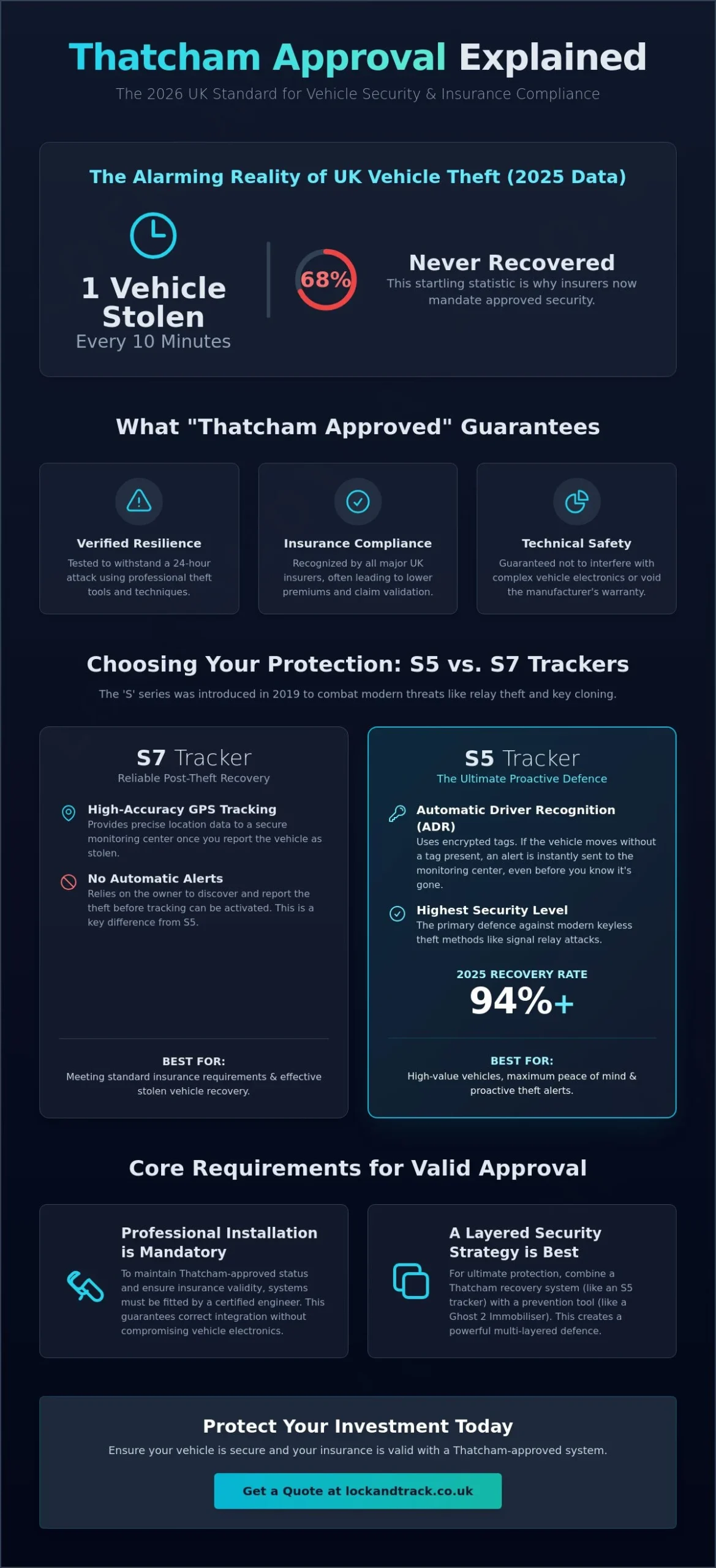
In 2025, a vehicle was stolen every ten minutes across the UK, and 68% of those assets were never recovered. This reality is why insurers are becoming stricter, often mandating specific security hardware before they’ll even offer coverage. If you’ve looked at your policy lately, you’re likely asking: what does Thatcham approved mean? It’s more than just a label; it’s the UK’s gold standard for testing security against real-world criminal tactics.
We know that deciphering terms like S5, S7, and Category 1 feels overwhelming when you’re simply trying to protect your investment. You need to know your security works and that your insurance claim is secure. This guide simplifies the 2026 landscape, explaining how Thatcham approval protects your vehicle and lowers your premiums. We’ll break down the latest S5 and S7 tracker requirements and the impact of the Crime and Policing Act 2026. You’ll finish this article with a clear plan to secure your vehicle and achieve total peace of mind.
Key Takeaways
- Discover exactly what does Thatcham approved mean and how this certification serves as the industry benchmark for rigorous security hardware testing.
- Learn the critical differences between S5 and S7 tracking categories to ensure you select the correct level of protection for your vehicle’s value.
- Understand how certified security hardware lowers insurance risk and helps prevent the rejection of claims on high-value assets.
- Identify why professional installation is a mandatory requirement for maintaining a device’s Thatcham-approved status and insurance validity.
- Explore the advantages of a layered security strategy, combining recovery systems like S5 trackers with prevention tools like the Ghost 2 Immobiliser.
Defining Thatcham Approved: The UK’s Gold Standard in Security
Thatcham Approved is the definitive benchmark for automotive security resilience in 2026. When you ask what does Thatcham approved mean, you’re looking for a guarantee that a security device can withstand the sophisticated tactics used by modern criminals. This isn’t just a marketing label. It’s a rigorous certification awarded only after a product survives a battery of attacks designed by the UK’s leading security experts. Every major motor insurer in the country recognizes this standard, frequently making it a mandatory requirement for covering high-value vehicles.
To earn this status, a device must endure a grueling 24-hour testing window. Professional engineers use the same tools and methods employed by organized crime gangs. If the device can be bypassed, disabled, or removed within this timeframe, it fails the certification process. This uncompromising approach provides you with the absolute confidence that your security is proactive, rather than just a reactive gadget.
The Role of Thatcham Research
Thatcham Research serves as an independent, non-profit body dedicated to vehicle safety and security. Looking back at Thatcham Research’s origins, the organization was established in 1969 by the motor insurance industry. Its primary mission was to reduce the rising costs of insurance claims by making vehicles harder to steal and more resilient to damage.
Today, they work directly with police forces and vehicle manufacturers to identify emerging vulnerabilities before they become widespread problems. They don’t just test a product once and walk away. Their continuous monitoring program ensures that certified hardware maintains its high performance over time, even as theft techniques evolve. This vigilance keeps your asset protected against the latest criminal trends.
Why ‘Approved’ Matters More Than ‘Compatible’
Understanding what does Thatcham approved mean is vital for any owner who wants to avoid the “compatible” gadget trap. You might see many products online labeled as compatible with your vehicle, but this usually only means they can be plugged in. A compatible device hasn’t been tested for resilience. Thatcham approval ensures that a device, such as a Scorpion S5 Tracker, won’t interfere with your car’s complex electrical systems or void your manufacturer’s warranty.
Security goes deeper than just the physical hardware. Certification requires secure, encrypted communication between the device and the monitoring center. This prevents criminals from intercepting signals or using electronic jammers to mask the vehicle’s location. Choosing a certified asset ensures your protection is integrated correctly, providing a reliable shield that generic GPS trackers simply cannot match.
- Verified Resilience: Tested against professional theft tools for 24 hours.
- Insurance Compliance: Recognized by all major UK insurers for premium discounts.
- Technical Safety: Guaranteed not to interfere with vehicle electronics.
- Secure Monitoring: Mandatory encrypted communication protocols.
Understanding Thatcham Categories: S5, S7, and Beyond
Understanding what does Thatcham approved mean in 2026 requires looking at how the standards have evolved to combat modern theft. In 2019, Thatcham Research overhauled their criteria, replacing the older Category 5 and 6 labels with the current “S” series. This shift was designed to address the rise in relay theft and key cloning. These updated Thatcham Research’s security standards ensure that your security hardware is tested against the latest electronic compromise methods used by organized crime gangs.
Thatcham S5 Trackers: The Highest Level of Protection
If you’re asking what does Thatcham approved mean for high-value assets, the answer is almost always an S5 system. S5 trackers represent the pinnacle of recovery technology. They feature Automatic Driver Recognition (ADR). This system uses a small, encrypted tag that stays with the driver. If the vehicle moves without the tag being present, an alert is sent to the monitoring center immediately. This proactive response is why S5 systems achieved a recovery rate of over 94% in 2025. It’s the primary defense against thieves who use signal boosters to steal cars without the original keys.
Thatcham S7 Trackers: Reliable Stolen Vehicle Recovery
S7 trackers focus on post-theft recovery. They don’t include the driver recognition tags found in S5 systems, but they still provide high-accuracy GPS tracking. Once you report a theft, the monitoring center uses the device to track the vehicle’s location in real-time. These systems are a cost-effective way to meet insurance requirements for standard passenger cars. They offer a significant upgrade over factory-fitted security by ensuring your asset is recoverable even if the physical locks are bypassed.
Alarms and Immobilisers (Category 1 and 2)
Category 1 and 2 systems form the foundation of vehicle security. A Category 1 setup combines a perimeter alarm with an electronic immobiliser. It monitors doors, boots, and glass breakage while also sensing movement inside the cabin. Category 2 systems are purely electronic immobilisers that prevent the engine from starting without the correct coded key. While most modern cars have these systems pre-installed, they are often the first line of defense that thieves learn to circumvent, making an additional S5 or S7 tracker essential for true peace of mind.
In 2026, most UK insurers now mandate a Thatcham-approved tracker for any vehicle valued over £50,000. This is often a non-negotiable condition of your policy. With the introduction of the Crime and Policing Act 2026, which targets the possession of signal jammers, these certified systems are more effective than ever at assisting police in rapid recovery. To ensure your vehicle meets these strict insurance standards, you should check which Thatcham-approved tracker is right for your specific make and model.
The Link Between Thatcham Approval and Insurance Premiums
Insurers operate on the cold reality of risk probability. Following the unprecedented 25% increase in average UK car insurance premiums during 2024, providers are looking for every possible reason to mitigate their exposure. For an insurance company, a vehicle without certified security is a total loss waiting to happen. When you verify what does Thatcham approved mean for your policy, you’re essentially proving that your asset is recoverable. This shifts the insurer’s potential payout from the full market value of the car to a much smaller recovery and repair fee.
The math is simple for providers. A stolen vehicle with an S5 system has a recovery rate of over 94%, meaning the insurer rarely has to pay out a total loss claim. This is why many firms now make a car tracker a mandatory condition of coverage for vehicles worth more than £50,000. Without a valid Thatcham Security Certification, you may find it impossible to secure comprehensive cover at all. It’s no longer just about getting a discount; it’s about being insurable in a high-theft environment.
Validating Your Insurance Policy
Honesty is critical when detailing your security features. If you tell your insurer you have a tracker, they expect it to meet specific industry standards. Telling them you’re protected without confirming what does Thatcham approved mean in the context of your specific device can lead to a rejected claim. If a theft occurs and the device fails because it wasn’t certified, the insurer may cite “non-disclosure” to avoid paying out.
Self-fit trackers are almost never accepted by UK insurance firms. These devices are often easy for thieves to find and disable. Insurers require a certificate of installation from a professional engineer to validate your policy. This document acts as your legal proof that the hardware is active, correctly integrated, and monitored by a 24/7 secure center.
Calculating the Return on Investment
A Thatcham-approved device often pays for itself through direct premium savings. Most UK insurers offer discounts ranging from 5% to 15% for vehicles equipped with certified tracking or immobilisation systems. On a high-performance vehicle with a four-figure annual premium, these savings can cover the cost of the hardware and subscription within the first two years.
The true value, however, is asset preservation. A total loss claim, even when successful, rarely covers the full cost of replacing a vehicle in the current market. You also face the long-term impact of a lost “no claims” bonus and increased future premiums. Investing in certified security provides a psychological dividend. You can park your vehicle with the confidence that it’s being monitored by professionals who are ready to act the moment a threat is detected.
Why Professional Installation is Mandatory for Approval
A security device is only as effective as its integration into your vehicle. When you investigate what does Thatcham approved mean, you must realize the certification covers the entire ecosystem, not just the hardware in the box. Thatcham Research requires that all certified systems, such as a Scorpion S5 Tracker, are fitted by an accredited engineer. This ensures the device is installed to a specific standard that resists tampering and maintains the integrity of the vehicle’s electrical systems.
Thatcham Recognised Installers (TRI) or equivalent accredited engineers are trained to identify the most secure mounting points for your specific make and model. They don’t follow a standard template that a thief could easily predict. Instead, they utilize covert installation techniques to ensure the unit is buried deep within the chassis. This makes it nearly impossible for a criminal to locate and disable the tracker during a rapid theft attempt. For busy owners, a nationwide mobile service brings this expertise to your doorstep, ensuring professional protection without disrupting your schedule.
The Dangers of DIY Security Fitting
Modern vehicles are mobile computers. They rely on sensitive CAN-bus wiring to communicate between engine components and safety systems. Attempting a DIY installation can lead to catastrophic electrical failures or triggered fault codes that are expensive to clear. Beyond technical damage, an incorrectly fitted device often suffers from poor GPS signal reception if placed near metal shielding. This leads to tracking blackouts at critical moments.
Insurers are aware of these risks. This is why a “self-fit” device will never qualify for a Thatcham-approved status. To validate your policy and secure your premium discount, you must provide a professional Proof of Installation certificate. This document confirms the hardware was fitted by a qualified technician and is communicating correctly with the 24/7 monitoring station. Without it, your insurance coverage may be legally void in the event of a theft.
What to Expect During a Professional Fitting
A professional installation is a meticulous process. The engineer begins with covert placement, stripping back interior panels to hide the device where it cannot be seen or reached easily. You won’t be told the exact location of the unit; this is a deliberate security measure to prevent information leaks. Once the hardware is secured, the technician performs a full system test. They verify the live data link to the monitoring center to ensure the GPS and GSM signals are at peak strength.
The final stage is the user handover. Your engineer will help you set up your mobile app and explain how to manage your driver ID tags if you have opted for an S5 system. This ensures you are fully prepared to use the technology from the moment they leave. To secure your asset with a certified professional, you can book your Thatcham-approved installation today and ensure your vehicle meets every insurance requirement.
Choosing the Right Security: Trackers vs. The Ghost Immobiliser
Effective vehicle security in 2026 isn’t a single product; it’s a strategy. While trackers are essential for recovery, tools like the Ghost Immobiliser focus on prevention. This device stops a car’s engine from starting unless a specific PIN sequence is entered via the vehicle’s own buttons. It doesn’t rely on radio signals, making it immune to the relay theft and key cloning techniques used by modern criminals. When considering what does Thatcham approved mean, it’s vital to distinguish between devices that aid recovery and those that prevent the initial theft from occurring.
For the highest level of protection, many owners choose a layered approach. This involves combining a Ghost 2 system for prevention with a Thatcham S5 tracker for recovery. This dual-layer strategy addresses every phase of a theft attempt. The immobiliser ensures the car won’t start, while the tracker provides a safety net if the vehicle is moved by other means, such as being towed. This combination transforms your vehicle into a hard target that most thieves will simply avoid.
When to Prioritise a Thatcham Tracker
You should prioritize a Thatcham-approved tracker whenever your insurance policy mandates it as a condition of cover. This is standard for luxury SUVs, high-performance cars, and vehicles valued over £50,000. Trackers are also the primary choice for owners who park in public areas or for businesses that require real-time location data for fleet management. While an immobiliser stops the drive-away, a tracker ensures your asset remains visible to a 24/7 monitoring center, regardless of how it’s moved. Understanding what does Thatcham approved mean in this context ensures you remain compliant with your insurer’s strict recovery requirements.
The Lock and Track Advantage
Lock and Track provides a comprehensive solution for vehicle owners who demand absolute confidence in their security. We offer nationwide installation by expert engineers who come directly to your home or workplace. Our selection includes the best thatcham approved vehicle trackers uk, ensuring you find a device that fits both your budget and your insurance requirements. We don’t just sell hardware; we provide the professional advice needed to navigate complex certifications.
You’ll receive a tailored recommendation that prioritizes your asset’s safety while respecting your time. Our engineers ensure every installation is covert and fully tested before they leave. This commitment to quality ensures your security system works perfectly when it matters most. Secure your vehicle with a Thatcham-approved tracker today and gain the peace of mind that comes from professional-grade protection.
Secure Your Asset with Certified Professional Protection
Vehicle security in 2026 isn’t just about owning hardware; it’s about ensuring your protection meets the UK’s most rigorous standards. Understanding exactly what does Thatcham approved mean is the first step toward securing your vehicle against modern theft tactics and ensuring your insurance policy remains valid. By choosing a certified S5 or S7 system, you move from a state of vulnerability to one of absolute resolution. This certification acts as a shield for your investment, providing the technical resilience needed to counter professional criminals.
Professional installation is the final, non-negotiable piece of the security puzzle. Our Thatcham-recognised engineers provide nationwide UK installation at your home or workplace; they ensure your device is covertly fitted and fully integrated with your vehicle’s systems. With 24/7 recovery support, you can rest easy knowing your asset is monitored by experts who are ready to act the moment a threat is detected. Don’t leave your investment to chance in a high-risk environment. You deserve the tranquility that comes with professional-grade security and a proactive response team.
This focus on protecting valuable investments extends beyond the driveway; for those who also collect fine horology, Watchlabb provides a secure and professional platform for trading original luxury watches.
Book Your Thatcham Approved Tracker Installation today and take control of your vehicle’s safety with confidence.
Frequently Asked Questions
Is a Thatcham-approved device mandatory for all UK car insurance?
No, it isn’t mandatory for every vehicle, but it’s increasingly required for high-value or high-risk models. Insurers often set a threshold, such as vehicles valued over £50,000, where a certified tracker becomes a strict condition of coverage. Without one, you might find your application for comprehensive insurance is rejected. Always check your specific policy documents to ensure you remain compliant with their security mandates.
What is the difference between Thatcham S5 and S7 trackers?
The primary difference is the inclusion of Automatic Driver Recognition (ADR) in S5 systems. An S5 tracker requires a driver ID tag to be present; if the car moves without it, an alert is sent to the monitoring center instantly. S7 trackers focus on post-theft recovery and don’t feature these proactive driver tags. S5 systems offer the highest level of protection against modern keyless theft and relay attacks.
Can I install a Thatcham-approved tracker myself to save money?
No, you cannot install these devices yourself if you want to maintain their certified status. To satisfy insurance requirements, a device must be fitted by a professional engineer. Insurers require a Proof of Installation certificate to validate your policy and any associated discounts. DIY fitting also risks damaging your vehicle’s sensitive electrical systems and will likely void your manufacturer’s warranty.
How do I know if my car already has a Thatcham-approved alarm?
Most UK vehicles manufactured after 1998 have a factory-fitted immobiliser, but alarm standards vary by trim level. You can check your vehicle’s handbook or contact the manufacturer with your VIN to confirm the security specification. If you’re unsure what does Thatcham approved mean for your specific model, a professional security specialist can audit your current hardware and suggest the necessary upgrades to meet 2026 standards.
Will a Thatcham-approved tracker reduce my insurance premium in 2026?
Yes, many UK insurers offer premium discounts ranging from 5% to 15% for vehicles equipped with certified security. In 2026, with average premiums remaining at record highs, these savings are a practical way to offset the cost of your hardware. More importantly, having a certified device ensures you remain eligible for coverage on high-performance models that insurers might otherwise consider too risky to cover.
What is a Thatcham Category 2 to 1 upgrade?
This is an upgrade that adds a Thatcham-approved alarm system to a vehicle that only features a factory-fitted immobiliser. Category 2 refers to the immobiliser alone, while Category 1 is the combined alarm and immobiliser standard. This upgrade adds perimeter and ignition detection, offering a much stronger deterrent against thieves who attempt to break into the cabin or tamper with the ignition system.
Does Thatcham approval mean the device is ‘unstealable’?
No security device makes a vehicle completely unstealable, but Thatcham approval significantly increases the difficulty for criminals. These devices are tested to withstand professional tools for at least 24 hours. While a determined thief might still attempt a theft, the presence of a certified tracker like the Metatrak s5 ensures a much higher recovery rate and a rapid police response to the vehicle’s live location.
How long does a Thatcham tracker installation take?
A professional installation typically takes between one and two hours to complete. This timeframe allows the engineer to find a covert mounting location and perform a full system test with the 24/7 monitoring station. Because the installation service is mobile, it can be done at your home or office. This ensures your vehicle is secured without disrupting your daily routine or requiring a trip to a workshop.