
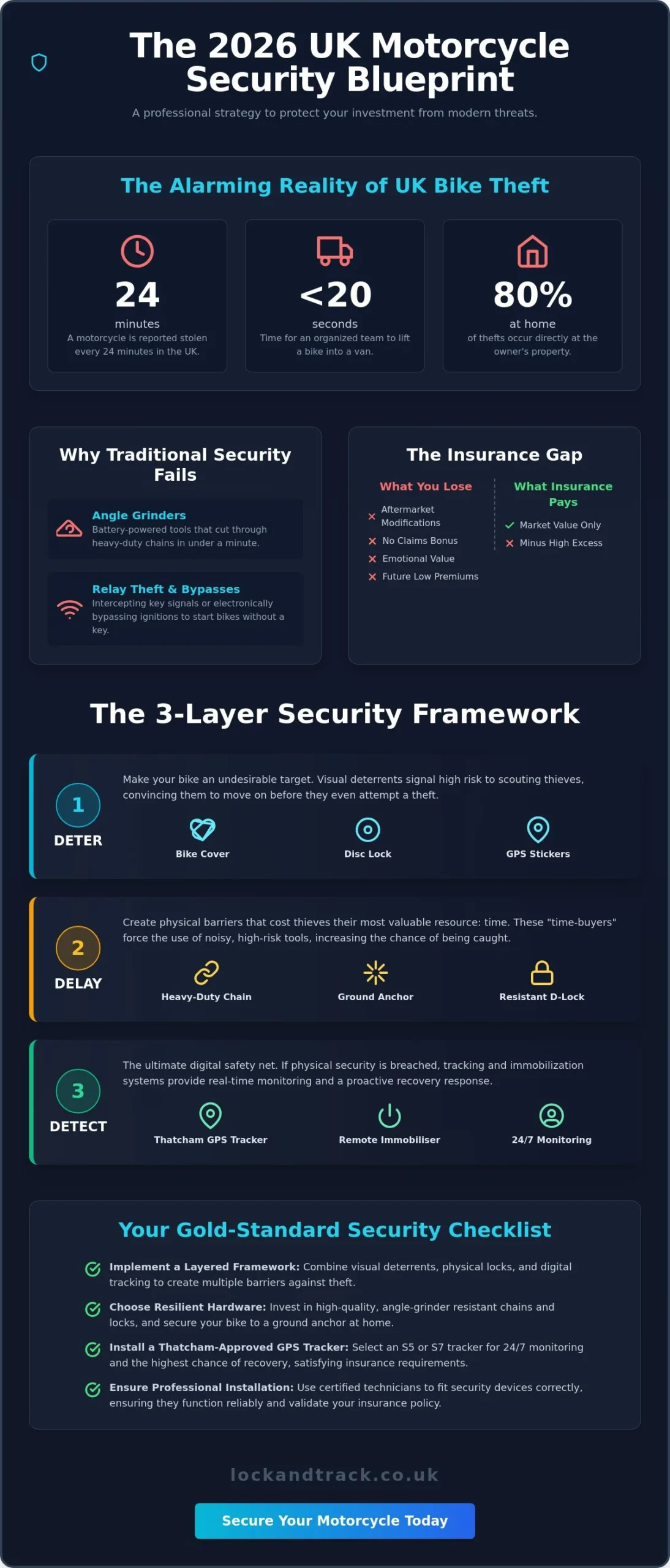
In the UK, a motorcycle is reported stolen every 24 minutes. It’s a sobering statistic that reflects the reality of modern bike theft, where organized groups can lift a machine into a van in under 20 seconds. You’ve likely felt that spike of anxiety when parking in public or even at home, wondering if a heavy chain is enough to stop a determined thief with a portable angle grinder.
Finding the best way to secure my motorcycle is no longer just about buying the heaviest lock you can find. It requires a strategic, layered approach that outsmarts professional criminals before they even touch your handlebars.
This 2026 guide provides the expert-approved security strategy you need to protect your investment. We’ll cut through the confusion surrounding Thatcham versus Sold Secure ratings and show you how to combine physical barriers with advanced tracking technology. You’ll get a clear security checklist and understand exactly which trackers meet the latest insurance standards to ensure your claim is valid.
We’ll preview the most effective hardware combinations and explain how digital monitoring provides a proactive response to theft. By the end of this article, you’ll have a professional blueprint for total peace of mind, ensuring your bike remains exactly where you left it.
Key Takeaways
- Learn the gold-standard layered security framework designed to counter professional thieves. This strategy uses multiple barriers to delay and deter attacks effectively.
- Identify the most resilient physical hardware for 2026, including angle-grinder resistant locks and ground anchors. These tools provide essential protection when parking at home or in public.
- Discover why a Thatcham-approved GPS tracker is the best way to secure my motorcycle for total peace of mind. Compare S7 and S5 monitoring levels to find the right recovery solution for your needs.
- Protect your insurance coverage by choosing professional, certified installation for your security devices. Proper fitting ensures your technology is always vigilant and ready to respond.
The Reality of Motorcycle Theft in the UK (2026)
The 2026 landscape for UK riders is increasingly challenging. A motorcycle, scooter, or moped is reported stolen every 24 minutes. In London alone, the Metropolitan Police area records over 500 thefts every month. These motorcycle theft statistics reveal a professionalization of crime that standard security measures struggle to counter.
Hotspots like the West Midlands and Greater Manchester are seeing sustained activity, with 80% of these thefts occurring directly at the owner’s property. If you’re searching for the best way to secure my motorcycle, you must first understand that factory-fitted steering locks offer almost no protection. A thief can snap a standard steering lock with a single, forceful kick in seconds, leaving the bike ready to be wheeled away.
The “van-lift” has become the preferred method for organized gangs. This tactic involves a team of three or four individuals who lift a motorcycle into a van in under 20 seconds. They don’t waste time cutting locks or bypassing ignitions on the street.
They simply remove the entire asset. This speed makes traditional, single-point security obsolete. Proactive protection is always cheaper than an insurance claim. The psychological impact of losing your machine is significant, and the recovery process is often a long, frustrating ordeal. Taking a vigilant approach to security is the only way to ensure your bike stays in your possession.
Why Traditional Security Often Fails
Modern criminals are equipped with high-performance, battery-powered angle grinders. These tools can slice through even heavy-duty chains in less than a minute. We are also seeing a rise in electronic bypasses and “relay theft,” where thieves intercept key signals to start modern bikes without a physical key. Thieves often scout locations days in advance.
They monitor your daily routine and identify weaknesses in your home setup. If your security is static and predictable, it becomes a target. The best way to secure my motorcycle in 2026 is to use technology that monitors the bike even when you aren’t looking.
The Insurance Gap: Why Payouts Aren’t Enough
An insurance payout is rarely a “win” for the rider. You’ll likely face a high excess payment and the immediate loss of your No Claims Bonus. Even worse, your premiums will spike for several years following a claim. Insurers pay out “market value,” which almost never covers the emotional value or the cost of aftermarket modifications you’ve added.
There is a massive financial and emotional gap between a payout and actually replacing your pride and joy. High-quality security is a strategic investment in asset preservation rather than a simple hardware cost.
The Layered Security Framework: Slowing Down vs. Stopping Thieves
Relying on a single lock is a high-risk strategy that rarely ends well. The best way to secure my motorcycle in 2026 is to implement a layered security framework. This approach creates a series of independent obstacles that drain a thief’s most valuable resource: time.
We categorize these layers into three distinct phases: deter, delay, and detect. By compounding these defenses, you move from a state of vulnerability to one of proactive protection.
Layer 1 focuses on visual deterrence. A high-quality, non-branded bike cover is your first line of defense. It hides the make and model from scouting thieves and makes the bike a “blind” target. Brightly colored disc locks and visible stickers for GPS tracking systems further signal that your bike is a difficult and risky prospect. These simple measures often convince a thief to look for an easier target before they even touch your machine.
Layer 2 involves physical barriers designed to delay. This includes heavy-duty chains, ground anchors, and D-locks. These tools are the “time-buyers” of your setup. They force a thief to use noisy power tools, which increases their risk of being caught. When combined with GPS motorbike trackers, these physical barriers buy the necessary minutes for your digital systems to alert you to a tampering attempt.
Layer 3 is your digital defense. This is the ultimate safety net. If a thief manages to bypass the first two layers, digital systems like immobilisers and trackers provide the final, most effective barrier. This layer ensures that even if the bike is moved, it can be monitored and recovered in real-time. It transforms a potential total loss into a manageable recovery situation.
Understanding Thatcham vs. Sold Secure Ratings
Understanding security certifications is essential for insurance compliance and hardware reliability. Thatcham Research is the primary benchmark for UK insurers. They test the electronic integrity and resistance of trackers and immobilisers.
If your bike is valued over £5,000, most insurers will mandate a Thatcham-approved installation. Sold Secure focuses on physical hardware, categorizing items into Gold or Diamond ratings. For home security, always prioritize Sold Secure Diamond chains and anchors. These ratings guarantee the equipment has been tested against professional-grade tools and sustained attacks.
The “Two-Minute Rule” for Bike Security
Professional thieves operate on a strict clock. Most will abandon an attempt if they cannot bypass your security within 120 seconds. This is why the best way to secure my motorcycle involves compounding the time required for a theft.
While an angle grinder might cut a single chain in 45 seconds, having to navigate a ground anchor, a disc lock, and a hidden immobiliser pushes the effort well beyond the two-minute threshold. Secondary deterrents like motion-activated lighting and audible alarms add further psychological pressure. The goal is to make your motorcycle the least attractive and most time-consuming option on the street.
Physical Security Essentials: Choosing the Right Hardware
Selecting the correct hardware is the most visible part of your defense. While digital tracking provides a vital safety net, physical barriers are what stop a casual opportunist in their tracks. The best way to secure my motorcycle involves matching the right tool to the specific environment.
A heavy chain that stays in your garage requires different specifications than a portable lock used for a quick stop at the shops. High-quality physical security doesn’t just protect your bike; it projects an image of a hard target that most thieves would rather avoid.
Always lock your motorcycle to an immovable object. A lamppost, a dedicated ground anchor, or a heavy steel railing are ideal. If you simply lock the wheel to the frame, thieves can still lift the bike into a van in seconds.
This is a common mistake that renders expensive equipment useless. Every time you park, ensure the anchor point is as solid as the lock itself. If you’re at home, a bolt-down ground anchor is the foundation of a secure garage setup. It provides a permanent, high-strength point of attachment that forces a thief to bring heavy power tools and make significant noise to succeed.
The “chain off the ground” rule is a critical technical detail many riders overlook. When a chain rests on the pavement, a thief can use the ground as an anvil. They can strike the links with a sledgehammer or use long-handled bolt croppers with the ground providing the necessary leverage. By looping the chain through the frame and keeping it tight and high, you remove this mechanical advantage. This simple adjustment significantly increases the difficulty of a manual attack.
Chains and Ground Anchors
For home security, prioritize a chain with a link thickness of 16mm or greater. These are typically too thick for manual bolt croppers and require an angle grinder to defeat. While these chains are heavy, they provide the maximum resistance for overnight storage.
For commuting, a lighter 10mm or 12mm chain offers a better balance of portability and protection. Keeping the chain tight and high prevents thieves from using the floor as an anvil to strike the links with a sledgehammer. Bolt-down anchors should be fitted into solid concrete to ensure they cannot be pried up with a crowbar.
Disc Locks and D-Locks
Disc locks are excellent secondary deterrents because they are compact and easy to carry. Alarmed versions are particularly effective; they provide an immediate audible warning if the bike is bumped or moved. This noise often causes a thief to flee before they can cause serious damage. D-locks are another robust option.
Their rigid structure is often more resistant to cropping than cheaper, thinner chains. When fitting a disc lock, place it close to the brake caliper to minimize the distance the wheel can rotate. This prevents a thief from gaining momentum if they try to roll the bike away, protecting your brake discs from unnecessary damage.
Digital Defense: Why GPS Trackers are the Best Way to Secure a Motorcycle
Physical locks are essential, but they have a fundamental limitation: once a thief cuts them or lifts the bike into a van, they cease to be effective. This is why a Thatcham-approved digital defense is the best way to secure my motorcycle in 2026.
While a heavy chain buys you minutes, a tracker buys you the asset back. Digital security provides 24/7 vigilance, ensuring that even if your physical layers are breached, the recovery process begins immediately. It transforms a total loss into a high-tech pursuit.
A high-quality system like the Scorpion S5 Tracker connects your bike to a professional monitoring centre. If the bike moves without the authorized driver tag present, an alert is triggered instantly. This proactive monitoring is the ultimate safety net.
It bypasses the uncertainty of traditional alarms, which are often ignored by passersby, and replaces it with a coordinated, professional response. You aren’t just buying hardware; you’re securing a team of specialists who monitor your asset so you don’t have to.
S5 vs. S7 Trackers: Which is Best for Motorcycles?
Choosing between Thatcham categories depends on your bike’s value and your insurance requirements. S7 trackers are the standard entry point for insurance compliance. They provide reliable GPS location data and 24/7 monitoring, which is sufficient for many mid-range bikes. However, for high-value motorcycles or those parked in high-risk urban areas, S5 trackers offer superior protection. The key difference is the Automatic Driver Recognition (ADR) tags. If the bike is started or moved without the tag, the control centre is notified immediately, even if the thief has cloned your keys. This rapid detection is why many consider S5 the best way to secure my motorcycle against modern theft tactics.
The Role of Immobilisation
An immobiliser is the perfect partner for a GPS tracker. While the tracker handles recovery, the immobiliser focuses on prevention. Modern systems like the Scorpion X-Series are virtually invisible to thieves. They prevent the engine from starting unless a specific sequence or ADR tag is detected. This effectively counters “hot-wiring” and key-cloning, which are increasingly common in the UK.
Even if a thief manages to bypass your physical locks and get into the ignition, the bike simply won’t start. For more on how these devices work, read our Car Immobiliser Guide 2026. Combining this with a tracker ensures you have both a shield and a recovery team working for you. Protect your investment today by exploring our full range of GPS motorbike trackers.
Professional Installation: The Lock and Track Advantage
The best way to secure my motorcycle isn’t just about what you buy, but how it’s installed. A high-end tracker is useless if a thief finds it within seconds of taking the bike. DIY installations often leave obvious traces, such as exposed wires or predictable mounting locations.
Professional installation ensures your security hardware is integrated seamlessly into the motorcycle’s loom, making it invisible to the untrained eye. This “stealth factor” is the difference between a successful recovery and a total loss. When an engineer hides a device, they use locations that even experienced thieves struggle to identify during a quick sweep of the asset.
Beyond the physical security of the device, there is the matter of insurance compliance. Most UK insurers mandate that trackers and immobilisers are fitted by Thatcham-approved engineers to validate a policy.
If you attempt a DIY fitment, you risk a rejected claim in the event of theft. Lock and Track provides the technical expertise required to meet these high-level industry standards, ensuring your investment is fully protected both physically and legally. Professional fitment is an investment in your insurance validity as much as it is in the bike’s safety.
Nationwide Mobile Fitting
We understand that your time is valuable. Our nationwide mobile installation service brings the expert to you. Whether you’re at home, at your workplace, or picking up a new bike from a dealership, our engineers provide a streamlined service.
You can book an appointment at a time and location that suits your schedule. During the appointment, the engineer conducts a full system test to ensure the GPS and GSM signals are optimal. Every cable is hidden and secured to prevent vibration damage, ensuring long-term reliability. This professional approach is the best way to secure my motorcycle without the hassle of visiting a workshop.
Securing Your Peace of Mind
Once the installation is complete, you’ll receive a formal certificate of installation. This document is your proof of compliance for your insurance provider, often leading to reduced premiums. Lock and Track is a trusted partner for both individual riders and large-scale fleet managers because we prioritize the resolution phase of security.
We don’t just sell hardware; we provide a comprehensive monitoring and recovery infrastructure. Our goal is to move you quickly from a state of vulnerability to a state of absolute confidence. Secure your motorcycle today with a professionally installed Thatcham-approved tracker and ensure your machine is protected by the industry’s highest standards.
Take Control of Your Motorcycle’s Security
Protecting your bike in 2026 requires a shift from passive hardware to active, digital defense. We’ve explored how physical barriers like ground anchors and 16mm chains buy you time, but it’s the digital layer that ensures you get the asset back.
Implementing a comprehensive, layered strategy is the best way to secure my motorcycle against the rising threat of van-lifting and angle-grinder attacks. By combining visual deterrents with Thatcham-approved technology, you transform your machine from a vulnerable target into a high-risk prospect for thieves.
Lock and Track offers the professional infrastructure needed for total peace of mind. Our nationwide installation by Thatcham-approved engineers ensures your device is hidden perfectly, while our 24/7 monitoring via global control centres provides a proactive response the moment tampering is detected.
Whether you need an insurance-approved S5 or S7 tracking solution, we have the expertise to safeguard your investment. Browse our range of Thatcham-approved motorcycle security solutions today. Secure your ride, stay vigilant, and enjoy the road with absolute confidence.
Frequently Asked Questions
Is a steering lock enough to secure my motorcycle?
No, a factory steering lock is not a sufficient deterrent against professional thieves. These locks are made of relatively thin metal and can be snapped with a single, forceful kick to the handlebars. While they might stop a casual joyrider, they won’t delay an organized gang for more than a few seconds. You should always use a steering lock in combination with heavy-duty physical barriers and a GPS tracker.
What is the difference between Thatcham Category S5 and S7 trackers?
The primary difference is the level of proactive alert technology. Category S5 trackers include Automatic Driver Recognition (ADR) tags that identify you as the authorized rider. If the bike moves without the tag present, the control centre is notified immediately. Category S7 trackers provide reliable GPS location and 24/7 monitoring but lack the ADR tag feature, making them a more cost-effective choice for standard insurance compliance.
Will a motorcycle tracker reduce my insurance premiums in the UK?
Yes, installing a Thatcham-approved tracker often leads to lower insurance premiums. Many UK providers offer significant discounts because these devices dramatically increase the chances of asset recovery. For motorcycles valued over £5,000, having a professionally installed S5 or S7 tracker is frequently a mandatory requirement for obtaining any theft coverage at all. Check with your specific insurer for their approved hardware list.
Can thieves block or jam a GPS motorcycle tracker? (Best Way to Secure My Motorcycle)
While some thieves attempt to use signal jammers, professional-grade trackers feature sophisticated countermeasures. High-quality units utilize multi-frequency technology and internal sensors that detect interference. If the system identifies a jamming attempt, it can trigger an instant alert to the 24/7 monitoring centre. This proactive response ensures that digital defenses remain vigilant even when criminals try to bypass them with electronic tools.
Do I need a ground anchor if I keep my bike in a locked garage?
Yes, a ground anchor is essential for home security. Approximately 80% of motorcycle thefts occur at the owner’s property, and standard garage doors are surprisingly easy to bypass. Without an anchor, thieves can simply wheel your bike out or lift it into a van. Bolting a Sold Secure Diamond anchor into a concrete floor provides a permanent point of attachment that forces thieves to use noisy power tools for the Best Way to Secure My Motorcycle.
What is the best way to secure my bike while commuting or parked in public?
The best way to secure my motorcycle in public is to use a visible, layered approach. Combine a high-quality disc lock with a non-branded bike cover to hide the machine’s make and model. This makes the bike a “blind” target and removes the visual incentive for scouting thieves. Always try to park in well-lit areas covered by CCTV, and ensure your GPS tracker is active to provide a digital safety net.
Are AirTags a good alternative to professional motorcycle trackers? (Best Way to Secure My Motorcycle)
No, AirTags are not a professional security solution and lack Thatcham approval. They rely on the proximity of other smartphones to update their location, which is unreliable in remote areas. More importantly, Apple’s anti-stalking features will eventually alert a thief that a tracker is present on the bike. Professional trackers offer 24/7 monitoring centres and hidden installations that AirTags simply cannot match.
How long does it take to install a motorcycle immobiliser and tracker?
A professional installation typically takes between one and two hours to complete. This timeframe allows an engineer to carefully integrate the hardware into your motorcycle’s electrical loom and find a stealthy, secure mounting location. The process includes a full system test to ensure the GPS and GSM signals are optimal before you receive your certificate of installation for insurance purposes the Best Way to Secure My Motorcycle.