
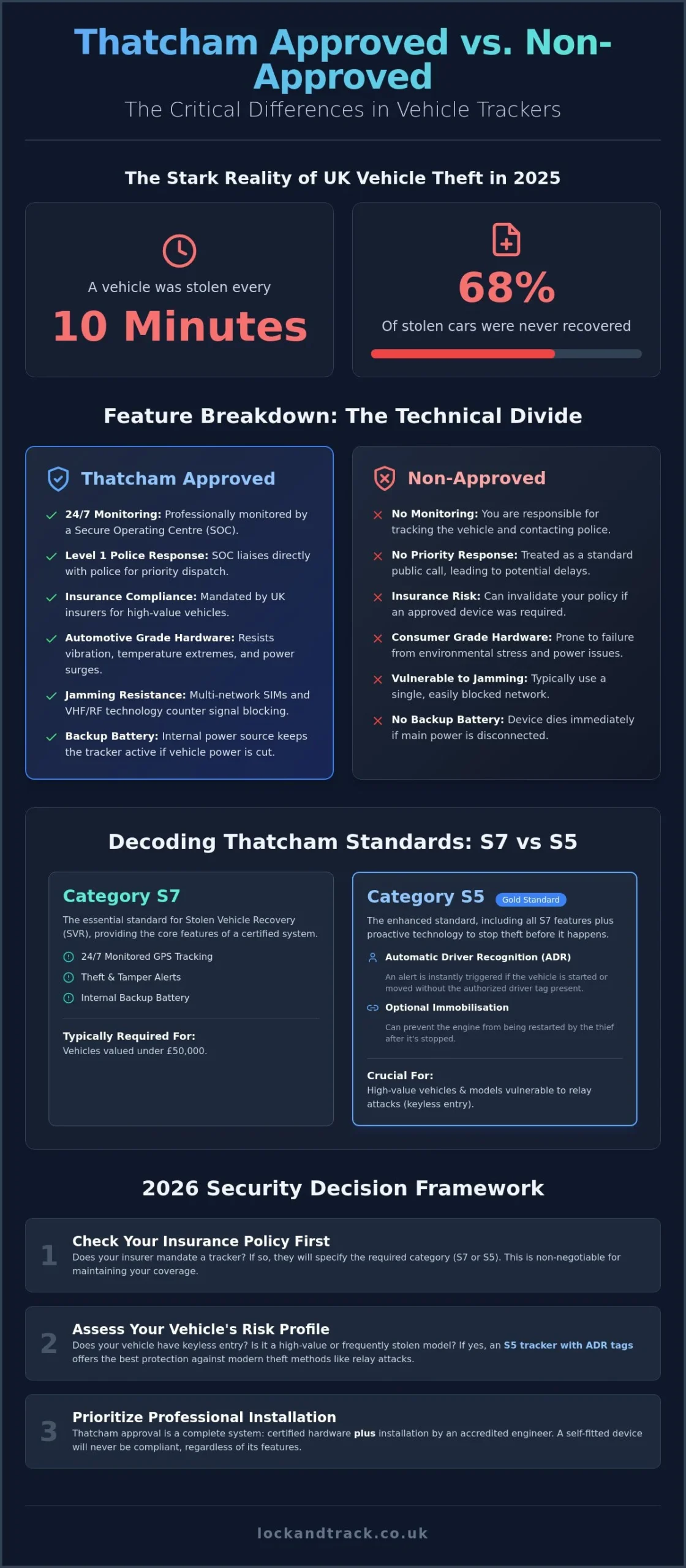
In 2025, a vehicle was stolen every ten minutes in the UK, and 68% of those cars were never recovered. You likely feel the growing anxiety of rising insurance premiums and the constant threat of relay attacks on your driveway. Choosing between thatcham approved vs non-approved trackers isn’t just about a price tag; it’s about whether your insurance policy remains valid when you need it most. A standard GPS device might show you where your car was, but it lacks the regulated recovery ecosystem required to actually bring it home.
You want a security solution that works without the confusion of technical jargon like S5 and S7. This comparison reveals the critical differences between basic hardware and certified security standards that insurers demand. You’ll learn how features like Automatic Driver Recognition (ADR) stop thieves in their tracks and why professional installation is your only path to total compliance. We’ll show you how to move from a state of vulnerability to absolute confidence, ensuring your high-value asset is monitored by professionals who are ready to act the moment a threat is detected.
Key Takeaways
- Understand why Thatcham certification is the gold standard for UK vehicle security and how 24/7 monitoring centers act as your first line of defense.
- Learn the technical differences in signal resilience and hardware quality that separate professional-grade units from consumer GPS gadgets.
- Protect your coverage by discovering why insurers mandate specific tracker categories and the risks of non-disclosure.
- Use our 2026 decision framework to evaluate thatcham approved vs non-approved trackers based on your vehicle’s value and specific theft risks.
- Identify the best security configurations for modern keyless cars, including the industry-leading Scorpion S5 Tracker.
What is a Thatcham Approved Tracker and Why Does the Standard Matter?
Thatcham Research is the central intelligence hub for the UK automotive industry. Funded by insurers, this independent body evaluates vehicle security hardware to set the highest possible standards for theft prevention and recovery. When you compare thatcham approved vs non-approved trackers, you’re looking at the difference between a regulated security ecosystem and a standalone gadget. A Thatcham-certified device has undergone rigorous testing to ensure it can withstand physical attacks and signal interference.
The industry recently moved away from the old Category 5, 6, and 7 classifications. These have been replaced by the S5 and S7 standards to better reflect modern theft tactics. These systems often integrate with electronic immobiliser technology to provide a multi-layered defense. It’s not just about the hardware; it’s about the entire recovery process. Approval requires both certified hardware and installation by an accredited engineer. A self-fitted device, regardless of its features, will rarely meet the strict criteria required for insurance compliance.
The Role of the Secure Operating Centre (SOC)
A tracker without a monitoring team is just a beacon that tells you where your car used to be. Thatcham-approved systems mandate a 24/7 Secure Operating Centre. If your vehicle moves without authorization, the SOC receives an immediate alert. They verify the theft and liaise directly with the police using a Level 1 response protocol. This priority status is unique to monitored systems and significantly increases the chances of a fast recovery. The SOC acts as the critical bridge between raw GPS data and the physical restoration of your asset.
Thatcham S5 vs S7: A Quick Distinction
The choice between these two categories is usually determined by your vehicle’s market value and your specific insurance policy requirements.
- S7 Trackers: This is the entry-level standard for Stolen Vehicle Recovery (SVR). It provides essential 24/7 monitoring and GPS tracking. It’s typically required for vehicles valued under £50,000.
- S5 Trackers: This is the enhanced standard. It includes all S7 features plus Automatic Driver Recognition (ADR) tags. If the car is started without the tag present, an alert is triggered instantly.
In 2026, S5 remains the gold standard for high-value vehicles and models vulnerable to relay attacks. It identifies the thief before they even leave your street, providing a proactive response that standard GPS devices simply cannot match.
Thatcham Approved vs. Non-Approved Trackers: The Technical Breakdown
The internal components of a security device define its success during a theft attempt. Most non-approved trackers use consumer-grade GPS chips similar to those found in basic smartphones. These components are designed for convenience, not for the high-stress environment of a vehicle. When you weigh up thatcham approved vs non-approved trackers, the primary difference lies in the hardware’s resilience. Automotive-grade components in certified units are built to withstand extreme temperatures, constant vibration, and electrical surges that would fry a cheaper device.
Battery management is another critical failure point for standard GPS gadgets. Cheap trackers often lack intelligent power-saving modes, leading to significant drain on your vehicle’s 12V battery. This is particularly problematic in cold weather when battery performance naturally drops. Thatcham-certified hardware is engineered to draw minimal current while remaining vigilant. If a thief cuts the power, these units feature dedicated internal backup batteries that keep the signal alive for days, a feature rarely found in budget alternatives.
Jamming Resistance and Multi-Network Roaming
Thieves in 2026 frequently use signal jammers to block GPS and GSM frequencies. Non-approved units typically rely on a single network provider. If that signal is jammed or the vehicle enters a low-coverage area, the tracker effectively disappears. Thatcham-approved hardware utilizes multi-network roaming SIMs that automatically switch between all available providers to maintain a connection. Many premium systems also incorporate VHF (Very High Frequency) technology. This radio frequency can penetrate metal shipping containers and underground car parks, ensuring your car remains visible even when GPS signals are suppressed.
Build Quality and Longevity
Reliability requires more than just a strong signal. Certified trackers are tested for water ingress with high IP ratings and thermal shock resistance. This ensures the device won’t fail after a few months of exposure to road salt and moisture. In contrast, “plug and play” OBD trackers are the most vulnerable systems on the market. They sit in a visible port, making them the first thing a professional thief will remove.
Professional installation is a mandatory requirement for Thatcham approval. An accredited engineer hides the device deep within the vehicle’s wiring loom, making it nearly impossible for a thief to locate quickly. This “ghost” presence is your greatest advantage during a recovery operation. Attempting a DIY installation with an uncertified unit also carries the risk of voiding your vehicle’s manufacturer warranty. To avoid these technical pitfalls, it is wise to invest in professional security that meets the highest industry standards for 2026.
The Insurance Factor: Why “Approved” is Usually Mandatory
Insurance is a legal contract. When you evaluate thatcham approved vs non-approved trackers, you’re defining the terms of your financial protection. UK insurers paid out an estimated £1.24 billion in theft claims in 2024. These massive losses drive the strict requirements for specific security hardware. If your policy specifies an S5 or S7 device, installing a non-approved GPS unit from a retail site is a form of non-disclosure. In the event of a theft, this oversight gives the insurer a legal reason to void your claim entirely. You’re left with a lost vehicle and no payout.
Many high-value models, particularly Range Rovers and BMWs, now require mandatory tracking for a policy to even be issued. For vehicles valued over £50,000, an S5 tracker with Automatic Driver Recognition is frequently the baseline requirement. While the initial cost and subscription are often points of contention, the return on investment is clear. Premium discounts for installing a Thatcham-approved system typically range from 5% to 20%. For luxury assets, these savings often cover the cost of the device and its monitoring fees within the first year. It’s a proactive investment that pays for itself.
Validating Your Policy with a Certificate of Installation
A standard receipt from a generic electronics shop won’t satisfy a UK insurer. They require a formal Certificate of Installation issued by a Thatcham-recognised engineer. This document proves the hardware is genuine and the installation meets strict security protocols. We provide this necessary documentation immediately upon completion of your install. It serves as your proof of compliance, allowing you to validate your S5 Trackers or S7 systems and ensure your asset is fully protected under the law. Without this certificate, your tracker effectively doesn’t exist in the eyes of your provider.
High-Risk Vehicles and Insurer Demands
Trends in 2026 show that insurers are moving from optional discounts to hard mandates. If you own a vehicle on the high-theft list, you’ll likely need an S5 tracker regardless of your location. Don’t wait until you need to make a claim to check your policy’s small print. Verify the specific category required by your provider before purchasing any hardware. This proactive step ensures your security investment aligns with your legal obligations. It provides the tranquility that comes from knowing your insurance is bulletproof.
When Should You Consider a Non-Approved Tracker?
Thatcham certification is the gold standard for recovery, but uncertified devices have a specific place in the market. You might consider a standard GPS unit when theft recovery isn’t your primary objective. If you simply want “find my car” convenience for a busy car park or want to monitor a low-value asset, a basic device provides utility without the cost of a monitoring subscription. When weighing thatcham approved vs non-approved trackers, it’s a choice between professional security and personal convenience.
Some owners use non-approved trackers as a secondary layer of protection. They might install a high-end immobiliser for primary security and hide a cheap GPS unit elsewhere as a backup. This strategy has flaws. Uncertified hardware lacks the signal resilience and battery management of professional units. You also lose the direct police liaison protocol. Without a Secure Operating Centre to verify the theft, your report is treated as a standard call rather than a priority Level 1 response. This delay often makes the difference between a successful recovery and a permanent loss.
Fleet Tracking and Business Efficiency
Business owners often prioritize data over recovery. If you manage a team of drivers, you need telematics to monitor fuel efficiency, route optimization, and driver behavior. In these scenarios, fleet tracking solutions UK business owners rely on often include non-approved hardware to manage costs across a large number of vehicles. You might choose to install S7 trackers on your most expensive vans while using standard telematics for the rest of the fleet. This hybrid approach balances operational efficiency with targeted asset protection.
Budget Constraints vs. Asset Value
The “better than nothing” fallacy often leads owners of low-value vehicles to buy cheap trackers. If your car is worth £2,000, an S5 system might not be a logical investment. However, a poor-quality tracker can provide false confidence. These devices are prone to high false-alarm rates and can drain your battery in days. For low-value assets, traditional physical security like steering locks or basic alarms is often more effective than a cut-price GPS unit. If your vehicle’s value or insurance policy demands real protection, you should browse our range of professional car trackers to ensure you’re genuinely covered.
Securing Your Vehicle: Selecting the Right Solution for 2026
Choosing your security setup for 2026 requires a balance of three factors: your vehicle’s market value, your insurer’s specific demands, and your personal need for peace of mind. While the debate over thatcham approved vs non-approved trackers often centers on initial cost, the real-world performance during a theft attempt is the only metric that matters. For owners of modern vehicles with keyless entry, the Scorpion S5 Tracker stands out as the premier solution. It combines advanced GPS technology with Automatic Driver Recognition, specifically countering the relay attacks that accounted for 94% of high-end vehicle thefts in 2025.
Relying on a single device is no longer enough to deter professional thieves. We recommend a “Security Stack” approach. This involves pairing a robust tracking system with a high-quality car immobiliser. By layering your defenses, you create multiple points of failure for a criminal. If they manage to bypass your factory security, they still face an independent immobilization system and a silent tracker that is already alerting a monitoring center. This proactive stance ensures you aren’t just reacting to a crime, but actively preventing it.
The Ultimate Duo: S5 Tracker + Ghost 2 Immobiliser
This combination represents the “Prevent vs. Recover” philosophy. While a tracker is designed to help find your vehicle after it’s been moved, the Ghost 2 Immobiliser focuses on prevention. It stops the engine from starting even if the thief has cloned your keys or used a relay device. They can’t drive away. If they attempt to tow the vehicle, the S5 tracker’s displacement sensor triggers an immediate alert to the Secure Operating Centre. It’s the most comprehensive setup our experts recommend for total asset preservation and insurance compliance.
Booking Your Nationwide Installation
Professional fitting is the final piece of the security puzzle. When you book an installation, our Thatcham-approved engineers come to your home or workplace. This removes the hassle of visiting a workshop and ensures the device is hidden deep within the vehicle’s wiring to industry standards. On the day, you can verify your installer’s credentials for absolute confidence. We’ll guide you through the app setup, activate your subscription, and provide your insurance certificate on the spot. Don’t leave your vehicle’s safety to chance. Choose a solution that delivers both technical sophistication and the tranquility of knowing your car is truly protected.
Take Control of Your Vehicle Security
Your choice between thatcham approved vs non-approved trackers determines the survival of your asset during a theft attempt. A certified S5 or S7 system provides more than just a location; it gives you access to a 24/7 Secure Operating Centre and a priority Level 1 police response. This regulated ecosystem is the only way to ensure your insurance policy remains valid and your high-value vehicle is recoverable. Standard GPS gadgets lack the signal resilience and professional monitoring required to counter sophisticated 2026 theft tactics like relay attacks and signal jamming.
Protecting your car should be a simple, stress-free process. Our Thatcham-approved expert engineers provide nationwide mobile installation at your home or workplace, ensuring your device is hidden and functional. We deliver official installation certificates for immediate insurance compliance, giving you the tranquility you deserve. Secure your vehicle today with a Thatcham-approved tracker and professional nationwide installation. You don’t have to monitor your car alone; let our technology and experts act as your proactive guardian.
Frequently Asked Questions
Do I really need a Thatcham-approved tracker for my insurance?
You need a Thatcham-approved tracker if your insurance policy mandates it as a condition of coverage. This is common for vehicles valued over £50,000 or models with high theft rates. If you fail to install the required category, your insurer can legally void your theft claim, leaving you with a total financial loss. Always check your policy’s small print to confirm whether you require an S5 or S7 device.
What is the difference between an S5 and an S7 tracker?
The main difference is the inclusion of Automatic Driver Recognition (ADR) tags in the S5 category. An S7 tracker is an entry-level recovery system that triggers an alert if the vehicle is moved without the ignition on. An S5 tracker is more proactive; it alerts the monitoring center the moment the engine starts if the ADR tag isn’t present. This makes S5 systems far more effective at stopping relay attacks and key cloning theft.
Can I install a Thatcham-approved tracker myself?
No, you cannot self-install a tracker and maintain its Thatcham certification. To be recognized by UK insurers, the device must be fitted by an accredited engineer who provides a formal Certificate of Installation. This ensures the hardware is hidden correctly within the vehicle’s wiring and functions according to strict security protocols. A DIY installation, even with approved hardware, will not be accepted for insurance compliance.
How much does a Thatcham-approved tracker cost in 2026?
The total investment for a certified system varies based on the specific hardware category and the length of the monitoring subscription. When comparing thatcham approved vs non-approved trackers, you should consider the long-term value rather than just the initial price. Many owners find that the substantial discounts on insurance premiums, which can range from 5% to 20%, often cover the cost of the device and subscription within the first year.
Will a non-approved tracker still help the police find my car?
A non-approved tracker provides a GPS location, but it lacks the priority response of a certified system. Thatcham-approved units are linked to a 24/7 Secure Operating Centre that verifies the theft and provides a Level 1 police liaison. Without this professional team, you are responsible for reporting the theft yourself. This delay often gives thieves enough time to find and disable a basic tracker or hide the vehicle in a shielded location.
Do Thatcham-approved trackers have a monthly fee?
Yes, all Thatcham-approved trackers require an ongoing subscription fee for the 24/7 monitoring service. This fee funds the Secure Operating Centre team who monitor your vehicle for unauthorized movement and coordinate recovery efforts with the police. Without an active subscription, the monitoring center cannot receive alerts, and the device will not meet the requirements for insurance-approved security.
What happens if my tracker is jammed by a thief?
Professional Thatcham-approved trackers are designed with signal resilience to counter jamming attempts. Unlike standard GPS gadgets that rely on a single network, certified hardware often uses multi-network roaming SIMs and VHF technology. VHF is particularly effective because its radio frequency can penetrate metal containers and underground car parks. This ensures your vehicle remains visible to recovery teams even if thieves use sophisticated interference devices.
Is a Ghost Immobiliser Thatcham approved?
The Ghost 2 Immobiliser – Autowatch is an industry-leading security device, but it does not fall under the Thatcham S5 or S7 tracking categories. It is a standalone immobilization system designed to stop the car from being driven away. We recommend using it as part of a “Security Stack” alongside a Thatcham-approved tracker. This combination provides the best of both worlds: the Ghost stops the theft, while the tracker ensures recovery if the vehicle is towed.