
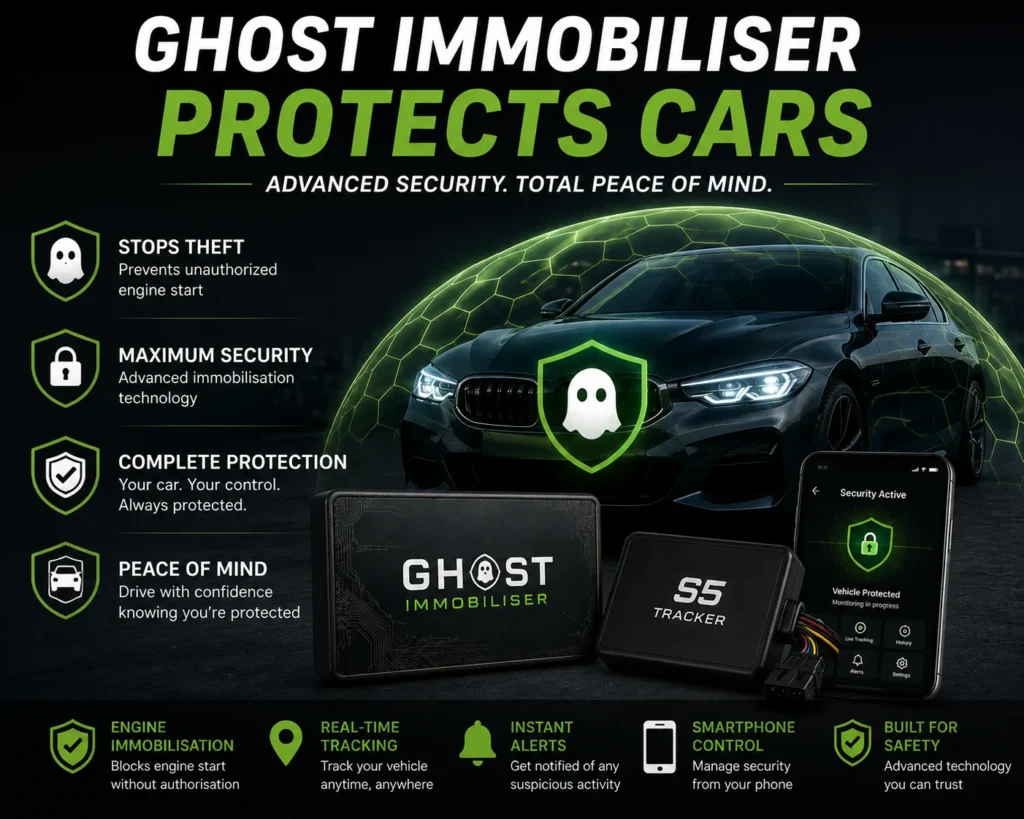
How Ghost Immobiliser Protects Cars: 7 Powerful UK Security Benefits
Vehicle theft has become a major concern for many UK motorists, particularly owners of luxury, performance and frequently targeted vehicles. Modern cars contain sophisticated electronic security systems, but thieves have also developed increasingly advanced methods of gaining access to vehicles and attempting to drive them away.
This has led many drivers to consider additional aftermarket security.
One popular option is the Ghost Immobiliser.
But how does Ghost Immobiliser protect cars, and what makes it different from a traditional alarm or factory immobiliser?
A Ghost Immobiliser is designed to provide an additional authentication barrier before a compatible vehicle can be driven. Current Autowatch information describes its Ghost systems as covert CAN-based immobilisers that use a personalised authorisation sequence through existing vehicle controls, rather than relying on an additional RF key fob.
In this guide, we’ll explain how the technology works, seven key benefits and why it can be considered as part of a layered UK vehicle-security strategy.
What Is a Ghost Immobiliser?
A Ghost Immobiliser is an aftermarket electronic vehicle security system designed to prevent unauthorised use of a compatible vehicle.
Unlike a traditional alarm, whose primary function is to alert people when a security event occurs, an immobiliser focuses on the vehicle’s ability to operate.
Autowatch describes its Ghost-II system as a covert CAN-bus immobiliser that uses a secret disarm sequence entered through existing vehicle buttons.
Newer Ghost-III systems are designed for modern vehicle networks and support CAN-FD, with digital engine blocking through CAN/LIN and other vehicle-specific methods.
The exact functionality depends on the Ghost model and the vehicle.
How Does Ghost Immobiliser Protects Cars?
The basic concept is straightforward.
After installation, the system is configured with an authorised disarm method. On compatible Ghost systems, this can involve entering a personalised PIN sequence using existing buttons in the vehicle.
If the correct authentication is provided, the system allows normal driving.
If the required authorisation is not provided, the vehicle remains immobilised according to the system’s configuration.
Autowatch states that its Ghost-II system does not rely on additional RF key fobs and that its disarm sequence is entered through the vehicle’s own controls.
This creates an additional security layer beyond simply possessing the vehicle’s original key.
7 Powerful Ways Ghost Immobiliser Protects Cars
1. Adds an Extra Starting Barrier
The first way a Ghost Immobiliser protects cars is by adding another authentication requirement before authorised driving.
Modern vehicles already have factory security systems, including immobilisation on many models. However, an aftermarket immobiliser can introduce an additional layer.
This means that gaining access to the vehicle and possessing the original key may not be sufficient to operate the vehicle normally when the additional immobiliser is active.
That makes an electronic immobiliser particularly interesting to drivers who want security beyond their factory system.
2. Provides Discreet Vehicle Security
Traditional security products often rely on visibility.
A steering lock can be seen through the window, while a traditional alarm may have a visible siren or security indicator.
Ghost systems take a different approach.
Autowatch describes its Ghost systems as being installed discreetly, with no visible hardware and no additional key fob required for the standard PIN-based operation.
This means the security system can remain largely hidden from view.
For vehicle owners, discreet protection can be useful because the security technology is not immediately obvious to someone examining the vehicle.
3. Adds Protection Against Key-Related Theft
Modern vehicle theft can involve more than simply stealing a physical car key.
Thatcham Research highlights the evolving nature of vehicle security and specifically considers digital vulnerabilities and keyless-entry resilience within its vehicle-security assessments.
A Ghost Immobiliser provides another authentication layer.
Even where a thief has obtained or manipulated the vehicle’s normal key-access process, the additional immobiliser authentication can provide another barrier to unauthorised driving.
Autowatch specifically markets its Ghost systems as protection against key cloning and relay theft.
However, no aftermarket security product should be described as making a vehicle completely theft-proof.
4. Helps Address Keyless Vehicle Risks
Keyless vehicles provide convenience, but their wireless systems have introduced additional security considerations.
Thatcham Research notes that passive keyless entry systems can potentially expose vehicles to different attack methods and continues to research digital and keyless vehicle security.
For owners of a keyless vehicle, adding an immobiliser can create another layer that is separate from simply having the original key.
Drivers should still follow sensible key-security measures.
For example:
- Keep keys away from external doors and windows.
- Consider suitable signal-blocking storage where appropriate.
- Check whether your vehicle has keyless security settings.
- Follow the manufacturer’s security recommendations.
- Consider additional physical or electronic security.
A layered approach is more sensible than expecting one product to address every risk.
5. Works Alongside Factory Security
A Ghost Immobiliser is generally considered an additional security layer rather than a replacement for every factory security function.
Modern cars can already have multiple security features, including:
- Factory immobilisation
- Central locking
- Alarm systems
- Electronic key authentication
- Keyless entry
- Engine-management security
An aftermarket system can supplement these existing protections.
This layered approach is consistent with the broader principle of combining appropriate security measures. Thatcham Research recommends considering certified alarms, immobilisers and tracking systems as part of vehicle-security protection.
6. Can Complement a Vehicle Tracker
Another important benefit is that an immobiliser and tracker can address different parts of the theft process.
An immobiliser focuses primarily on prevention.
A tracker focuses primarily on location and recovery.
This means a vehicle owner does not necessarily have to choose between them.
A layered setup could look like:
Factory Security → Original protection
Ghost Immobiliser → Additional starting protection
Tracker → Vehicle location and recovery
Steering Lock → Physical deterrence
This can provide broader protection than relying on a single device.
Thatcham Research classifies S5 products as Vehicle Tracking Systems and S7 products as Asset Location Systems.
7. Provides an Additional Layer for High-Value Vehicles
High-value vehicles can represent a substantial financial investment.
For owners of premium SUVs, performance cars or other vehicles with an elevated theft risk, additional security may be worth considering.
A Ghost Immobiliser can form part of a broader security package alongside an appropriate tracker, physical deterrent and key-security measures.
However, the best security setup depends on the individual vehicle.
Before installation, consider:
- Vehicle theft risk
- Vehicle value
- Where the car is normally parked
- Whether it has keyless entry
- Insurance requirements
- Manufacturer recommendations
- Compatibility with the security system
Ghost Immobiliser vs Factory Immobiliser
A common question is whether a Ghost Immobiliser is necessary when a vehicle already has a factory immobiliser.
The two systems have similar overall goals but can provide different layers of protection.
A factory immobiliser is integrated by the vehicle manufacturer as part of the original vehicle security architecture.
An aftermarket Ghost system adds another security layer after manufacture.
The exact benefits depend on the vehicle and the specific system installed.
The important point is that an aftermarket immobiliser should be viewed as additional protection, not as evidence that the factory system is completely ineffective.
Ghost Immobiliser vs Traditional Alarm
An alarm and immobiliser serve different primary purposes.
| Feature | Ghost Immobiliser | Traditional Alarm |
|---|---|---|
| Main purpose | Additional starting protection | Detects and alerts |
| PIN authentication | Yes, on compatible systems | Usually no |
| Audible warning | Not its primary function | Yes |
| Visible deterrent | Low | Usually higher |
| Electronic immobilisation | Yes | Depends on system |
| Can complement factory security | Yes | Yes |
| Can be combined with tracker | Yes | Yes |
A traditional alarm can be valuable because it draws attention to unauthorised access.
An immobiliser provides a different layer by making unauthorised vehicle operation more difficult.
For some vehicles, using multiple security technologies may therefore make more sense than choosing only one.
Does Ghost Immobiliser Protect Cars From Relay Attacks?
A Ghost Immobiliser is designed to add an authentication requirement that is separate from the vehicle’s standard keyless access process.
Autowatch states that its Ghost systems are designed to address relay attacks and key cloning through covert vehicle integration and PIN-based authorisation.
However, it’s important not to claim that any security system eliminates every possible theft technique.
Vehicle security is constantly evolving, and Thatcham Research continues to assess digital and keyless vulnerabilities.
For this reason, drivers should combine electronic security with sensible key-protection practices.
Does Ghost Immobiliser Protect Cars Without the Original Key?
The Ghost system’s purpose is to add another authorisation requirement to the vehicle.
For compatible systems, the driver enters the configured sequence using vehicle controls before authorised driving is permitted.
Autowatch states that its Ghost-II system uses a secret sequence through existing vehicle buttons and does not require an additional RF key fob for its standard operation.
The exact behaviour depends on the vehicle and installed system, so drivers should discuss the operation with their installer.
Is a Ghost Immobiliser Thatcham Approved?
This is an important distinction for UK drivers.
Thatcham Research operates a formal security certification programme for vehicle-security products. Its categories include electronic immobilisers, alarms, wheel-locking devices and vehicle tracking systems.
However, you should verify the certification status of the specific product rather than assuming that every product carrying a particular brand name has the same certification.
Thatcham Research also states that certification does not automatically guarantee insurer recognition, as this is negotiated separately between manufacturers and insurance partners.
If insurance recognition is important to you, speak to your insurer before installation.
Does a Ghost Immobiliser Reduce Insurance?
There is no universal insurance discount simply because a Ghost Immobiliser has been installed.
Insurance companies have their own requirements and may consider:
- Vehicle make and model
- Vehicle value
- Theft risk
- Security system
- Certification
- Installer
- Policy conditions
If you are considering an immobiliser specifically to satisfy an insurance requirement, contact your insurer before purchasing.
Ask whether the exact product and installation meet its requirements.
Is Professional Installation Important?
Yes.
Modern vehicles contain complex electronic systems, and aftermarket security equipment should be installed correctly.
Autowatch recommends installation by approved professionals and provides a nationwide dealer installation network for its products.
Before booking an installation, check:
- The installer is experienced with your vehicle.
- The specific Ghost model is compatible.
- You receive installation documentation.
- Warranty terms are clear.
- You understand the PIN or authorisation process.
- You know how Service/Valet Mode works if available.
Professional installation is an important part of making sure the security system works as intended.
How to Make Your Car Even More Secure
A Ghost Immobiliser should not necessarily be your only security measure.
Thatcham Research recommends considering a combination of appropriate vehicle-security measures, including alarms, immobilisers, tracking systems and physical deterrents.
You can also improve everyday security by:
- Keeping keys away from external doors and windows.
- Using appropriate signal-blocking storage for vulnerable keyless systems.
- Parking in well-lit or secure locations.
- Using a steering lock where appropriate.
- Considering a suitable tracker.
- Keeping your vehicle’s software and security features updated.
- Avoiding leaving valuables visible inside the vehicle.
Final Verdict: How Ghost Immobiliser Protects Cars
So, how does Ghost Immobiliser protect cars?
The main principle is additional authentication.
Rather than relying entirely on the vehicle’s original key and factory security, a compatible Ghost system can require an additional authorisation sequence before the vehicle can be driven.
This provides several potential benefits:
- Additional starting protection
- Discreet security
- Extra protection against key-related theft
- A layer for keyless vehicles
- Compatibility with factory security
- The ability to complement tracking systems
- Stronger layered protection for higher-risk vehicles
However, no security system should be considered completely theft-proof.
The strongest approach is to combine appropriate electronic, physical and behavioural security measures.
For UK drivers, a professionally installed Ghost Immobiliser can be one part of that wider strategy, particularly when combined with sensible key protection and suitable tracking technology.
Frequently Asked Questions
How does Ghost Immobiliser protects cars? (Ghost Immobiliser Protects Cars)
A Ghost Immobiliser adds an additional authentication requirement before a compatible vehicle can be driven. On supported systems, this involves a personalised sequence entered through existing vehicle controls.
Does a Ghost Immobiliser stop car theft? (Ghost Immobiliser Protects Cars)
It is designed to make unauthorised vehicle use more difficult by adding an additional immobilisation and authentication layer. However, no security system can guarantee that a vehicle will never be stolen.
Can a Ghost Immobiliser Protects Cars against key cloning? (Ghost Immobiliser Protects Cars)
Ghost systems are designed to add a separate authorisation layer rather than relying solely on the original vehicle key. Autowatch specifically markets Ghost-II as protection against key cloning and relay theft.
Does Ghost Immobiliser work with keyless cars? (Ghost Immobiliser Protects Cars)
Compatible Ghost systems can provide an additional security layer for keyless vehicles. Owners should still follow appropriate keyless-security practices.
Is a Ghost Immobiliser better than a car alarm? (Ghost Immobiliser Protects Cars)
They perform different functions. An alarm primarily detects and alerts, while an immobiliser adds protection against unauthorised vehicle operation. Using appropriate layers can provide broader security.
Can I use a Ghost Immobiliser Protects Cars with an S5 tracker? (Ghost Immobiliser Protects Cars)
Yes, where the products and vehicle are compatible. The immobiliser focuses on prevention, while an S5 tracker focuses on vehicle tracking and recovery.
Does a Ghost Immobiliser Protects Cars insurance? (Ghost Immobiliser Protects Cars)
It can be relevant to some insurance policies, but recognition and discounts vary between insurers. Check your policy requirements before installation.
Is a Ghost Immobiliser Protects Cars Thatcham certified? (Ghost Immobiliser Protects Cars)
Certification depends on the specific product. Thatcham Research maintains a database of certified security products, so verify the exact system rather than relying solely on the brand name.
Does Ghost Immobiliser Protects Cars require a separate key fob? (Ghost Immobiliser Protects Cars)
The standard Ghost-II PIN-based system described by Autowatch uses the vehicle’s existing controls rather than requiring an additional RF key fob. Some newer systems can also support key-tags or smartphone authorisation.
Is a Ghost Immobiliser Protects Cars worth it for a high-value car? (Ghost Immobiliser Protects Cars)
It can be worth considering if you want an additional layer beyond factory security, particularly for a higher-risk or high-value vehicle. The decision should take into account the vehicle, theft risk, insurance requirements and other security measures already in place.
Follow us on instagram.