
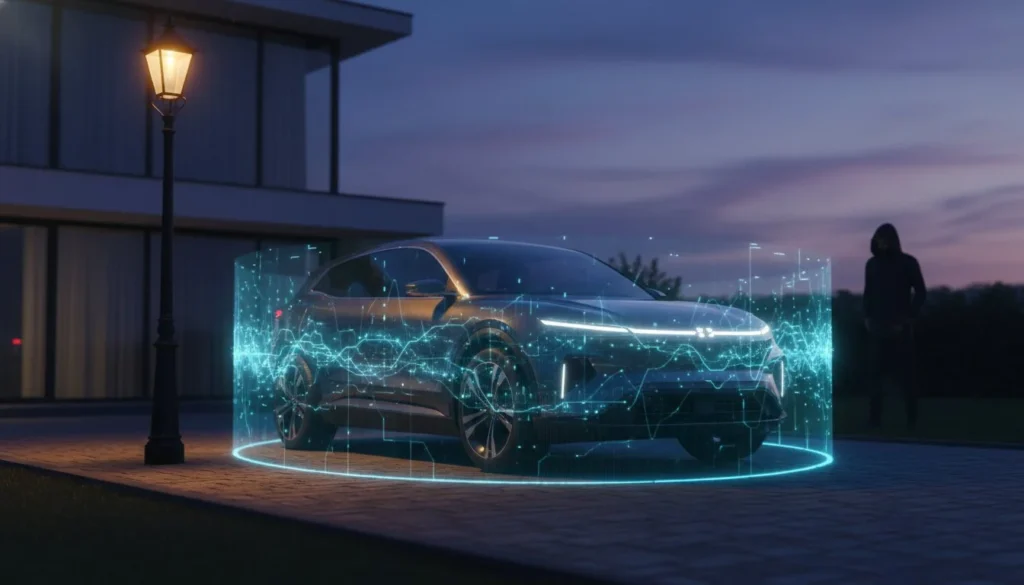
Modern vehicle theft is no longer limited to breaking a window, forcing a lock or hot-wiring a car. Electronic theft techniques, keyless systems and increasingly sophisticated attacks have made vehicle security a major concern for UK drivers.
This has led many owners to compare two popular security options: a Ghost Immobiliser vs Car Alarm.
Although both can improve vehicle security, they work in very different ways. A car alarm is primarily designed to detect unauthorised access and alert people nearby. A Ghost Immobiliser is designed to add an electronic immobilisation and driver-authentication layer that makes unauthorised driving more difficult.
So which is best?
The answer depends on your vehicle, security priorities and budget. In many cases, the strongest approach is not choosing one instead of the other, but understanding how each device contributes to a layered security strategy.
What Is a Ghost Immobiliser?
A Ghost Immobiliser is an aftermarket electronic vehicle-security system designed to help prevent unauthorised vehicle use.
The Ghost-II, for example, is a covert CAN-bus immobiliser. It uses a personalised sequence entered through compatible existing vehicle controls before the vehicle can be driven normally.
The driver doesn’t need an additional RF key fob for standard PIN operation, and the system is designed to operate discreetly.
This gives the owner another authentication step beyond the vehicle’s original factory key or keyless system.
What Is a Car Alarm?
A car alarm is primarily designed to detect and alert people to suspicious or unauthorised activity involving the vehicle.
Depending on the system, sensors can monitor events such as:
- Door opening
- Bonnet opening
- Boot opening
- Unauthorised movement
- Impact
- Interior movement
- Tampering
When the system detects a relevant event, it can activate an audible or visual alarm.
The main purpose is detection and deterrence.
A car alarm can draw attention to an attempted theft, whereas an immobiliser focuses more directly on preventing the vehicle from being driven away.
Ghost Immobiliser vs Car Alarm: What Is the Main Difference?
The simplest way to understand the difference is:
Ghost Immobiliser = prevent or restrict unauthorised driving
Car Alarm = detect and alert to unauthorised access or activity
That distinction matters because the products address different stages of a potential theft.
An alarm can tell people that something is wrong.
An immobiliser can add another requirement before the vehicle can be driven.
For this reason, both systems can have a useful place in a broader security strategy.
7 Powerful Security Differences Between Ghost Immobiliser and Car Alarm
1. Immobilisation vs Detection
The biggest difference in Ghost Immobiliser vs Car Alarm is their core purpose.
Ghost is an immobilisation system.
Its personalised authentication sequence is designed to be entered before normal driving is allowed.
A car alarm is primarily a detection and alert system.
It can identify certain forms of unauthorised access and produce an audible warning.
This means:
Ghost asks: “Has the authorised driver authenticated?”
Alarm asks: “Has a security event occurred?”
Both are useful questions, but they solve different problems.
2. Personalised PIN vs Sensor-Based Protection
The Ghost-II uses a personalised sequence entered through compatible vehicle controls.
This creates a driver-authentication process.
A car alarm generally relies on sensors and switches to determine whether an event such as a door opening, impact or movement has occurred.
Therefore, the user experience is very different.
With Ghost, the driver interacts with the system.
With an alarm, the system generally reacts automatically to detected events.
3. Covert Security vs Visible Deterrence
Ghost is designed to be covert.
Its normal PIN operation does not require an obvious keypad or additional RF key fob, making the security system difficult to identify simply from the vehicle’s interior.
A car alarm often has a visible or audible presence.
Its siren, warning indicators or security markings can make it clear that the vehicle is protected.
This creates two different deterrence strategies:
Ghost → discreet protection
Alarm → visible and audible deterrence
A combination can therefore potentially provide both.
4. Electronic Theft Protection vs Intrusion Alerts
Modern vehicle theft can involve electronic methods such as key cloning, relay attacks and other forms of unauthorised electronic access.
Ghost-II is designed as a CAN-bus immobiliser and is marketed as protection against modern theft methods, including key cloning and relay attacks.
A conventional alarm is generally focused on detecting an intrusion or security event.
This doesn’t make an alarm ineffective. It simply means its primary function is different.
For modern vehicles, combining electronic immobilisation with alarm protection can create a more comprehensive security setup.
5. Driving Authentication vs Automatic Alerts
Ghost requires the authorised driver to enter their personalised sequence.
Once authentication is accepted, the vehicle can operate normally.
An alarm generally doesn’t require the driver to enter a PIN every time they drive.
Instead, it automatically arms and disarms according to the vehicle’s or alarm system’s configuration.
This means drivers who prioritise convenience may appreciate an alarm’s automatic operation, while those wanting another authentication layer may prefer Ghost.
6. Keyless Vehicle Security
Keyless vehicles are an important part of this comparison.
Keyless entry systems can expose vehicles to certain wireless attack techniques depending on the vehicle’s design and security architecture.
Ghost-II’s standard driving authentication doesn’t rely on an additional RF key fob. Instead, the driver uses existing vehicle controls to enter the personalised sequence.
A car alarm can still provide valuable intrusion detection, but it doesn’t necessarily add a separate driver-authentication requirement in the same way.
For keyless vehicles, an additional immobilisation layer can therefore be attractive.
7. Security Layer vs Security Layer
The best interpretation of Ghost Immobiliser vs Car Alarm may be that both can be useful parts of a layered security system.
For example:
Factory security → original vehicle protection
Ghost Immobiliser → additional electronic immobilisation
Car alarm → intrusion detection and audible deterrence
Tracker → location and recovery support
Steering lock → physical deterrence
Keyless precautions → additional wireless protection
Rather than asking which single device solves every problem, consider which layers your vehicle needs.
Ghost Immobiliser vs Car Alarm Comparison
| Feature | Ghost Immobiliser | Car Alarm |
|---|---|---|
| Primary purpose | Electronic immobilisation | Intrusion detection and alert |
| Driver authentication | Personalised sequence | Usually automatic |
| Audible warning | Not its main function | Yes |
| Covert operation | Designed to be covert | Often more visible |
| PIN-based driving | Yes | Usually no |
| Additional RF key fob | Not required for standard Ghost-II PIN operation | Depends on system |
| Keyless security relevance | High | Useful but different role |
| CAN-bus integration | Yes on compatible Ghost systems | System dependent |
| Prevents/restricts unauthorised driving | Designed for this | Not its primary purpose |
| Can work with other security | Yes | Yes |
The exact features of individual alarms and immobilisers vary, so always check the specification of the specific product.
Is a Ghost Immobiliser Better Than a Car Alarm?
It depends on what you want the system to do.
If your main concern is preventing unauthorised driving, a Ghost Immobiliser may be more relevant.
If your priority is detecting and loudly alerting people to a break-in, a car alarm may be more suitable.
However, the two aren’t necessarily competing products.
A Ghost Immobiliser can add electronic authentication, while an alarm can provide a visible and audible deterrent.
For many drivers, the best solution may be a combination.
Does a Ghost Immobiliser Replace a Car Alarm?
No.
Ghost is primarily designed to provide immobilisation and driver authentication.
A car alarm has a different purpose: detecting and alerting to certain forms of unauthorised access or tampering.
If you already have a factory alarm, adding Ghost can provide another layer rather than removing the existing system.
This is one reason why aftermarket immobilisers can complement factory security.
Can a Ghost Immobiliser Stop Car Theft?
No security product should be described as a guarantee that theft is impossible.
Ghost is designed to make unauthorised vehicle use more difficult by adding a separate authentication and immobilisation requirement.
The effectiveness depends on:
- The specific vehicle
- System compatibility
- Installation quality
- Configuration
- Driver behaviour
- The theft method
For comprehensive protection, owners should consider multiple security layers.
Can a Car Alarm Prevent Car Theft?
A car alarm can act as a deterrent and alert people to certain unauthorised activities.
However, an alarm doesn’t necessarily prevent a determined thief from moving or removing a vehicle.
Its primary strength is detection and attention.
This is why an alarm and immobiliser can complement one another.
Ghost Immobiliser for Keyless Cars
For owners of keyless vehicles, the comparison becomes especially relevant.
A factory keyless system is designed for convenience, but owners may be concerned about electronic attacks involving vehicle-to-key communication.
A Ghost Immobiliser adds another authentication layer.
With Ghost-II, the driver enters a personalised sequence through the vehicle’s existing controls rather than relying on an additional RF key fob.
This can provide another obstacle to unauthorised driving.
However, owners should still protect their original keys and follow sensible keyless-security practices.
Car Alarm for Keyless Cars
A car alarm remains useful for keyless vehicles because it can detect certain forms of intrusion or tampering.
Its warning function can discourage opportunistic theft and alert nearby people.
But an alarm doesn’t necessarily add the same type of driver-authentication requirement as a Ghost Immobiliser.
This is an important distinction when comparing the two.
Ghost Immobiliser vs Car Alarm for High-Value Vehicles
Owners of high-value or highly desirable vehicles may have more reason to consider layered security.
A possible security setup could include:
Ghost Immobiliser
Factory alarm
Steering lock
Appropriate tracker
Secure key management
Secure parking
Each layer has a different function.
The goal isn’t to make theft technically impossible.
The goal is to increase the number of obstacles a thief encounters and improve detection and recovery capabilities.
Does Ghost Immobiliser Have a Service Mode?
Yes.
Ghost-II includes Service/Valet Mode, which is intended for situations such as vehicle servicing and handovers.
This allows the owner to avoid giving their personal authentication sequence to a mechanic or valet who needs to move the vehicle.
After servicing, the owner can restore normal Ghost operation.
This practical feature is one of the differences between an aftermarket immobiliser and a conventional alarm.
Is Ghost Immobiliser Difficult to Use?
The system is designed to become part of the owner’s normal driving routine.
A typical sequence is:
Enter vehicle → switch on ignition → enter personalised sequence → receive confirmation → drive
Once familiar, the additional step can become quick and straightforward.
Drivers who prefer completely automatic security may find a conventional alarm more convenient, while those who value additional authentication may consider the extra step worthwhile.
How Much Does a Ghost Immobiliser Cost?
Installation prices vary according to the vehicle, Ghost system version and installer.
When comparing prices, don’t look only at the cheapest quote.
Consider:
System
Professional installation
Vehicle compatibility
Warranty
Aftercare
PIN configuration
Service Mode guidance
The total value depends on more than the initial purchase price.
Is a Car Alarm Worth It?
A car alarm can still be valuable, especially for drivers who want a visible and audible deterrent.
It can help draw attention to certain forms of unauthorised access and may complement the vehicle’s existing factory security.
For higher-risk vehicles, however, an alarm alone may not provide the same additional immobilisation layer as a dedicated aftermarket immobiliser.
What About a Ghost Immobiliser and Car Alarm Together?
This can be one of the strongest combinations because the systems perform different jobs.
For example:
Alarm → detect and alert
Ghost → authenticate and immobilise
Tracker → locate and recover
Steering lock → physically deter
This creates a multi-layer approach.
If a thief encounters one security measure, another may still remain.
Insurance Considerations
Security requirements vary between insurers and vehicle types.
Some policies may require specific security products or tracking categories.
Don’t assume that installing an alarm or Ghost Immobiliser automatically gives you an insurance discount.
Before buying a security product for insurance purposes, confirm:
Whether the insurer recognises the product
Whether a specific category is required
Whether professional installation is required
Whether proof of installation is needed
Whether the active system must be maintained
This prevents misunderstandings after installation.
Clear Installation Call to Action
Looking to improve your vehicle’s security?
Contact a reputable Ghost Immobiliser installer to check compatibility with your exact make, model and year. A professional specialist can explain how Ghost can work alongside your existing factory alarm and recommend additional security measures where appropriate.
Before booking, ask about installation, warranty, aftercare, PIN setup and Service/Valet Mode.
Add another layer of protection to your vehicle — contact a trusted Ghost Immobiliser installer today to check compatibility and arrange professional installation.
Final Verdict: Ghost Immobiliser vs Car Alarm
When comparing Ghost Immobiliser vs Car Alarm, the most important point is that they have different primary functions.
A car alarm is designed mainly to detect suspicious activity and alert people with an audible or visual warning.
A Ghost Immobiliser is designed to add an electronic immobilisation and driver-authentication layer, requiring a personalised sequence before normal driving.
That makes Ghost particularly relevant to drivers who are concerned about modern electronic and keyless vehicle theft.
However, an alarm still has an important role as a deterrent and intrusion-detection system.
For many UK drivers, the strongest strategy may therefore be Ghost Immobiliser + Car Alarm + appropriate additional security, rather than choosing one product alone.
No security system can guarantee that a vehicle will never be stolen. But combining different security layers can make unauthorised access and use more difficult while improving overall vehicle protection.
FAQs
Is a Ghost Immobiliser better than a car alarm? (Ghost Immobiliser vs Car Alarm)
They perform different functions. Ghost focuses on electronic immobilisation and driver authentication, while a car alarm focuses on detecting and alerting to certain forms of unauthorised access.
Can I have Ghost Immobiliser vs Car Alarm? (Ghost Immobiliser vs Car Alarm)
Yes. They can complement each other because they address different aspects of vehicle security.
Does Ghost Immobiliser replace a factory alarm? (Ghost Immobiliser vs Car Alarm)
No. Ghost is an additional security layer and isn’t intended simply to replace the vehicle’s factory alarm.
Does a Ghost Immobiliser make a car theft-proof? (Ghost Immobiliser vs Car Alarm)
No. No security system should be described as completely theft-proof. Ghost is designed to make unauthorised vehicle use more difficult.
Does a car alarm prevent keyless theft? (Ghost Immobiliser vs Car Alarm)
An alarm can detect certain forms of intrusion and provide an audible deterrent, but it doesn’t necessarily provide the additional driver-authentication layer offered by an immobiliser.
Does Ghost Immobiliser protect keyless cars? (Ghost Immobiliser vs Car Alarm)
Ghost-II is designed for compatible keyless vehicles and uses a personalised sequence through existing vehicle controls rather than requiring an additional RF key fob for normal PIN operation.
Can Ghost Immobiliser prevent key cloning? (Ghost Immobiliser vs Car Alarm)
Ghost adds a separate authentication requirement, which can make compromised factory key authentication less useful for driving the vehicle. However, no security system guarantees protection against every theft technique.
Does Ghost Immobiliser protect against CAN-bus theft? (Ghost Immobiliser vs Car Alarm)
Ghost-II is designed as a CAN-bus immobiliser and adds another electronic immobilisation layer. Its effectiveness depends on the vehicle, installation and attack method.
Does Ghost Immobiliser have a Service Mode? (Ghost Immobiliser vs Car Alarm)
Yes. Ghost-II includes Service/Valet Mode for situations such as servicing and vehicle handovers.
Is a car alarm still useful in 2026? (Ghost Immobiliser vs Car Alarm)
Yes. A car alarm can provide audible and visual deterrence and detect certain forms of unauthorised access. It can also complement an immobiliser.
Should I install Ghost Immobiliser vs Car Alarm first? (Ghost Immobiliser vs Car Alarm)
Consider your main security priority. For additional electronic immobilisation, Ghost may be more relevant. For audible intrusion detection, an alarm is useful. Using both can provide broader protection.
Does Ghost Immobiliser require professional installation? (Ghost Immobiliser vs Car Alarm)
Professional installation is recommended because the system interfaces with the vehicle’s electronic architecture. Compatibility should be checked for the exact vehicle before installation.
Can a Ghost Immobiliser lower insurance costs? (Ghost Immobiliser vs Car Alarm)
It may be recognised by some insurers, but there is no universal discount. Always check your individual insurer’s requirements before installation.
Should I add a tracker as well? (Ghost Immobiliser vs Car Alarm)
A tracker serves a different purpose by helping monitor location and support recovery. For higher-value vehicles, combining immobilisation, alarm protection and tracking can provide a more comprehensive security strategy.
Follow us on instagram.