
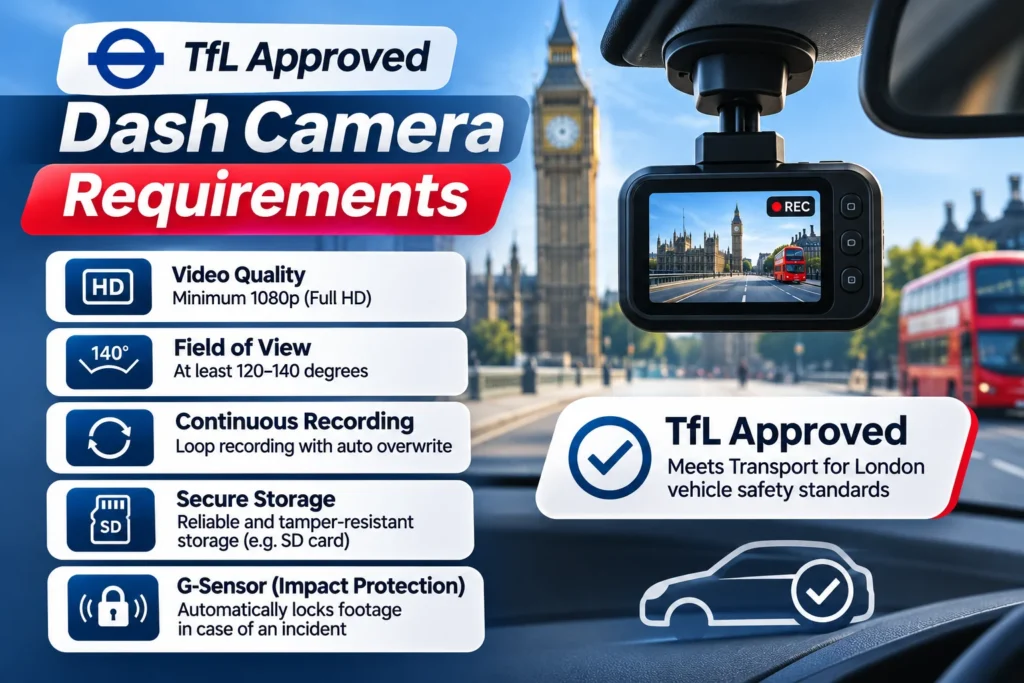
Choosing the right dash camera for a taxi or private hire vehicle in London is important for driver safety, passenger protection, and licensing compliance. However, not every dash camera available in the UK is suitable for a TfL-licensed vehicle. Drivers and vehicle owners need to understand the official approval process, installation standards, recording rules, and data protection responsibilities.
Understanding the TfL Approved Dash Camera Requirements can help you choose suitable equipment and avoid problems during vehicle inspections. Whether you operate a black cab or a private hire vehicle (PHV), selecting a compliant camera system is an important step towards safer journeys and better incident management.
This guide explains the main TfL Approved Dash Camera Requirements, including approved equipment, camera positioning, installation, recording, signage, and privacy responsibilities.
1. What Are the TfL Approved Dash Camera Requirements?
Transport for London (TfL) has specific guidelines for CCTV and incident recording systems installed in licensed taxis and private hire vehicles. These guidelines are designed to protect drivers and passengers, support investigations, and ensure that recording equipment is installed and operated responsibly.
One important point is that TfL’s CCTV guidance covers more than traditional dashboard cameras. Its definition includes electronic recording devices attached inside a vehicle that can capture and retain visual images or audio from inside or outside the vehicle. This can include incident and accident recording equipment.
The TfL Approved Dash Camera Requirements mean that a system installed as part of this approved in-vehicle CCTV and incident-camera arrangement must meet TfL’s technical and safety standards and be included in its approved equipment arrangements.
A standard consumer dashcam should not automatically be assumed to be TfL approved. Always check the exact camera model and its approved vehicle application before purchasing or arranging installation.
2. Are TfL-Approved Dash Cameras Mandatory?
Drivers should understand the difference between having a dash camera for personal protection and installing an approved CCTV system in a TfL-licensed vehicle.
TfL has an approval process for CCTV and incident camera equipment used in licensed taxis and private hire vehicles. However, its published guidance describes installation as a choice for vehicle owners rather than a blanket requirement for every licensed vehicle.
If you choose to install an in-vehicle CCTV or incident recording system, it must comply with the applicable TfL requirements.
Before buying equipment, check whether the camera is approved for your particular vehicle type. The approved list distinguishes between different taxi models and private hire vehicles.
Understanding this distinction is essential when reviewing the TfL Approved Dash Camera Requirements because purchasing an ordinary dashcam does not automatically establish licensing compliance.
3. Choose a Camera From the TfL Approved List
One of the most important TfL Approved Dash Camera Requirements is selecting an approved system rather than relying only on a manufacturer’s marketing claims.
TfL publishes an approved CCTV supplier and installer list. The published list dated 12 May 2025 includes different systems for forward-facing incident recording, interior CCTV, and combined camera arrangements.
Examples appearing on that list include:
- Exeros Trackeye Nano 168SD.
- VisionTrack VT5500.
- Surecam IT1000.
- Kasava KDC404 Camera System.
- Smartwitness KP1.
- Samsara CM31 Dash Cam.
- Samsara CM32 Dash Cam.
- ACSS Dual Camera.
These examples are not universally approved for every vehicle. The list identifies which systems are approved for particular vehicle types, including certain taxi models and PHVs.
Always verify the latest TfL list, the exact model number, and the vehicle category before ordering a system. Approval for one vehicle does not necessarily mean approval for another.
4. Camera Installation and Positioning Requirements
Correct installation is another important part of the TfL Approved Dash Camera Requirements. Even suitable equipment can create problems if it is fitted incorrectly.
The camera system must be installed securely and according to the equipment manufacturer’s instructions.
Important installation considerations include:
Secure Camera Mounting
The camera must be firmly attached to prevent it from becoming loose during normal driving or an accident. TfL’s guidance does not permit temporary fixing methods such as suction cups for these CCTV installations.
Clear Windscreen Visibility
The camera must not obstruct the driver’s view of the road. It should be positioned carefully so that it does not interfere with visibility or safe vehicle operation.
Airbags and Safety Equipment
Camera equipment must not interfere with airbags, air curtains, autonomous braking systems, or other essential vehicle safety equipment.
Safe Wiring
All wiring must be appropriately routed and fused according to the manufacturer’s technical specifications. Poor wiring can create electrical and safety risks.
Professional Installation
Use an appropriate approved supplier or installer and confirm that the complete installation matches the approved configuration for your vehicle.
Following these TfL Approved Dash Camera Requirements helps reduce installation risks and supports a safer environment for drivers and passengers.
5. Video Recording and Audio Recording Rules
Recording capabilities are an important consideration when choosing an approved camera system.
TfL’s guidance places particular emphasis on protecting passenger privacy. Video recording must be handled responsibly, and systems should not be used to record conversations between members of the public.
If a selected system includes audio recording functionality, that function should be disabled wherever possible.
Audio recording may only be justified in limited circumstances involving a specific safety threat. Where it is used, the system must have appropriate activation and reset arrangements, and clear signage must explain that audio recording is taking place or may take place.
Drivers should not assume that a camera’s ability to record sound means continuous audio recording is permitted.
Understanding these rules is essential when considering the TfL Approved Dash Camera Requirements for a taxi or private hire vehicle.
6. Data Storage, Encryption and Footage Retention
A compliant camera system must protect recorded footage against unauthorised access, loss, and misuse.
TfL’s published CCTV guidance sets out important requirements for image security and storage.
Secure and Encrypted Footage
Recorded images must be protected using approved encryption arrangements. Where SD cards are used, they must be secured within the camera device, formatted for the device, and encrypted.
Automatic Overwriting
The system must include an automatic overwriting function. Under TfL’s published guidance, footage should normally be retained for a maximum of 28 days.
Longer Retention in Exceptional Cases
Footage may be retained beyond the normal period where it is needed for an exceptional reason, such as an insurance claim or criminal investigation. Once the relevant matter is concluded, the data should be deleted.
Controlled Access
Recorded footage should only be accessed by authorised individuals for legitimate purposes. It should not be copied or shared casually.
These storage and security measures are a significant part of the TfL Approved Dash Camera Requirements because they protect both drivers and passengers.
7. CCTV Signage and Passenger Awareness
Passengers should be informed when recording equipment is operating inside a licensed vehicle.
TfL’s approved equipment information specifies two important signage arrangements:
- An interior sign issued by TfL that informs passengers about the data controller details.
- An exterior-facing sign supplied by the equipment provider that informs the public that recording is taking place.
Approved signage must be in place at all times when the relevant system is installed and operating.
If audio recording is used in the limited circumstances permitted by the guidance, the signage must clearly explain that audio recording is taking place or may take place.
Clear signage supports transparency and helps passengers understand how their personal information may be recorded.
8. Data Protection and ICO Responsibilities
Installing a camera system also creates responsibilities under UK data protection legislation.
The person or organisation deciding to install and operate the system will generally be responsible for controlling the recorded personal data. This may be the vehicle owner, operator, or another relevant organisation, depending on the arrangement.
Important responsibilities include:
- Identifying a lawful basis for recording.
- Explaining the purpose of the camera system.
- Protecting footage against unauthorised access.
- Establishing suitable retention and deletion procedures.
- Handling requests for recorded personal information.
- Reviewing whether the system remains necessary and appropriate.
- Considering a Data Protection Impact Assessment (DPIA) where required.
You should also check whether you need to pay the applicable ICO data protection fee. The requirement depends on your organisation’s data processing activities and any relevant exemption.
Following data protection responsibilities is just as important as selecting equipment that meets the TfL Approved Dash Camera Requirements.
9. What Happens During a TfL Vehicle Inspection?
Camera installation and safety may be checked during the annual licensing inspection.
TfL’s guidance explains that installed CCTV systems are inspected to ensure they are securely fitted and do not create a safety risk for drivers or passengers.
Before presenting your vehicle, consider the following checks:
- Confirm that the camera model is on the relevant approved list.
- Check that the installation matches the approved vehicle configuration.
- Make sure the camera is securely mounted.
- Confirm that the windscreen view is not obstructed.
- Check that wiring is safely routed and fused.
- Make sure recording and storage functions work correctly.
- Confirm that required signage is displayed.
- Review your footage security and data protection arrangements.
Preparing in advance can help you identify problems before your vehicle inspection.
10. How to Choose the Right TfL-Approved Camera System
Choosing a camera should involve more than comparing prices and video resolution. You need a system that matches your vehicle and meets the relevant licensing requirements.
Consider the following factors:
Vehicle compatibility: Confirm that the exact model is approved for your taxi or PHV.
Camera coverage: Decide whether you need forward-facing incident recording, interior CCTV, or an approved combined arrangement.
Recording quality: Choose equipment capable of producing useful footage for its intended purpose.
Data security: Check the encryption, storage, access, and automatic overwriting arrangements.
Installation support: Use an appropriate supplier or installer familiar with TfL requirements.
After-sales service: Consider technical support, maintenance, repairs, and replacement options.
A suitable camera system can support driver protection, passenger safety, and incident investigation. Taking time to compare approved options can help you make a more informed decision.
Conclusion
Understanding the TfL Approved Dash Camera Requirements is important for taxi and private hire vehicle owners who want to install CCTV or incident recording equipment in London. From choosing an approved camera model and arranging safe installation to managing recordings, displaying signage, and protecting passenger information, every stage requires attention.
Remember that an ordinary consumer dashcam is not automatically TfL approved. Always check the latest approved equipment list and confirm that the selected system is suitable for your specific vehicle.
By following the TfL Approved Dash Camera Requirements, choosing an appropriate supplier, and maintaining responsible recording practices, drivers can improve vehicle security, support incident investigations, and create a safer environment for everyone.
Frequently Asked Questions (FAQs)
1. What are the TfL Approved Dash Camera Requirements?
The TfL Approved Dash Camera Requirements cover approved equipment, safe installation, camera positioning, secure footage storage, privacy, and signage for CCTV and incident recording systems installed in licensed London taxis and PHVs.
2. Is a dash camera compulsory for all TfL-licensed vehicles?
TfL’s published guidance describes the installation of approved CCTV systems as voluntary. However, if you choose to install an in-vehicle CCTV or incident recording system, it must comply with the relevant TfL requirements.
3. Can I use an ordinary dashcam in my private hire vehicle?
Do not assume that an ordinary consumer dashcam is approved for a TfL-licensed PHV. Check the exact model and configuration against TfL’s approved equipment information before installation.
4. How long can TfL-approved camera footage be stored?
TfL’s published CCTV guidance specifies automatic overwriting and a normal maximum retention period of 28 days. Longer retention may be justified in exceptional circumstances, such as an ongoing insurance claim or criminal investigation.
5. Is audio recording allowed in TfL-licensed taxis?
Audio recording is generally discouraged because of passenger privacy. TfL’s guidance says the audio function should be disabled wherever possible. Limited use may be justified in specific safety circumstances with appropriate safeguards and signage.
6. Do I need CCTV signs in my taxi or private hire vehicle?
Yes, where the relevant approved CCTV system is installed, TfL’s approved information specifies an interior passenger notice and an exterior-facing recording notice. Additional clear information is required where audio recording is used.
7. Where can I check the latest approved camera systems?
You can check the approved CCTV suppliers and installers information published by Transport for London. Verify the exact model and vehicle category before purchasing or installing equipment.