
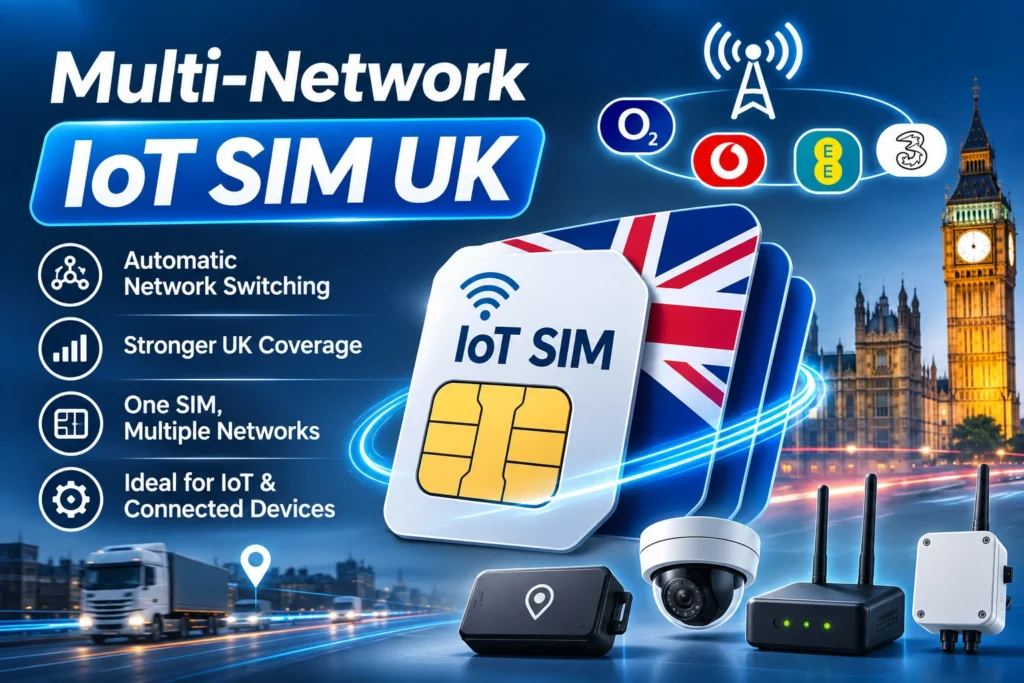
Businesses increasingly depend on connected devices to monitor vehicles, manage equipment, track assets and collect real-time information. These devices need reliable internet connectivity to communicate with software platforms and cloud applications. A standard mobile SIM may not provide the flexibility required for devices operating across different locations.
A Multi-Network IoT SIM UK provides access to multiple mobile networks through one SIM, helping connected devices maintain communication when coverage from one operator is unavailable or unsuitable. It is particularly useful for businesses that operate equipment across cities, rural areas, warehouses and transport routes.
Whether you need connectivity for GPS trackers, smart meters, security systems or industrial equipment, choosing the right Multi-Network IoT SIM UK can help improve connectivity options and simplify device management.
This complete buyer’s guide explains how multi-network IoT SIM cards work, their benefits, important features and what to consider before purchasing one.
1. What Is a Multi-Network IoT SIM UK?
A Multi-Network IoT SIM UK is a specialist SIM card designed for Internet of Things (IoT) and machine-to-machine (M2M) devices. Unlike a conventional SIM that normally connects through one mobile operator, a multi-network SIM can be provisioned to access multiple supported mobile networks.
For example, depending on the provider’s agreements and SIM configuration, a device may be able to connect through networks such as EE, Vodafone, O2 and Three.
This flexibility is useful when a connected device moves between locations where different operators provide better coverage.
A Multi-Network IoT SIM UK can be used in:
- GPS vehicle tracking systems
- Fleet management equipment
- Smart meters and monitoring devices
- Industrial IoT equipment
- Security alarms and monitoring systems
- Remote sensors
- Vending machines and payment terminals
- Connected agricultural equipment
The SIM provides the mobile data connection that allows these devices to communicate with their applications and management platforms.
2. How Does a Multi-Network IoT SIM UK Work?
A Multi-Network IoT SIM UK uses mobile network access arrangements to connect devices to supported operators.
When an IoT device starts up, its modem searches for compatible mobile networks. The SIM and network configuration determine which networks it can access and which operator it attempts to use.
If the current network becomes unavailable, the device may search for another permitted network and reconnect.
The process generally involves four stages:
Network Detection
The device searches for available mobile networks in its location.
Network Selection
The SIM and modem select a network according to availability, signal conditions and the provider’s network-selection policy.
Data Connection
Once registered, the device establishes a data connection and sends information to its server or cloud platform.
Network Recovery
If the connection is lost, the device may attempt to register with another supported network.
It is important to understand that a multi-network SIM does not normally connect to every network simultaneously. It generally uses one network at a time, and switching may take time depending on the SIM, modem, network and configuration.
3. 9 Powerful Benefits of a Multi-Network IoT SIM UK
Choosing a Multi-Network IoT SIM UK can offer several advantages for businesses that depend on connected equipment.
1. Access to Multiple Mobile Networks
One of the biggest advantages is the ability to access more than one supported mobile operator. This provides additional connectivity options compared with a SIM restricted to a single network.
2. Improved Coverage Options
Mobile coverage varies between locations. One operator may provide a stronger connection in a particular area, while another may perform better elsewhere.
A multi-network SIM can give compatible devices more opportunities to find a usable connection.
3. Better Connectivity for Vehicle Tracking
Vehicle tracking systems frequently operate across different towns, motorways and rural locations.
A Multi-Network IoT SIM UK can help tracking devices access alternative supported networks when travelling through areas where a particular operator has limited coverage.
4. Reduced Dependence on One Network
Businesses using hundreds of connected devices may not want their entire operation to depend on one mobile operator.
Multi-network connectivity provides more network choices and can help reduce dependence on a single provider’s coverage.
5. Centralised SIM Management
Many IoT connectivity providers offer online management portals.
Depending on the service, businesses may be able to monitor SIM activity, check data consumption, activate or suspend SIMs and manage connected devices from one location.
6. Flexible Data Packages
IoT devices have different data requirements. A GPS tracker may use relatively little data, while a camera or industrial monitoring device may require a larger allowance.
A Multi-Network IoT SIM UK can be available with different data packages to suit individual applications.
7. Suitable for Remote Equipment
Remote sensors, monitoring systems and agricultural equipment may operate far away from business premises.
Access to multiple supported networks can improve the range of connectivity options available to these devices.
8. Support for Business Expansion
Businesses expanding their connected-device operations may need SIMs that can be deployed across multiple regions.
A multi-network solution can make it easier to manage connectivity across different locations without choosing a separate SIM provider for every area.
9. International Connectivity Options
Some IoT SIM providers also offer international roaming.
This can be useful for equipment travelling outside the UK or devices deployed across multiple countries. However, international coverage, supported networks and roaming charges should always be checked before purchasing.
4. Multi-Network IoT SIM UK vs Standard SIM Card
Understanding the difference between a standard SIM and a Multi-Network IoT SIM UK can help businesses choose the right connectivity solution.
| Feature | Standard SIM | Multi-Network IoT SIM |
|---|---|---|
| Network access | Usually one operator | Multiple supported operators |
| Automatic network selection | Limited to its home network and roaming arrangements | Depends on SIM and provider configuration |
| IoT applications | May support basic applications | Designed for connected-device deployments |
| Management portal | Depends on provider | Often includes IoT management features |
| Data packages | Consumer or business plans | IoT-focused data plans may be available |
| International roaming | Depends on plan | Often available through provider agreements |
| Device management | Varies | May include centralised SIM controls |
A standard SIM may be sufficient for a device that operates in one location with reliable coverage.
However, businesses managing mobile or geographically distributed equipment may benefit from the additional network options offered by a Multi-Network IoT SIM UK.
5. Which Devices Can Use a Multi-Network IoT SIM UK?
A Multi-Network IoT SIM UK can support many different types of connected equipment, provided the device is compatible with the SIM and its supported mobile technologies.
GPS Trackers
Vehicle and asset tracking devices use mobile data to send location information to tracking platforms.
A suitable multi-network SIM can help trackers stay connected across different geographical areas.
Fleet Management Systems
Fleet operators can use connected devices to transmit vehicle information, location updates and operational data.
Smart Monitoring Equipment
Smart sensors can send measurements and alerts to remote monitoring systems without requiring a fixed broadband connection.
Security and Alarm Systems
Connected security equipment can communicate alerts and status information through mobile networks.
Industrial IoT Devices
Factories and industrial businesses can use mobile connectivity to monitor equipment, collect information and manage remote operations.
Before purchasing, confirm that the device supports the SIM’s required network technology, frequency bands and configuration.
6. Important Features to Check Before Buying
Not every Multi-Network IoT SIM UK offers the same features. Comparing the technical specifications and service conditions can help you avoid compatibility and connectivity problems.
Multiple UK Network Access
Check which UK mobile networks are actually included in the package. Do not assume that every provider offers access to all four major UK network operators.
Data Allowance
Choose a data allowance that matches your device’s usage.
Consider how frequently the device sends information, the size of each transmission and whether it uploads images, video or large files.
Automatic Network Selection
Ask the provider how network selection works. Check whether the SIM uses network steering, multiple IMSIs or another connectivity arrangement.
Also ask how long reconnection may take after losing coverage.
4G and 5G Compatibility
Check which network technologies the SIM supports and whether your device is compatible.
A 4G or 5G SIM cannot make an incompatible device support a newer mobile technology.
International Roaming
If your equipment operates outside the UK, check supported countries, roaming partners and additional data charges.
SIM Management Portal
A management platform can make it easier to monitor data usage, manage SIM status and identify connectivity problems.
Security Features
For business-critical applications, ask about private APNs, VPN connectivity, IP addressing options and access controls.
These features may help protect communication between connected devices and business systems.
Contract and Pricing
Compare monthly charges, activation fees, data limits, minimum contract periods and out-of-bundle rates before making a decision.
7. Choosing the Right IoT Data Plan
Selecting the correct data package is an important part of purchasing a Multi-Network IoT SIM UK.
Different devices consume different amounts of data.
For example:
- GPS trackers may send small, regular location updates.
- Smart meters may transmit periodic readings.
- Security systems may send alerts and status information.
- Industrial devices may transmit larger quantities of monitoring data.
- Connected cameras may require substantially more data.
Before selecting a plan, estimate the average monthly data consumption of each device.
You should also consider whether data is shared across multiple SIMs, whether unused data rolls over and what happens when a device reaches its monthly allowance.
A suitable plan should provide enough data for normal operation without paying for unnecessary capacity.
8. Why 4G and 5G Compatibility Matters in the UK
Mobile network technology is an important consideration when choosing a Multi-Network IoT SIM UK.
The UK’s 3G networks have now been switched off. Mobile operators are also planning the gradual withdrawal of 2G services over the coming years.
This makes it important to check whether your IoT equipment supports suitable 4G or 5G technologies.
Some specialist IoT devices use technologies such as LTE-M or NB-IoT. These are not automatically supported by every SIM, network or device combination, so compatibility must be confirmed.
Before buying, check:
- Supported mobile network generations.
- Compatible frequency bands.
- Whether LTE-M or NB-IoT is required.
- Whether the device supports the selected SIM configuration.
- Whether the service will remain suitable as older networks are withdrawn.
Choosing compatible equipment can help avoid unnecessary upgrades and connectivity interruptions.
9. Common Mistakes to Avoid When Buying a Multi-Network IoT SIM UK
Businesses should consider more than the advertised data allowance when comparing IoT SIM cards.
Avoid these common mistakes:
Ignoring network availability: Multiple network access does not guarantee strong coverage everywhere. Test the actual locations where your devices will operate.
Choosing the wrong data plan: An insufficient allowance can interrupt services or create extra charges.
Overlooking device compatibility: Check SIM size, frequency bands, network technology and modem support.
Assuming instant network switching: Reconnection may take time and depends on the equipment and network configuration.
Ignoring roaming restrictions: International coverage is not necessarily included in every package.
Overlooking security: Consider whether your application needs private connectivity, IP restrictions or additional security controls.
Not checking contract conditions: Review minimum terms, SIM suspension policies, activation costs and data limits.
10. How to Choose the Best Multi-Network IoT SIM UK Provider
Finding a suitable provider involves comparing technical features, support and commercial terms.
Use the following checklist:
- Confirm which UK networks are supported.
- Check whether the SIM supports your device’s mobile technology.
- Compare available data packages.
- Ask about automatic network selection and reconnection.
- Check international roaming requirements.
- Review the SIM management platform.
- Ask about security and private APN options.
- Compare pricing and contract conditions.
- Confirm customer and technical support availability.
A reliable provider should explain the service clearly and help you identify whether the SIM is suitable for your application.
Conclusion
A Multi-Network IoT SIM UK can be a valuable connectivity solution for businesses that depend on vehicle trackers, remote sensors, security equipment and other connected devices.
By providing access to multiple supported mobile networks, it offers more connectivity options than relying on a single network alone. However, network access, automatic switching, data allowances and device compatibility vary between providers.
Before purchasing, compare network coverage, 4G and 5G support, data packages, roaming arrangements, security features and management tools.
Choosing the right Multi-Network IoT SIM UK can help your business build a more flexible and dependable connected-device solution.
Frequently Asked Questions (FAQs)
1. What is a Multi-Network IoT SIM UK?
A Multi-Network IoT SIM UK is a specialist SIM card that allows compatible connected devices to access multiple supported mobile networks. It is designed for applications such as GPS tracking, remote monitoring and industrial IoT.
2. How does a multi-network IoT SIM work?
The SIM and device modem identify available supported networks and select one according to their configuration and network policies. If the connection becomes unavailable, the device may attempt to reconnect through another permitted network.
3. Can one IoT SIM connect to EE, Vodafone, O2 and Three?
Some multi-network SIM providers offer access to multiple major UK operators, potentially including EE, Vodafone, O2 and Three. However, network availability depends on the provider’s agreements and the specific SIM package.
4. Is a Multi-Network IoT SIM UK suitable for GPS trackers?
Yes. It can be suitable for compatible vehicle and asset tracking devices that need mobile data connectivity across different locations.
5. Does a multi-network SIM automatically switch networks?
Many multi-network IoT SIMs support automatic network selection or reconnection. However, the switching process and speed depend on the SIM technology, modem, network availability and provider configuration.
6. How much data does an IoT SIM need?
Data requirements depend on the connected device and how frequently it sends information. GPS trackers often use less data than cameras or equipment transmitting large files. Check actual device usage before choosing a plan.
7. Can I use a Multi-Network IoT SIM UK outside the UK?
Some providers support international roaming across multiple countries. Check the provider’s country list, roaming partners, data allowances and charges before using the SIM internationally.
8. Does a multi-network IoT SIM support 4G and 5G?
Some solutions support 4G and 5G, while others offer different combinations of network technologies. Always check the SIM specifications and device compatibility.
9. What is the difference between an IoT SIM and a normal SIM?
An IoT SIM is designed for connected equipment and may include specialist data plans, remote SIM management, roaming and business connectivity features. A normal SIM is generally designed for consumer mobile services.
10. Can I use one IoT SIM for multiple devices?
One physical SIM is normally installed in one device at a time. If you have multiple connected devices, you will generally need an individual SIM or supported eSIM profile for each device.
11. Are multi-network IoT SIM cards secure?
Security depends on the provider, device and network configuration. Features such as private APNs, VPNs, access controls and secure device management can help protect connected systems.
12. How do I choose the best Multi-Network IoT SIM UK?
Compare supported networks, coverage, data allowances, device compatibility, roaming, management features, security options and pricing. Select a provider that can meet your specific application requirements.