
Connected devices rely on mobile networks to send and receive information. For businesses using vehicle trackers, monitoring equipment, smart devices and remote sensors, a weak or unavailable signal can interrupt communication and affect operations.
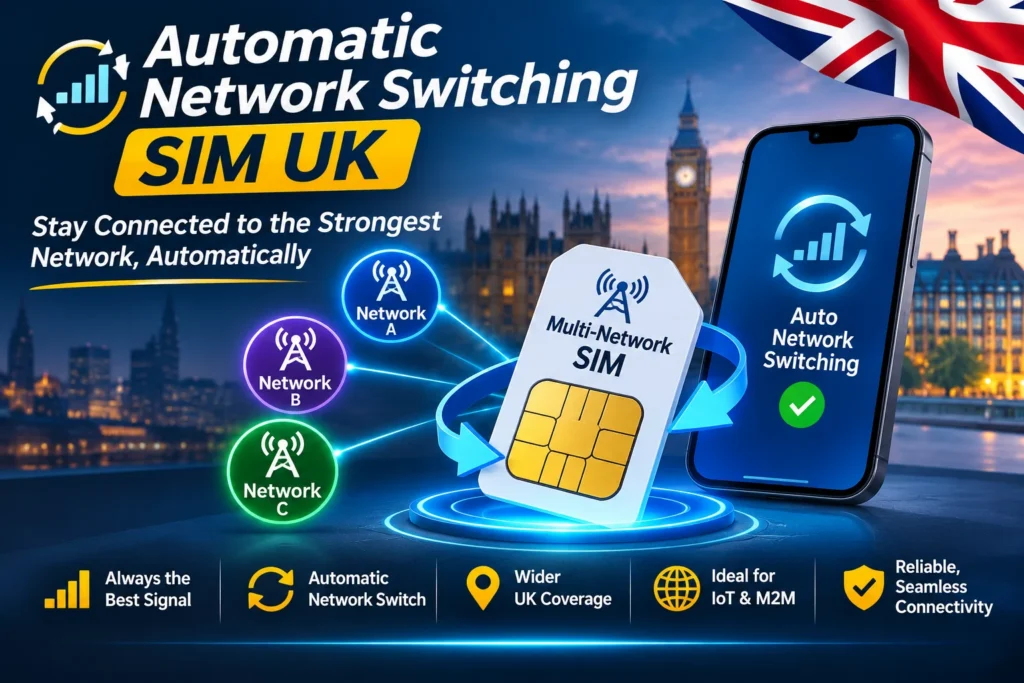
An Automatic Network Switching SIM UK solution is designed to give compatible devices access to more than one supported mobile network. Instead of depending on a single network in every location, the SIM or connectivity service may allow the device to use another available network when permitted by the provider and local network agreements.
Understanding how this technology works can help businesses choose a suitable connectivity solution for their Internet of Things (IoT) projects.
What Is Automatic Network Switching?
Automatic network switching is a connectivity feature that allows a SIM-enabled device to connect through different supported mobile networks. The exact behaviour depends on the SIM technology, provider agreements, device configuration and network availability.
A traditional SIM may be associated with a particular mobile operator, while a multi-network service can provide access to multiple networks under defined conditions.
An Automatic Network Switching SIM UK service may be useful for devices that operate in different locations, travel between regions or need connectivity where one network has limited coverage.
However, network switching does not mean that every network is always available. Access depends on the provider’s agreements, signal conditions and supported technologies.
1. How Does Multi-Network Connectivity Work?
A compatible device uses its cellular modem to search for an available network. Depending on the SIM and service configuration, it may be able to register on one of several supported networks.
The SIM provider determines which networks can be accessed and under what conditions. Network selection may be automatic, policy-based or controlled through device and connectivity management settings.
With an Automatic Network Switching SIM UK service, the aim is to give compatible devices more connectivity options when the preferred network cannot provide a suitable connection.
The switching process is not always instant. A device may need time to search for another network, register and restore its data connection.
2. Why Businesses Use Multi-Network SIMs
Businesses often deploy connected devices across different areas. A fleet of vehicles, for example, may travel through towns, motorways and rural locations where mobile coverage varies.
Using multiple supported networks can provide additional connectivity options compared with relying on one operator alone.
Potential applications include:
- Vehicle tracking systems
- Fleet management equipment
- Remote monitoring devices
- Industrial sensors
- Smart utility equipment
- Connected vending machines
- Security and alarm systems
An Automatic Network Switching SIM UK solution may help businesses manage devices that operate across changing coverage areas. The actual benefit depends on the networks supported and the locations where devices are used.
3. Benefits for IoT Devices
IoT devices often need to operate with limited human intervention. Some are installed in vehicles or remote locations, where manually changing a SIM or network is inconvenient.
Multi-network connectivity can offer several advantages.
More network options: Devices may be able to connect through different supported operators.
Flexible deployment: Businesses can use compatible devices across a wider range of locations.
Centralised management: Some providers offer online platforms for monitoring SIM status, usage and connectivity.
Reduced dependence on one operator: Access to additional networks may help when one network is unavailable in a particular area.
These benefits make Automatic Network Switching SIM UK technology worth considering for projects where connectivity is important across multiple locations.
4. Understand Network Coverage and Limitations
Multi-network access does not guarantee a signal everywhere. Coverage depends on the operators involved, local infrastructure, building materials, device antenna performance and environmental conditions.
Some locations may have weak coverage across all supported networks. Other areas may have strong signal from one operator but limited access to another because of the provider’s commercial agreements.
Before purchasing an Automatic Network Switching SIM UK, ask which UK networks are supported and whether the service allows access to 4G, 5G or other relevant technologies.
Also check whether the device itself supports the required frequency bands. A SIM cannot make an incompatible modem connect to a network technology it does not support.
5. Compare Data Plans and Costs
IoT devices can have very different data requirements. A basic tracker may send small amounts of information, while a camera or monitoring system may use considerably more data.
When comparing plans, check:
- Monthly or annual data allowance
- Pay-as-you-go or fixed subscription options
- UK network access
- International roaming availability
- Data overage charges
- SIM management fees
- Contract length and cancellation terms
Some providers offer pooled data plans for multiple devices, while others charge each SIM separately.
A suitable Automatic Network Switching SIM UK plan should match the expected data usage and deployment size. Estimate how much data each device will consume before choosing a package.
6. Check Device and SIM Compatibility
Not every IoT device supports every SIM format or network technology. Devices may use standard SIM cards, micro SIMs, nano SIMs or embedded SIM technology.
Check the modem specifications, supported frequency bands, SIM format and any provider restrictions before ordering.
For larger deployments, test the SIM in the actual device before installing it across the entire fleet. This can help identify configuration problems and coverage limitations early.
7. Use SIM Management Tools
Some IoT connectivity providers offer dashboards for managing SIM cards and monitoring usage. Depending on the platform, businesses may be able to view connection status, data consumption, activation details and other information.
Centralised management can be useful when operating many connected devices. It may also help identify inactive SIMs or unexpected usage patterns.
Before choosing an Automatic Network Switching SIM UK provider, ask to see the management platform and check which features are included in the service.
How to Choose the Right Multi-Network SIM Provider
Compare providers based on network access, pricing, technical support and management tools. Ask for a clear explanation of how network selection works and whether switching is controlled by the SIM, device or provider platform.
You should also confirm what happens when a device loses connection, whether it automatically attempts to reconnect and how connection problems can be investigated.
For business deployments, consider a small-scale trial before committing to a large order. Testing in real operating locations can provide a more accurate picture of performance than relying only on coverage maps.
Frequently Asked Questions
1. What is an automatic network switching SIM?
It is a SIM or connectivity service that can allow a compatible device to access more than one supported mobile network, subject to provider agreements and network availability.
2. Does a multi-network SIM connect to every UK network?
No. The available networks depend on the SIM provider’s agreements and service configuration. Ask for the current supported network list.
3. Does network switching happen automatically?
It may happen automatically on compatible services, but the selection process depends on the SIM, device and provider configuration.
4. Can I use a multi-network SIM in a GPS tracker?
Many cellular GPS trackers can use multi-network SIM services, provided the SIM format, modem and network technologies are compatible.
5. Does a multi-network SIM guarantee better coverage?
No. It can provide additional network options, but it cannot guarantee connectivity in areas where all supported networks have poor or no signal.
6. Can multi-network SIMs support 4G and 5G?
Some services support 4G, 5G or both, depending on the provider, network agreements and device compatibility. Confirm the supported technologies before ordering.
7. Are there monthly charges for IoT SIM cards?
Costs vary. Some providers offer monthly subscriptions, pooled data packages or usage-based plans. Check all recurring charges and contract conditions.
8. How do I choose an Automatic Network Switching SIM UK provider?
Compare supported networks, coverage, data pricing, device compatibility, management tools and technical support. Test the service in your intended operating locations before large-scale deployment.
Conclusion
Multi-network SIM technology can give compatible IoT devices access to additional mobile connectivity options. This can be useful for vehicle tracking, fleet management and remote monitoring applications where devices operate across different locations.
Before choosing an Automatic Network Switching SIM UK service, check the supported networks, device compatibility, data plan and management features. A practical trial can help confirm whether the service meets your coverage and connectivity requirements.