
Last November, a family in the Cotswolds woke at 3 AM to the sound of their side door clicking open, a chilling reminder that modern thieves now use silent relay technology to bypass standard locks. You’ve probably felt that same spike of anxiety when parking up for the night or noticed your insurance premium jump by £150 this year. It’s a harsh reality, but protecting your investment shouldn’t be a source of constant stress. Installing the right motorhome alarms is the most effective way to safeguard your vehicle and your family while you sleep.
Alongside electronic security, clever storage solutions can also protect your belongings by keeping them out of sight while maximising living space. For example, innovative systems from specialists like LoftRobe utilise motorised ceiling storage, a popular high-tech upgrade for modern motorhomes.
We agree that the technical jargon around Thatcham categories and S5 tracking is often more confusing than it needs to be. This guide simplifies your security choices. We promise to help you select a system that guarantees insurance compliance and absolute peace of mind. You’ll discover how advanced immobilisation prevents the engine from starting even if your keys are cloned. We’ll also explain how our mobile technicians provide expert installation at your home, ensuring your home on wheels remains exactly where it belongs throughout 2026.
Key Takeaways
- Identify why factory-fitted systems fail against modern relay theft and how Thatcham-approved upgrades close these critical security gaps.
- Learn to build a layered defence by integrating motorhome alarms with S5 tracking and immobilisation to deter and recover your vehicle.
- Explore “Night Mode” settings that secure your habitation area and belongings, allowing you to sleep soundly while your perimeter remains armed.
- Discover how professional mobile installation protects your manufacturer’s warranty and helps lower your annual insurance premiums across the UK.
- Understand the transition to newer S5 and S7 standards to ensure your recovery systems meet the latest industry requirements for 2026.
Understanding the Vulnerabilities: Why Standard Motorhome Alarms Often Fall Short
Your motorhome is a high-value target. It’s often worth upwards of £75,000, and it carries your personal belongings along with your holiday memories. Relying on a factory-fitted car alarm is a mistake. These systems are designed for mass-market vehicles, not the unique structure of a leisure vehicle. Understanding Vehicle Alarm Systems is the first step toward securing your investment. A standard car alarm monitors the doors and maybe an interior sensor, but it doesn’t account for habitation doors, skylights, or the large expanses of acrylic glass found on modern coachbuilt models.
Professional thieves use CAN-bus injection to steal vehicles without making a sound. They access the wiring through an external point, such as a headlight or a wheel arch. They send a digital command to the Engine Control Unit to unlock the doors and disable the immobiliser. It’s silent. It’s fast. Standard factory systems are often bypassed in under 90 seconds because they share the same vulnerabilities as the base van, such as the Fiat Ducato or Ford Transit. Without a dedicated security layer, your vehicle is essentially an open book to a tech-savvy criminal.
Motorhomes face specific risks during the winter months. Data shows that 65% of owners store their vehicles for at least four months of the year. During this time, they’re often left in remote storage yards or on driveways with limited supervision. This gives thieves ample time to work. A standard alarm might sound, but if no one is around to hear it, the siren is useless. You need a system that alerts you directly via a mobile app and connects to a 24/7 monitoring centre. This proactive approach is the only way to safeguard an asset that stays stationary for long periods.
The Rise of Keyless Theft in the Leisure Sector
Thieves now use signal boosters to bridge the gap between your key fob and the vehicle. If your keys are on the kitchen counter, a thief standing outside can trick the motorhome into thinking you’re right there. This allows them to drive away without any physical break-in. Dedicated motorhome alarms operate independently of the factory key. They require a secondary driver recognition tag. Without this tag, the vehicle won’t start, even if the thief has successfully boosted your key signal. This secondary layer of authentication is the difference between a secure vehicle and an empty driveway.
Insurance Requirements and the Thatcham Standard
Thatcham Research has set the UK benchmark for vehicle security since 1992. They rigorously test security products to ensure they resist determined attacks. Most UK insurers now mandate a Thatcham Category 1 or Category S5 system for any motorhome valued over £50,000. If you don’t meet these requirements, you risk a total loss. A non-approved alarm could void your theft claim entirely. This leaves you with a massive financial deficit and no vehicle. Using Thatcham-certified motorhome alarms ensures your policy remains valid and your asset is protected by industry-leading technology.
- Emotional Impact: Theft feels like a violation of your private home.
- Financial Loss: Insurance payouts rarely cover the cost of personal contents and modifications.
- Recovery Rates: Vehicles without advanced tracking have a recovery rate of less than 10% in the UK.
Don’t wait for a security breach to realize your factory system is inadequate. The cost of a professional upgrade is a small price to pay for absolute peace of mind. Secure your vehicle today and ensure your next journey isn’t cut short by a preventable crime.
Deciphering Thatcham Categories: Which Motorhome Alarm System Do You Actually Need?
Choosing the right motorhome alarms involves understanding a specific hierarchy of protection. Thatcham Research remains the definitive authority on vehicle security in the UK. Their rating system tells your insurer exactly how difficult your vehicle is to steal or break into. The Thatcham Security Certification standards ensure that every approved device undergoes rigorous testing to resist determined attacks. If a system doesn’t carry this certification, most specialist insurers won’t recognise it, leaving your investment vulnerable and your policy potentially void.
Security requirements have evolved significantly. While older systems focused solely on loud noises, modern standards integrate tracking and immobilisation. You must match the category to your vehicle’s value and your insurer’s specific mandates. Most providers now demand a minimum of Category 1 or Category S5 for vehicles valued over £40,000. Ignoring these details can lead to rejected claims after a theft occurrs.
Thatcham Category 1: The Gold Standard for Perimeter Security
A Category 1 system is the most comprehensive electronic security solution available. It combines a sophisticated alarm with an advanced immobiliser. These systems provide full perimeter detection, which means every door, boot, and bonnet is monitored. If a thief tries to force a seal, the alarm triggers instantly. High-quality motorhome alarms also include internal ultrasonic or microwave sensors to detect movement within the living area or cab. This is vital for protecting high-value contents like laptops or lithium battery systems.
- Ignition Detection: The system triggers if the ignition is hot-wired or tampered with.
- Battery-Backed Siren: A dedicated power source ensures the 120dB siren continues to sound even if the thief cuts the main vehicle battery cables.
- Passive Arming: The immobiliser sets itself automatically, ensuring the vehicle can’t be driven away even if you forget to lock it.
The primary benefit is absolute peace of mind. Installing a Cat 1 system can reduce annual insurance premiums by up to 15% in 2026. It serves as the ultimate deterrent, signaling to criminals that your motorhome is a hard target.
Upgrading Older Motorhomes with Category 2-to-1 Systems
Many motorhomes built between 2005 and 2015 arrived with a factory-fitted Category 2 immobiliser but no internal alarm. You don’t need to strip out the existing system to meet modern insurance standards. A Category 2-to-1 upgrade adds the necessary alarm components, sensors, and sirens to your existing immobiliser. This is a highly cost-effective route for owners of older campervan conversions or coachbuilts.
Upgrading is often a mandatory requirement for older vehicles when you switch insurance providers. These “add-on” systems provide the same level of protection as a full Cat 1 installation but at a lower hardware cost. It’s a practical solution that ensures your older vehicle meets 2026 security expectations without a total rewiring job.
Beyond traditional alarms, the industry has transitioned toward S5 and S7 tracking standards. S7 offers basic GPS recovery, while S5 includes driver identification tags to combat key cloning. If your motorhome is stolen without the tag present, a signal is sent to a 24/7 monitoring centre immediately. Always check your policy wording for the phrase “Thatcham Category Required” before purchasing. Professional certification is essential; your insurer will require a genuine certificate of installation from a qualified technician to validate your coverage. If you’re unsure which level fits your van, you can request a security audit to find the right match for your policy.
The Security Layer Strategy: Combining Alarms, Trackers, and Immobilisers
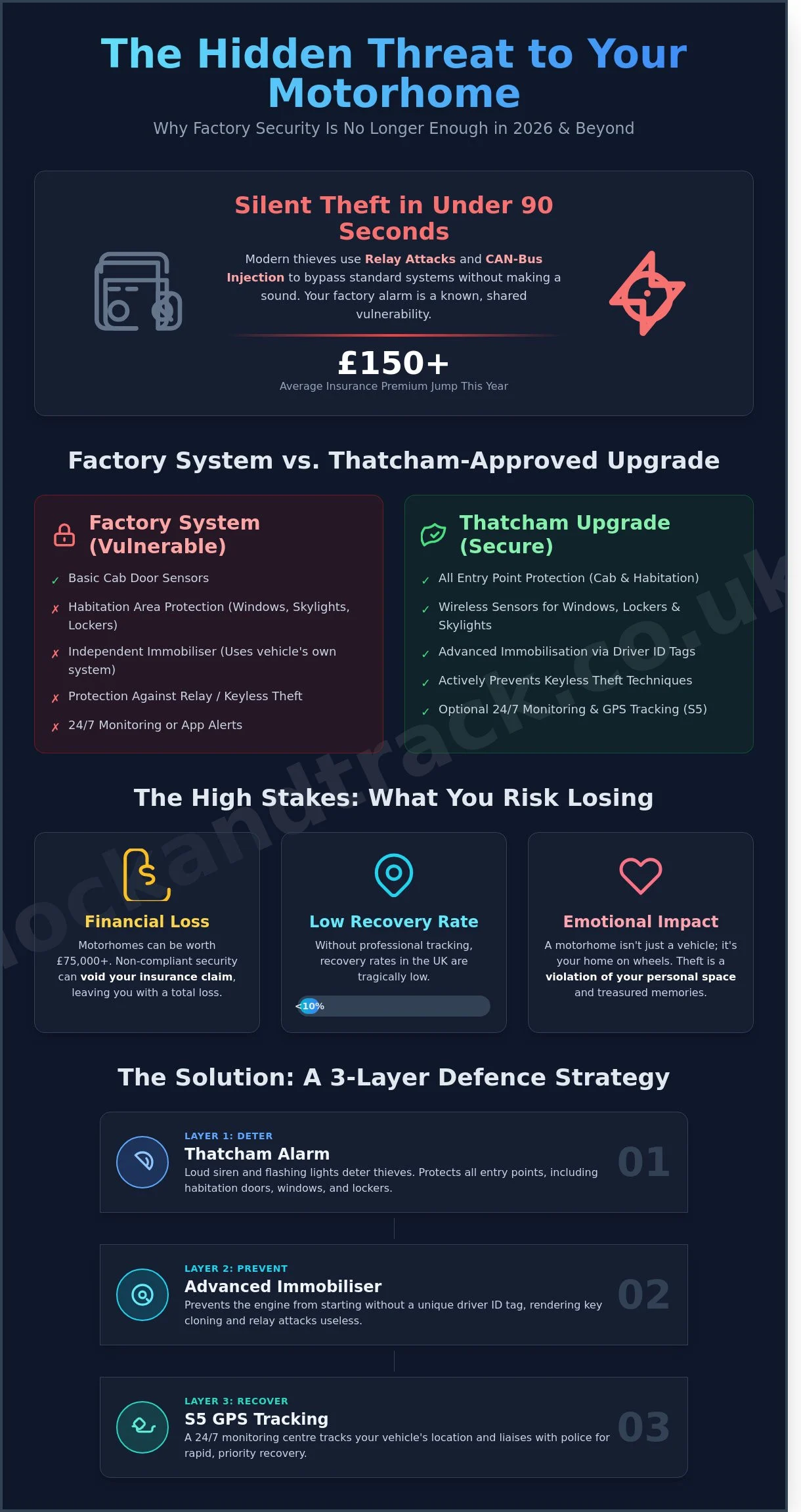
Effective security isn’t about a single device. It’s about creating a multi-layered defence system that makes your vehicle too much trouble for a thief to handle. Professional criminals look for the path of least resistance. When they see a vehicle protected by integrated layers, they usually move on to an easier target. You should view your security setup as a three-pronged strategy: deterrent, prevention, and recovery. While standard motorhome+alarms act as the primary deterrent by drawing unwanted attention, they shouldn’t stand alone.
High-value motorhomes like a £75,000 Auto-Sleeper or a £65,000 VW California are prime targets for organised gangs. These thieves often use signal boosters or key-cloning equipment to bypass factory security in under 60 seconds. Relying solely on a siren is a gamble you can’t afford to take. By combining motorhome+alarms with a physical immobiliser and a dedicated GPS tracker, you create a “fail-safe” environment. If the alarm is silenced, the immobiliser stops the engine from starting. If the vehicle is towed away, the tracker ensures you can find it.
- Alarms (Deterrent): These provide the initial shock factor. They alert you and bystanders to a breach.
- Immobilisers (Prevention): These stop the vehicle from being driven away, even if the thief has your keys.
- Trackers (Recovery): These act as the final safety net, providing real-time location data to recovery teams.
The Role of the Ghost 2 Immobiliser
The Ghost 2 Immobiliser is the ultimate secondary layer for modern motorhomes. It doesn’t use traditional key fobs or radio signals, which means there’s no signal for a thief to “grab” or clone with a relay device. Instead, it connects directly to your vehicle’s CAN-bus system. You start the engine only after entering a unique PIN code using the existing buttons on your dashboard or steering wheel. It’s completely silent. A thief won’t even know it’s installed until the engine refuses to start, leaving them stranded and exposed.
Integrating S5 and S7 Trackers for 24/7 Monitoring
If a thief manages to lift your motorhome onto a low-loader, an immobiliser won’t stop them. This is where Scorpion S5 or S7 trackers become essential. These systems provide 24/7 monitoring through dedicated centres that coordinate directly with the police. The S5 variant offers the highest level of protection, including Driver ID tags that alert the centre if the vehicle moves without the authorised driver present. This is particularly vital for preventing theft-with-key scenarios.
Choosing the right combination of hardware is critical for your peace of mind. Lock and Track specialises in these combined installations, ensuring that your alarm, Ghost immobiliser, and Scorpion tracker work in perfect harmony. In 2023, TASSA-verified installations like the Ghost 2 became the industry standard for securing high-end leisure vehicles. Don’t leave your investment to chance. A layered approach doesn’t just protect your motorhome; it ensures that even the most determined criminal fails at the first hurdle.
Securing the Habitation Area: Protecting Your Belongings and Your Peace of Mind
Your motorhome is a mobile sanctuary, but the living space presents unique vulnerabilities that a standard van might not face. While the cab is the gateway for driving, the habitation area holds your electronics, documents, and personal memories. Sophisticated motorhome+alarms must protect this interior space without making it feel like a cage. Effective security starts with a layered approach that secures every entry point, from the main door to the smallest skylight.
This focus on securing entry points is just as critical for your permanent home. For readers thinking about overall security, resources like andigitallock.com offer insights into foundational elements like door hardware.
One of the most vital features of a Thatcham approved system is “Night Mode” or “Stay Mode.” This setting allows you to arm the external perimeter while disabling the internal motion sensors. You can move freely inside, use the bathroom, or make a cup of tea, knowing that any attempt to open a door or window from the outside will trigger a full alarm response. It provides a critical safety net for solo travellers and families. Recent 2023 crime statistics suggest that 45% of motorhome thefts occur while owners are nearby or inside the vehicle, making this feature indispensable for personal safety.
Thieves often target external lockers first. These compartments frequently house expensive gas bottles, tools, or camping equipment. Standard factory locks on these hatches are notoriously weak and can often be bypassed with a simple screwdriver. Integrating magnetic switches on every locker door ensures your storage is as secure as your main cabin. For those carrying high-value leisure gear, such as e-bikes which now average £2,500 in the UK, additional cable loops or wireless sensors can be linked to the main alarm circuit. This ensures that if a thief tries to snip a lock on your bike rack, the siren sounds immediately.
PIR Sensors and Magnetic Contacts
PIR (Passive Infrared) sensors monitor for heat and movement within the cab and living area. They are highly effective at detecting an intruder who has bypassed a lock. If you travel with pets, you should specify pet-friendly PIRs. These sensors are calibrated to ignore movement below a certain height or weight, typically up to 25kg. This prevents false alarms caused by a restless dog during the night. Magnetic reed switches on windows provide the first line of defence; they trigger the motorhome+alarms the moment the contact is broken.
Visual Deterrents and Physical Locks
Prevention is always better than recovery. Visible deterrents like flashing LEDs and Thatcham branded window stickers signal to thieves that your vehicle is a “hard target.” These electronic measures work best when paired with physical hurdles. A heavy-duty steering wheel lock or a pedal box adds a visible layer of complexity. When a thief sees a physical lock, they know they face a time-consuming challenge. This visual hurdle, combined with the knowledge of an active electronic system, usually forces them to move on to an easier, unprotected mark.
Don’t leave your security to chance. Protect your investment and your family today. Explore our range of Thatcham approved motorhome alarms to find the perfect security fit for your vehicle.
Professional Installation: Why Nationwide Mobile Fitting is Essential for Motorhome Security
Fitting a security system yourself might seem like a cost-saving exercise. It isn’t. Modern motorhomes rely on complex CAN-bus wiring systems that are easily disrupted. A single misplaced wire can trigger permanent electrical faults or void your vehicle’s manufacturer warranty immediately. Beyond the technical risks, there’s the insurance hurdle. Most UK insurers, including specialists like Comfort or Safeguard, strictly require a certificate of professional installation for motorhome alarms. If you cannot prove a Thatcham-recognised engineer fitted the device, your policy is effectively worthless in the event of a theft.
Lock and Track eliminates these risks through a dedicated nationwide mobile installation service. We understand that moving a 7-metre motorhome to a city centre workshop is a logistical nightmare. Our engineers come to you instead. Whether your vehicle is parked on your driveway or tucked away in a remote storage centre, we bring the expertise to your doorstep. This saves you time, fuel, and the stress of navigating tight streets in a large leisure vehicle. Our mobile units are fully equipped to handle every aspect of the installation on-site, ensuring your motorhome alarms are integrated seamlessly with the vehicle’s existing electronics.
The job doesn’t end when the last wire is connected. Every Lock and Track installation includes a comprehensive handover process. Our engineers don’t just hand over a key fob and leave. We walk you through the entire system. You’ll learn how to arm and disarm the unit, how to use the mobile app for real-time alerts, and how to test the sensors. We ensure you’re confident in operating your new security measures before we depart. This education phase is vital. It transforms a complex piece of hardware into a simple, daily habit that keeps your asset safe.
The Lock and Track Expert Approach
We only employ Thatcham-approved engineers for our installations. This isn’t just about compliance; it’s about precision. Every engineer follows the 2024 Thatcham Research standards to ensure maximum reliability. We cover the entire UK, from the south coast to the Scottish Highlands. Our primary product isn’t just a box of electronics; it’s the peace of mind that comes from knowing your security was handled by a specialist. We’ve seen every tactic used by modern thieves and we’ve engineered our installation process to counter them effectively.
Final Checklist Before You Book
- Review your insurance schedule to see if they require a Thatcham Category 1 or Category 2 system.
- Identify the most vulnerable entry points on your specific model, such as large rear garage doors or habitation windows.
- Verify that your storage site allows third-party engineers to perform work on the premises.
- Call the Lock and Track team for a bespoke security recommendation tailored to your travel habits.
Taking proactive steps now prevents the heartbreak of a stolen vehicle later. Don’t leave your security to chance or an amateur DIY job. Trust the professionals who specialise in UK motorhome protection. Secure your motorhome today with a professional Thatcham alarm installation.
Secure Your Adventure for 2026 and Beyond
Your motorhome is a significant investment, often worth over £70,000. Relying on basic factory security is a gamble you don’t need to take. To truly protect your asset, you must move beyond standard motorhome+alarms and adopt a layered defence strategy. This involves combining Thatcham-approved hardware with active monitoring to ensure your vehicle remains exactly where you left it.
Lock and Track provides the ultimate safeguard through our specialist knowledge of Ghost 2 Immobilisers and Scorpion Trackers. Our Thatcham-approved engineers understand the specific vulnerabilities of modern motorhomes. We eliminate the stress of security by offering nationwide mobile installation at your home or workplace, ensuring your system is fitted to the highest professional standards. Whether you’re parked on the drive or exploring the coast, you’ll have the absolute confidence that your home on wheels is under the watch of a reliable guardian. Don’t wait for a theft attempt to upgrade your protection.
Book your nationwide motorhome alarm installation with Lock and Track today and enjoy the peace of mind you deserve for your next journey.
Frequently Asked Questions
Does a motorhome alarm reduce my insurance premium?
Yes, installing a Thatcham approved motorhome alarm typically reduces your annual insurance premium by 10% to 20%. UK insurers such as Caravan Guard or Comfort Insurance often mandate these systems for vehicles valued over £40,000. By choosing a certified device, you demonstrate a lower risk profile to your provider. This leads to immediate savings that help offset the initial installation cost while securing your investment.
What is the difference between a Thatcham Category 1 and Category 2 alarm?
A Thatcham Category 1 system is a combined alarm and immobiliser, whereas Category 2 refers to an immobiliser only. Category 1 systems must include perimeter detection, ignition detection, and a battery-backed siren to meet 2024 security standards. Category 2 systems focus solely on preventing the engine from starting. Most owners choose Category 1 motorhome alarms to meet the strict criteria of modern insurance policies.
Can I install a motorhome alarm myself to save money?
You cannot install a Thatcham approved alarm yourself if you want to maintain its certification. Thatcham Quality Assurance requires installation by a recognised technician to issue a valid certificate of compliance. DIY attempts void your insurance status and may lead to a 100% claim rejection in the event of a theft. Professional fitting ensures the complex wiring of your vehicle remains intact and fully functional.
Will an aftermarket alarm void my motorhome manufacturer warranty?
A professionally installed aftermarket alarm won’t void your motorhome manufacturer warranty. Under the Block Exemption Regulation, manufacturers can’t invalidate a warranty simply because an owner fitted a non-original part. Our technicians follow strict protocols to ensure the vehicle’s CAN-bus system remains protected. This preserves your 3-year or 5-year mechanical warranty while significantly upgrading your security levels.
How does a Ghost Immobiliser work with a motorhome alarm?
A Ghost Immobiliser acts as a secondary, silent layer of defence alongside your primary motorhome alarm. While the alarm provides an audible deterrent, the Ghost prevents the engine from starting without a unique PIN code entered via the dashboard buttons. This combination stops 99% of relay theft attempts. It secures the vehicle even if a thief manages to clone your keys or bypass the main siren.
What happens if my motorhome alarm goes off while I am sleeping inside?
Your alarm won’t go off while you sleep if you engage the “Night Mode” or “Stay” setting. This feature deactivates internal PIR motion sensors while keeping external door and window contacts active. It allows you to move freely inside the cabin while maintaining a secure perimeter against intruders. This provides total peace of mind during overnight stays at remote campsites or motorway service areas.
Do I need a subscription for my motorhome alarm and tracker?
You need an annual subscription for motorhome alarms that include Thatcham Category S5 or S7 tracking features. These fees, usually starting around £150 per year, cover the 24/7 monitoring centre costs and secure data links. If your system is a standalone Category 1 alarm without GPS, no ongoing subscription is required. Always check your policy, as 75% of high-value motorhome insurers now require active tracking.
How long does a professional motorhome alarm installation take?
A professional motorhome alarm installation typically takes between 2 and 4 hours to complete. Complex setups involving S5 tracking and multiple internal sensors might require up to 5 hours of labour for a thorough configuration. Our mobile engineers carry out the work at your home or storage site, ensuring zero downtime for your vehicle. This efficient service gets you back on the road with ultimate protection in a single afternoon.