
Did you know the average UK driver wastes over £250 every year simply by failing to monitor tyre pressure and acceleration patterns? Understanding exactly what will reduce fuel consumption is no longer optional when prices at British forecourts fluctuate by 5p per litre in a single week. You likely feel the pinch every time you tap your card at the pump. It’s frustrating to watch your hard-earned profit or monthly budget disappear into a fuel tank. We know that high overheads are a constant threat to your peace of mind of what will reduce fuel consumption.
This guide provides the technical expertise and direct tips you need to regain control of your costs. You’ll learn how to lower your monthly spend by 15% using smart vehicle telematics and Thatcham approved tracking insights. We also cover the specific knowledge required to pass the DVSA theory test section on fuel efficiency with confidence. From real-time driver feedback to 2026 maintenance standards, we’re providing the roadmap to a more efficient, secure journey of what will reduce fuel consumption.
Key Takeaways
- Maintain a constant speed in the highest appropriate gear to instantly improve your MPG. Anticipating the road ahead prevents the costly cycle of heavy braking and acceleration that drains your tank.
- Discover what will reduce fuel consumption through simple maintenance like correcting tyre pressures and removing drag-inducing roof racks. Small adjustments to your vehicle’s aerodynamics lead to significant savings at the pump.
- Master the 30mph threshold to decide between using air conditioning or opening your windows. Balancing engine load against aerodynamic drag is essential for maintaining efficiency on UK motorways.
- Use professional telematics and idling reports to identify and eliminate the hidden costs of stationary engines. Detailed data provides the technical edge needed to safeguard your fuel budget and optimise performance.
- Future-proof your driving strategy for 2026 by mastering range efficiency for the transition to electric vehicles. Learn how smart infrastructure is being deployed across the UK to help drivers save.
What Will Reduce Fuel Consumption? The Core Principles
Understanding what will reduce fuel consumption starts with a basic grasp of vehicle physics. At its simplest, fuel economy is improved by maintaining a constant speed in the highest gear appropriate for the road. Every time a driver fluctuates their speed, the engine must work harder to overcome inertia. High engine RPM creates internal friction that wastes energy. By keeping the engine at lower revolutions while maintaining momentum, you minimise the load on the cylinders. This directly translates to lower litres-per-hundred-miles figures across your entire fleet of what will reduce fuel consumption.
Anticipation is the most effective tool in a driver’s arsenal. Looking 12 seconds ahead allows a driver to react to traffic flow before it necessitates heavy braking. The DVSA teaches learner drivers that “easing off” the accelerator is the primary response to hazards. This technique ensures the vehicle maintains its kinetic energy for as long as possible. When a driver brakes hard, they effectively turn expensive fuel into wasted heat. Adopting energy-efficient driving techniques can reduce annual fuel spend by 15% for the average UK haulage business. This proactive approach mirrors the vigilance required in vehicle security; it is about preventing a loss before it occurs for what will reduce fuel consumption.
The “Golden Rules” of Eco-Driving
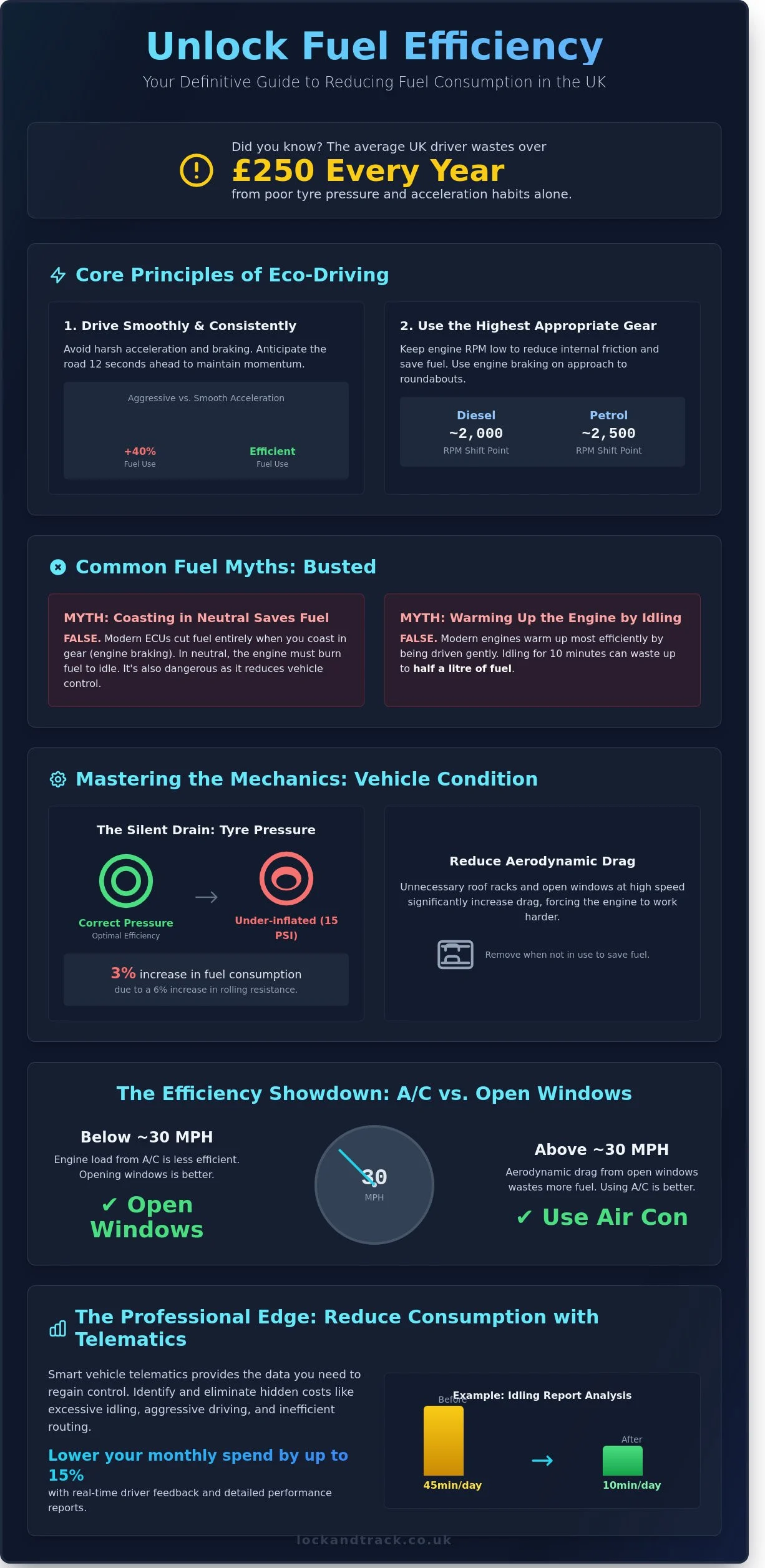
Smooth acceleration is essential for efficiency. The first five seconds of movement are the most expensive in terms of fuel. Aggressive starts can increase fuel consumption by 40% compared to a gradual build-up of speed. Drivers should aim to reach the highest gear as quickly as possible without straining the engine. For most diesel vans, shifting up at 2,000 RPM is the “sweet spot” for the torque curve. Petrol vehicles should usually shift at 2,500 RPM. When approaching UK roundabouts, use engine braking. Lift off the throttle early and stay in gear. This allows the fuel injection system to shut off the supply entirely while the wheels keep the engine turning.
Common Misconceptions About Fuel Economy
Coasting in neutral is a persistent and dangerous myth. It provides zero fuel savings and compromises vehicle control. Modern Electronic Control Units (ECUs) are programmed to cut fuel delivery completely when the vehicle is in gear but the throttle is closed. If you shift to neutral, the engine must burn fuel to maintain an idle speed of roughly 700 to 900 RPM. This wastes fuel and disconnects the driver from the drivetrain.
Warming up the engine on cold mornings is another common error. Idling for 10 minutes can waste up to half a litre of fuel. Modern synthetic oils circulate through the block within 30 seconds of ignition. The most efficient way to warm an engine is to drive it gently immediately after starting. Similarly, premium fuels often promise better mileage. While they contain cleaning additives that safeguard engine longevity, they rarely offer a significant increase in miles per gallon for standard commercial vehicles compared to standard BS EN 228 petrol or diesel. Focusing on what will reduce fuel consumption through driver behaviour yields a much higher return on investment than switching to expensive high-octane fuels.
Mastering the Mechanics: How Vehicle Condition Impacts MPG
Maintaining a fleet is not just a matter of safety; it is a direct investment in your bottom line. Mechanical efficiency provides the foundation for any strategy when considering what will reduce fuel consumption across your operations. Small oversights in vehicle health lead to significant financial leakage that compounds over thousands of miles. A proactive maintenance schedule ensures that every drop of diesel or petrol translates into movement rather than heat or friction.
Tyre Maintenance and Rolling Resistance
Under-inflated tyres are a silent drain on your profits. When a tyre lacks the correct pressure, its footprint on the road increases, which creates higher rolling resistance. According to industry data from Michelin, a tyre under-inflated by just 15 psi (1 bar) increases rolling resistance by 6%. This results in a 3% increase in fuel consumption. Drivers must check pressures every 14 days to maintain peak efficiency. This is especially vital for heavy goods vehicles where the weight distribution is constantly shifting.
Wheel alignment is another critical factor. Misaligned wheels cause tyres to “scrub” against the road surface. This creates unnecessary drag that can waste up to 2.5% of your fuel. When replacing rubber, look for the UK tyre labelling system. Choosing a tyre with an “A” rating for rolling resistance instead of an “E” rating can save a fleet operator approximately £110 in fuel costs over the lifespan of the tyre. By using fleet tracking systems to monitor mileage, managers can schedule these vital alignment checks before the damage to the fuel card becomes permanent.
The Impact of External Drag
Aerodynamics play a massive role in how much energy a vehicle requires to maintain speed. Drag increases exponentially as you go faster. Driving at 70mph on a UK motorway uses 15% more fuel than driving at 60mph. This is purely due to the air resistance the engine must overcome. If your vehicles are fitted with roof bars, racks, or empty cycle carriers, you are paying a heavy price for convenience. An empty roof rack alone adds 10% to your fuel bill due to disrupted airflow, while a bulky roof box can increase consumption by 20%.
The debate between windows and air conditioning has a definitive answer for the UK climate. At speeds below 45mph, opening a window is the more efficient way to cool the cabin. Once you exceed 45mph, the aerodynamic drag caused by an open window outweighs the energy required to run the air conditioning compressor. Keeping the exterior of the vehicle “clean” of unnecessary attachments is one of the simplest answers to what will reduce fuel consumption without spending a penny on new technology.
Engine health and weight management round out the mechanical essentials. A clogged air filter forces the engine to work harder to breathe, which can reduce MPG by up to 10% in older diesel units. Similarly, using the wrong grade of engine oil increases internal friction. Switching to high-quality, manufacturer-recommended synthetic oils can improve efficiency by 2%. Finally, audit your vehicles for “forgotten clutter.” Carrying 50kg of unnecessary equipment in the boot or load area increases fuel use by 2% in urban, stop-start traffic. Clear the decks, service the engines, and watch your fleet’s efficiency climb.
Air Conditioning vs. Open Windows: The Efficiency Showdown
Managing fleet costs requires a firm grasp of vehicle physics and environmental factors. Fleet managers often ask what will reduce fuel consumption more effectively during the warmer months: lowering the windows or activating the air conditioning. This isn’t merely a matter of driver preference; it is a technical calculation based on speed and aerodynamic drag. Understanding the 30mph threshold is vital for maintaining your bottom line and ensuring your drivers operate at peak efficiency.
The battle between engine load and aerodynamic drag determines your fuel spend. Air conditioning units rely on a compressor powered by the engine. This adds a mechanical burden that can sap up to 10% of a vehicle’s power, according to data from the Society of Automotive Engineers (SAE). Conversely, opening windows disrupts the vehicle’s streamlined profile. This creates air turbulence that forces the engine to work harder to maintain speed. Choosing the wrong cooling method can increase your weekly fuel bill by £15 to £20 per vehicle during a heatwave.
Driving in the City (Under 30mph)
In urban settings, wind resistance is a minor factor. Vehicles moving through London or Birmingham at low speeds don’t face significant air pressure. Research from the 2022 Emissions Analytics report suggests that at speeds below 30mph, rolling down the windows is the superior choice for fuel economy. The drag created by an open window at these speeds is negligible compared to the heavy energy draw of an AC compressor.
At low speeds, the AC pump remains a constant drain on the engine regardless of how fast the wheels are turning. For stop-start city traffic, encourage your drivers to use the “vent” mode. This circulates external air through the cabin using the electric fan without engaging the power-hungry compressor. It provides a steady breeze while protecting your MPG figures. If the heat becomes unbearable, suggest opening opposite windows slightly to create a cross-breeze, which clears hot air faster than a single open window.
Motorway Driving (Over 50mph)
Motorway driving changes the physics of cooling entirely. Once a van or car exceeds 50mph, aerodynamic drag becomes the primary obstacle to fuel efficiency. Modern fleet vehicles are designed with a specific “slipstream” profile to slice through the air. Opening a window at 70mph breaks this seal, creating a parachute effect that drastically increases wind resistance. A study by the Oak Ridge National Laboratory found that driving at motorway speeds with windows down can reduce fuel efficiency by as much as 20%.
Aerodynamic integrity is essential for long-distance hauls. At high speeds, the engine is already operating at a higher RPM, making the relative load of the AC compressor much smaller than the cost of wind drag. Switching to air conditioning at these speeds is the professional choice for any fleet. It allows the vehicle to remain aerodynamic while maintaining a stable cabin temperature. To find what will reduce fuel consumption on the M1 or M6, drivers should keep windows firmly shut and set the climate control to a steady 21 degrees Celsius.
Climate control best practices can further safeguard your fuel budget. Drivers should follow these specific steps to optimise their systems:
- Purge the heat: Open all windows for 60 seconds when first starting a hot vehicle to let trapped heat escape before turning on the AC.
- Use Recirculation Mode: Once the cabin is cool, hit the recirculation button. This stops the system from pulling in hot air from outside, reducing the compressor’s workload by up to 30%.
- Check the seals: Ensure window and door seals are intact. Even minor leaks can force the AC to work 15% harder to maintain temperature.
- Park in the shade: Reducing the initial cabin temperature by just 5 degrees can save significant energy during the first ten miles of a journey.
Pressing the recirculation button is a hidden trick that many drivers overlook. By cooling air that has already been chilled, the system reaches the desired temperature faster and stays there with less effort. This proactive approach to climate management transforms a complex technical challenge into a simple, functional habit that protects your fleet’s efficiency and your company’s profit margins.
The Professional Edge: Reducing Consumption via Telematics
Telematics software acts as a digital forensic tool for your business. It uncovers the hidden killers that drain your bottom line without a single mile being driven. If you are searching for what will reduce fuel consumption across a diverse fleet, the answer lies in granular data visibility. Fleet managers often find that small, invisible habits lead to thousands of pounds in wasted expenditure each year. By monitoring every turn of the key, you move from guesswork to precision management. This technology provides a vigilant eye over your assets, ensuring every drop of fuel contributes to your business goals.
Identifying and Eliminating Excessive Idling
Idling is the act of burning fuel while moving zero miles. It’s a silent drain on resources that many drivers overlook during rest breaks or loading sequences. Data from the Energy Saving Trust indicates that idling for just 10 seconds wastes more fuel than restarting the engine. Telematics alerts allow managers to set specific thresholds. If a vehicle idles for more than five minutes, an automated report is generated. Implementing these alerts can reduce fuel waste by up to 15% in commercial fleets. Beyond the immediate cost of the fuel, prolonged idling leads to premature engine wear and increased DPF soot loading, which triggers expensive maintenance cycles and unplanned downtime.
Route Planning and Traffic Avoidance
Efficiency is about the shortest path, but it’s also about the smartest path. Real-time GPS data identifies congested zones, allowing drivers to avoid the stop-start traffic that ruins fuel economy. This technology eliminates dead mileage, which is the distance driven without purpose or profit. By integrating fleet tracking solutions, you gain total visibility over every litre consumed. Geofencing also plays a critical role in your security and efficiency. It ensures fuel is only used for business purposes by alerting you if a vehicle leaves a designated zone or is used outside of shift hours. This prevents the common issue of unauthorised use or side jobs that quickly inflate your monthly fuel bill.
Aggressive driving is a primary driver of high fuel costs. Data from the Department for Transport suggests that speeding, harsh acceleration, and heavy braking can lower fuel economy by up to 33% at motorway speeds. For example, a light commercial vehicle travelling at 80mph uses roughly 25% more fuel than one kept to the 70mph limit. Telematics provides a definitive scorecard for every driver. It transforms abstract concerns into actionable data. When drivers know their performance is being monitored, they naturally adopt smoother, more efficient habits. This shift in behaviour provides a practical answer to what will reduce fuel consumption without requiring any expensive vehicle modifications or engine remapping. It is about coaching your team to work with the vehicle, not against it.
This principle of structured accountability applies beyond the driver’s seat; for business leaders looking to implement new habits and achieve strategic goals, it can be valuable to explore Discovery Program options that provide similar support.
A proactive approach to fleet management is the only way to safeguard your margins in a volatile market. You need a partner that understands the technical reality of UK road transport. Our systems are designed to provide absolute confidence and clear results.
Protect your fleet and your profits today. Contact our specialist team to see how our tracking systems provide the ultimate safeguard for your business assets.
Future-Proofing Your Fuel Strategy for 2026
The landscape of UK transport is shifting rapidly. By 2026, the Zero Emission Vehicle (ZEV) mandate requires 38% of new cars and 13% of new vans sold in the UK to be electric. This transition changes the definition of efficiency. While you currently focus on miles per gallon, your future strategy will hinge on miles per kilowatt-hour. Managing range becomes as critical as managing a petrol tank. Understanding what will reduce fuel consumption today builds the data foundation you need for an electric future.
National Highways is currently delivering the £24 billion RIS2 investment programme. By 2026, we’ll see more “connected corridors” where smart infrastructure communicates directly with vehicle telematics. These systems aim to smooth traffic flow and eliminate the stop-start congestion that plagues the M25 and M6. Avoiding a single hour of idling can save a heavy goods vehicle up to two litres of fuel. Real-time data integration ensures your drivers take advantage of these infrastructure improvements as they go live.
Combining Security and Efficiency
A stolen vehicle represents the ultimate fuel loss. You lose the tank’s contents, the physical asset, and the revenue from that day’s work. Using S5 trackers provides the highest level of Thatcham-approved protection. These systems include Automatic Driver Recognition (ADR) to counter relay theft, a method used in 90% of keyless vehicle thefts in the UK. Beyond security, these trackers monitor engine health. Identifying a faulty oxygen sensor or a clogged fuel injector early can prevent a 40% drop in fuel efficiency. Safe drivers are also efficient drivers. Smooth braking and controlled cornering safeguard your cargo and keep your fuel costs low.
- Check tyre pressures; under-inflation by just 6 PSI can increase fuel use by 3%.
- Set telematics alerts for idling longer than three minutes.
- Audit your routes to avoid city centres during peak hours.
- Install Thatcham-approved tracking to monitor vehicle health and prevent theft.
- Review driver speed reports; driving at 70mph uses 15% more fuel than at 60mph.
Summary: Your Path to Lower Bills
Reducing your overheads requires a balance of driving style, proactive maintenance, and modern technology. You can’t manage what you don’t measure. By using fleet tracking, you gain the visibility needed to spot waste and stop it immediately. This data-driven approach is exactly what will reduce fuel consumption across your entire operation. It moves your business from a reactive state to a proactive one, where every litre of fuel is accounted for and every asset is protected. Don’t wait for fuel prices to spike again before taking control of your fleet’s performance.
Protect your vehicle and optimise your fleet with Lock and Track. Our specialist team provides the tools you need to secure your assets and drive down operational costs. Get the peace of mind that comes from professional-grade security and real-time efficiency data.
Drive Your Fleet Towards a More Profitable 2026
Mastering fuel efficiency isn’t about guesswork; it’s about precise data and proactive management. You’ve seen that consistent vehicle maintenance and smarter driving habits are essential for any UK business looking to protect its margins. However, the most effective way to understand what will reduce fuel consumption across your entire operation is through real-time visibility. We provide specialist fleet management for 1 to 10,000 vehicles, delivering the granular insights needed to slash your daily overheads. Our team provides nationwide Thatcham-approved installation to ensure your security and tracking technology is fitted to the highest professional standards. By leveraging real-time telematics and driver behaviour reporting, you can immediately identify idling trends and inefficient routes that drain your annual budget. It’s time to transform your fuel strategy into a genuine competitive advantage before the 2026 regulations shift the landscape again. Optimise your fleet and slash fuel costs with Lock and Track today. We’re ready to help you safeguard your assets and your bottom line with absolute confidence.
Frequently Asked Questions
Will driving in a higher gear always reduce fuel consumption? (What Will Reduce Fuel Consumption)
Driving in the highest possible gear for your speed reduces fuel consumption because the engine runs at lower revolutions per minute. Most modern vehicles are designed to cruise at 1,500 to 2,500 RPM for maximum efficiency. Shifting up early, typically before 2,500 RPM in a petrol car or 2,000 RPM in a diesel, can improve your fuel economy by 15%. Don’t labour the engine in a gear that’s too high, as this causes unnecessary strain.
Does cruise control actually save fuel on UK motorways? (What Will Reduce Fuel Consumption)
Cruise control saves fuel on flat sections of the M1 or M6 by maintaining a steady speed and eliminating erratic throttle changes. It’s a vital tool for fleet drivers looking for what will reduce fuel consumption over long distances. However, it’s less efficient on hilly terrain like the Pennines, where the system often over-accelerates to maintain speed. Using it correctly on level motorways can lead to a 7% reduction in fuel use.
How much fuel does idling actually waste per hour? (What Will Reduce Fuel Consumption)
An idling engine wastes between 1.1 and 2.3 litres of fuel every hour, depending on the engine size and air conditioning use. For a fleet of 10 vans, idling for just 30 minutes a day costs over £1,200 annually based on current UK diesel prices of £1.50 per litre. Turning off the engine during stops longer than 30 seconds is a proactive way to safeguard your bottom line and reduce emissions.
Can a dirty air filter really affect my car’s MPG? (What Will Reduce Fuel Consumption)
A dirty air filter has a negligible impact on the MPG of modern fuel-injected vehicles because the Engine Control Unit adjusts the fuel mix automatically. However, it can reduce acceleration by 6% to 11%. For older, carburetted engines, a clogged filter can decrease fuel economy by up to 14%. Regular maintenance ensures your vehicle remains efficient and keeps your fleet operational without unexpected downtime or costly repairs.
Is it more efficient to drive with the windows down or the air con on? (What Will Reduce Fuel Consumption)
It’s more efficient to open windows at speeds below 45 mph to avoid the 10% fuel penalty caused by air conditioning compressors. Once you reach motorway speeds, the aerodynamic drag from open windows becomes more costly than the AC. At 70 mph, using air conditioning is the better choice, as open windows can reduce fuel efficiency by 20%. Balancing these factors is a simple way to manage what will reduce fuel consumption during summer.
What is the most fuel-efficient speed for a standard car? (What Will Reduce Fuel Consumption)
The most fuel-efficient speed for the average UK car is typically between 45 mph and 50 mph in the highest gear. Once you exceed 50 mph, fuel consumption increases significantly due to wind resistance. Driving at 80 mph uses up to 25% more fuel than driving at 70 mph. Maintaining a steady 56 mph is often cited by manufacturers as the sweet spot for long-distance efficiency and engine longevity.
How can fleet tracking help a small business save on diesel? (What Will Reduce Fuel Consumption)
Fleet tracking reduces diesel costs by providing real-time data on idling, speeding, and aggressive braking. Our S5 tracking systems allow business owners to identify inefficient routes and reduce total mileage by 12% through better planning. Monitoring driver behaviour typically leads to a 15% reduction in total fuel spend. This technology gives you total visibility, ensuring your assets are used efficiently and remain secure against unauthorised use or theft.
Does speeding significantly increase fuel consumption? (What Will Reduce Fuel Consumption)
Speeding significantly increases fuel consumption because aerodynamic drag increases with the square of the vehicle’s speed. Driving at 80 mph instead of 70 mph on the motorway increases fuel use by roughly 15%. For a heavy goods vehicle, this increase is even more pronounced due to the larger surface area. Reducing top speeds across your fleet is a direct, measurable action that provides immediate peace of mind and financial recovery.