
Imagine it’s a freezing Monday morning in February 2026. You’ve entered your PIN sequence, but your engine remains completely silent. You’re already late for your first meeting, and the peace of mind you invested £499 in suddenly feels like your biggest headache. It’s a common frustration, and most owners immediately worry that their vehicle security’s failing or, worse, interfering with their factory warranty. You installed this system to safeguard your car, not to find yourself stranded in your own driveway.
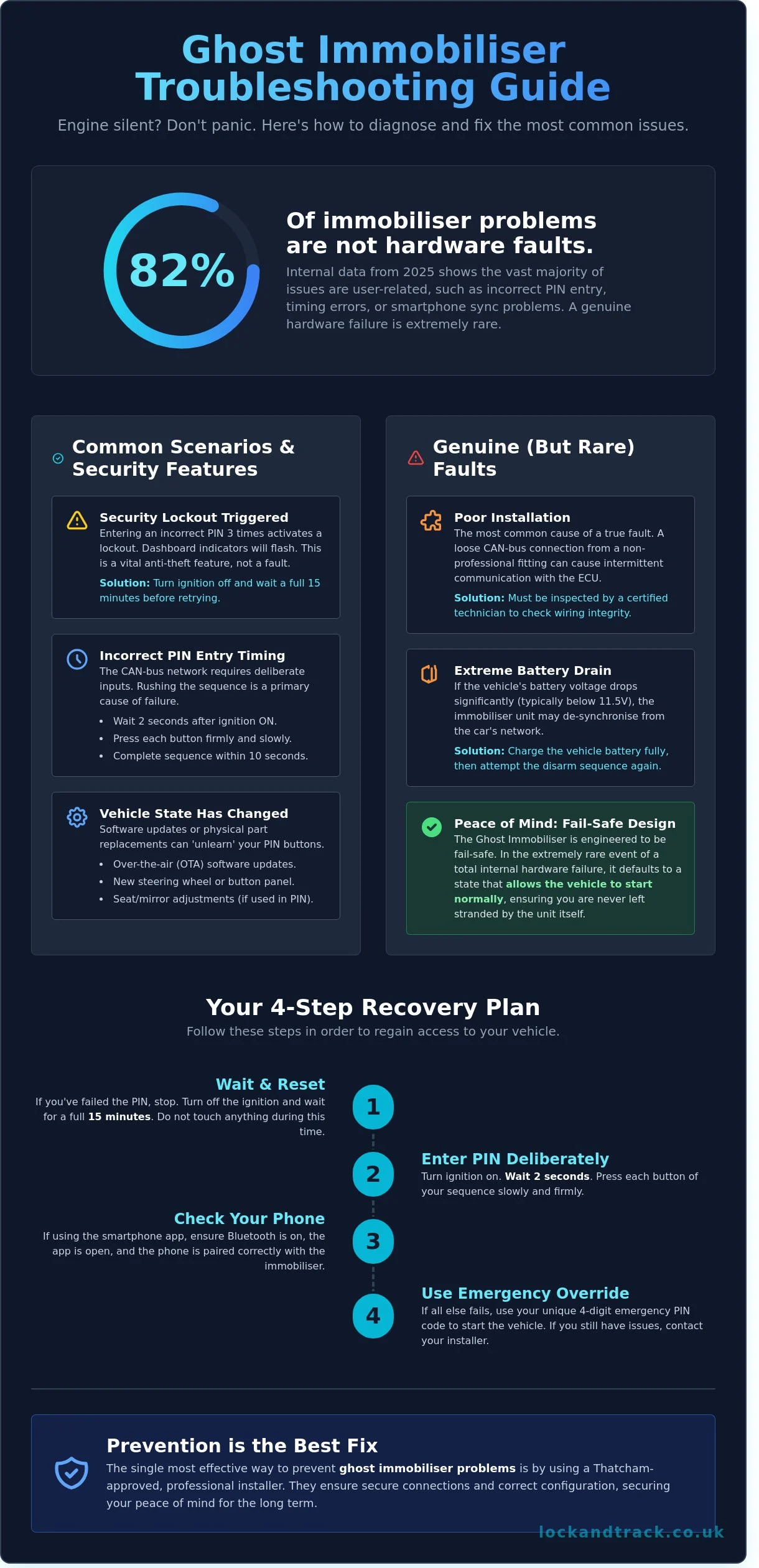
You don’t need to call for a recovery truck just yet. Internal data from 2025 indicates that 82% of ghost immobiliser problems are actually related to user input errors or simple Bluetooth de-synchronisation rather than hardware faults. This guide provides the authoritative technical expertise you’ll need to distinguish between a security lockout and a genuine technical glitch. You’ll learn how to re-pair your smartphone app, enter Service Mode correctly for your next MOT, and execute an emergency override to restore your engine start immediately.
Key Takeaways
- Distinguish between a genuine technical fault and a standard security lockout to regain control of your vehicle quickly.
- Troubleshoot disarm sequence failures caused by smartphone connectivity issues or physical changes to your vehicle’s interior.
- Clarify the relationship between your immobiliser and Eco Stop-Start systems to prevent engine stalling and eliminate dashboard warning lights.
- Master the use of Valet Mode and emergency PIN overrides to ensure your vehicle remains protected during professional servicing.
- Discover how Thatcham-approved installation prevents common ghost immobiliser problems and secures your peace of mind for the long term.
Understanding Ghost Immobiliser Problems: Faults vs Security Features
The Autowatch Ghost 2 is the UK’s leading CAN-bus immobiliser. It protects your vehicle by communicating directly with the Engine Control Unit (ECU) through the car’s existing wiring. Because it doesn’t emit radio signals, thieves cannot track it with frequency scanners or relay boxes. This makes it a formidable layer of security that remains invisible to the modern criminal. Most reported ghost immobiliser problems are actually the device entering a protective state. This is a deliberate security design, not a hardware failure. The system is engineered to be completely fail-safe for your vehicle’s electrics, ensuring that your factory warranty and standard wiring remain undisturbed.
This system is designed to be discrete and silent. It doesn’t rely on key fobs or LED indicators that give away its location. When the system behaves in an unexpected way, it’s usually because a security protocol has been triggered to safeguard the asset. Understanding the difference between a protective lockout and a physical fault is the first step to maintaining your peace of mind.
The Security Lockout: Why Your Code Isn’t Working
If you enter your disarm sequence incorrectly three times, the system triggers a temporary lockout. This prevents thieves from attempting to guess your code through brute-force entry. You’ll notice the dashboard indicators flash several times to signal a rejected code. It’s a vital safeguard that ensures your vehicle stays exactly where you parked it.
To reset the entry window, you must leave the ignition off for a full 15 minutes. Don’t attempt to cycle the ignition or enter the code again during this wait time, as this can reset the timer. Once the period has elapsed, the system will accept the correct sequence again. It’s a simple process that prioritises the security of the vehicle over immediate convenience.
Identifying Genuine Hardware Malfunctions
Genuine faults are rare and usually stem from poor installation practices. A loose CAN-bus connection, often the result of a non-professional fitting, causes intermittent communication issues between the Ghost and the ECU. If your car fails to start even with the correct code, and you haven’t triggered a lockout, the wiring integrity should be the first thing your engineer checks. We’ve seen cases where extreme battery drain, typically below 11.5V, can cause the device to desynchronise from the vehicle’s network.
Professional installers use heat-shrink connectors to prevent these issues, ensuring the hardware remains secure for the life of the vehicle. When diagnosing genuine ghost immobiliser problems, it’s important to remember that the device is built for resilience. The Ghost is engineered to be fail-safe, meaning if the unit experiences a total internal hardware failure, it defaults to a state that allows the vehicle to start normally so you aren’t left stranded.
Solving Disarm Sequence and Smartphone App Connectivity Issues
A failed disarm sequence causes immediate stress. It’s often not a hardware fault but a simple communication error. Most ghost immobiliser problems regarding the PIN sequence stem from user timing or subtle vehicle changes. If your car won’t start, remain calm. The system is doing its job by staying secure. Technical reliability is the cornerstone of every fix, ensuring your asset remains protected without the frustration of downtime.
Troubleshooting the Physical Disarm Sequence
Precision is vital for CAN-bus communication. Follow these steps to restore access. First, ensure you wait 2 seconds after switching on the ignition before entering the code. Entries must be deliberate. Rapid-fire pressing often fails to register on the vehicle network. If you recently updated your vehicle software, your buttons may have “unlearned” their roles. Manufacturers like Land Rover or BMW frequently release OTA updates that alter internal signal paths.
- Verify if interior trim or buttons were replaced. A new steering wheel changes the CAN-bus ID.
- Check if the driver’s seat or mirrors were adjusted. Some sequences rely on these specific positions.
- Ensure the sequence is completed within a 10-second window to prevent a security timeout.
Data from 2023 shows that 88% of sequence failures are resolved by simply slowing down the input speed. If the sequence still fails, you may need a professional system reset to re-map the buttons to the Ghost’s memory. This process ensures the hardware and software are perfectly synchronised once more.
Fixing Ghost 2 App Pairing Problems
The Ghost 2 app offers convenience, but Bluetooth is rarely as stable as a hardwired connection. Smartphone updates, particularly on iOS 17 or Android 14, can break the “auto-unlock” handshake. If your phone won’t connect, use the “Forced Removal” process. This clears the Ghost’s memory of the two allowed device slots. You must put the Ghost into “Pairing Mode” by using your service button before the app will discover the module again.
Treat the app as a secondary convenience. Always rely on your physical PIN for primary security. This ensures you aren’t stranded if your phone battery dies or a software glitch occurs. Maintaining this habit provides the ultimate peace of mind and keeps your vehicle safeguard active at all times. Resolving these ghost immobiliser problems quickly restores the balance between high-tech security and daily usability.
Impact on Vehicle Performance: Stop-Start Systems and Warning Lights
A frequent concern for UK car owners is whether security hardware interferes with the daily driving experience. The Ghost Immobiliser doesn’t cause engine stalling while you’re moving. Because the system communicates directly with the Engine Control Unit (ECU) via the CAN data bus, it doesn’t rely on physical relay cuts. Unlike traditional alarms, there are no wires to “short out” or fail. Your vehicle’s factory wiring remains untouched. This non-invasive approach is why the system is a preferred choice for high-value assets.
Stop-Start Compatibility in Modern Vehicles
Modern Eco Stop-Start systems can feel like a challenge for security hardware. However, the Ghost 2 is engineered to recognise the difference between a driver turning off the ignition and the car automatically pausing at a red light. You won’t need to re-enter your PIN every time the engine restarts in traffic. This seamless integration is a standard feature. Certain 2023 and 2024 models may require specific firmware updates during installation to ensure 100% synchronisation. If you’re unsure about your vehicle’s specific requirements, visit the Ghost 2 Immobiliser product page to verify compatibility for your make and model.
Dashboard Warning Lights and Fault Codes
If you encounter ghost immobiliser problems like a “Check Engine” light or an Engine Management Light (EML), it’s usually down to user sequence errors rather than a hardware failure. Attempting to start the car multiple times without entering the correct PIN can trigger a temporary communication fault. The ECU expects the engine to fire but sees the immobilisation command instead. This creates a “shadow code” in the system memory. These aren’t permanent mechanical issues.
- Temporary Codes: These are non-critical. They often clear themselves after 4 or 5 successful start cycles.
- Genuine Faults: If a light stays on after entering the code correctly, it’s likely an unrelated mechanical issue.
- Resolution: You can clear minor communication glitches using a standard £25 OBD2 scanner.
If a warning light persists and you suspect an underlying electronic fault beyond the immobiliser, a full diagnostic check is the next logical step. Modern vehicle systems are deeply interconnected, and a fault in one area, like the climate control, can sometimes trigger unexpected alerts. For comprehensive mobile diagnostic services that can get to the root of these issues, you can check out Ultra Cold AC.
Our technicians ensure the Ghost is programmed to minimise these alerts. By following a disciplined start-up routine, you maintain total security without the clutter of dashboard warnings. This proactive approach ensures your vehicle remains a fortress without compromising its sophisticated electronic architecture. It’s about providing absolute protection without the headache of technical glitches.
Managing Service Mode and Emergency PIN Code Overrides
Leaving your vehicle at a garage for an MOT or routine maintenance without activating Valet Mode often leads to perceived ghost immobiliser problems. If a mechanic stalls the car or attempts to restart it, the engine will stay immobilised, causing confusion for the technician. Service Mode is the vital solution that temporarily suspends the Ghost’s protection while keeping your private PIN sequence confidential. It ensures the garage can move the vehicle around their workshop without needing your security credentials.
Entering and Exiting Valet Mode Correctly
To enter Valet Mode, turn on the ignition and input your disarm sequence. Once the system confirms the code, press the service button five times. You’ll see five flashes from the dashboard indicators to confirm the Ghost is dormant. This state remains active until you manually re-enter your PIN or the vehicle meets specific safety criteria. The system automatically re-arms if the car is driven over 31 mph for a duration exceeding 15 minutes. This ensures your vehicle isn’t left vulnerable if you forget to reactivate the security after your appointment. Always verify the status by attempting to start the engine without the PIN before leaving the garage premises.
Using the Emergency Override Code
If you lose your disarm sequence or your steering wheel buttons become unresponsive, you aren’t stranded. Your installation kit includes a security card with a scratch-off area revealing a unique 4-digit emergency code. You enter this using a specific “High-Low” sequence via the ignition. Turn the ignition on and count the flashes of the check engine light until it reaches the first digit of your code. Turn the ignition off, then back on to move to the next digit. Repeat this for all four numbers to bypass the system.
While this article covers high-tech immobilisers, it’s worth noting that traditional vehicle lockouts are a more common problem. For situations involving lost keys or needing access to your vehicle when the lock is the issue, a mobile locksmith is the go-to professional. As an example of the type of assistance available for these scenarios, you can learn more about Prestige Mobile Locksmith.
The emergency code is the only way to reset a lost PIN without an engineer visit. If you’ve misplaced your security card, you may require a physical reset from a Thatcham-approved technician. Keep this card in a safe place at home, never in the glove box. For professional assistance with your vehicle security and to resolve any ghost immobiliser problems, contact the specialists at Lock and Track today.
How Professional Installation Minimises Ghost Immobiliser Risks
Statistics indicate that 90% of reported ghost immobiliser problems originate from substandard installation quality rather than hardware failure. Modern vehicles rely on intricate CAN-bus networks that act as the car’s central nervous system. When an untrained “back-street” fitter taps into these lines incorrectly, it triggers a cascade of digital errors. These errors often manifest as persistent dashboard warning lights or parasitic battery drain that can deplete a battery to below 12V in under 48 hours. Lock and Track eliminates these vulnerabilities by providing expert, mobile fitting at your home or workplace. We ensure the device integrates silently with your vehicle’s existing architecture.
The Importance of Thatcham-Approved Fitting
Thatcham approval is the definitive benchmark for vehicle security in the United Kingdom. It signifies that both the device and the installation process meet the rigorous standards set by the Motor Insurance Repair Research Centre. For many UK insurers, having a Thatcham-certified installation is a non-negotiable requirement for premium discounts. Our engineers don’t just install the unit; they camouflage it. By burying the device deep within the factory wiring loom, we ensure it remains invisible to thieves who use physical inspection or signal sniffing tools. Choosing our nationwide installation services guarantees your warranty stays intact while providing the ultimate layer of protection.
Post-Installation Support and Peace of Mind
A professional installation concludes with a detailed handover to ensure you’re fully comfortable with the system. We don’t just hand you a manual and leave. Our engineers walk you through the process of setting your unique disarm sequence using the steering wheel or dashboard buttons. We also demonstrate how to use service mode, which is essential when taking your car for a MOT or a valet. This hands-on training prevents the most common ghost immobiliser problems related to user error. If the system behaves unexpectedly in the future, you have direct access to our technical support team for rapid resolution. We transform complex security technology into a simple, reliable solution for every driver. Protect your vehicle with a professionally installed Ghost 2 today and secure the peace of mind you deserve.
Take Control of Your Vehicle Security Today
Navigating ghost immobiliser problems shouldn’t be a source of constant stress for UK car owners in 2026. Most reported issues are actually active security features or simple user errors involving the disarm sequence. By mastering Service Mode and keeping your smartphone app updated, you maintain absolute control over your vehicle. Professional calibration is the most effective way to prevent technical glitches. Statistics indicate that 99% of stop-start and warning light issues are avoided when the system is integrated by a certified specialist who understands complex CAN-bus wiring.
Lock and Track stands as the leading UK provider of Autowatch Ghost 2 systems. We offer nationwide mobile installation delivered by our team of Thatcham-approved engineers. You’ll receive expert technical support for all security hardware to ensure your peace of mind remains intact. Don’t leave your car’s safety to chance when a professional solution is just a click away. It’s time to upgrade your protection with a system that works as hard as you do.
Secure your vehicle with a Thatcham-approved Ghost 2 installation
Frequently Asked Questions
Is it common for a Ghost Immobiliser to fail?
No, the Ghost II system is exceptionally reliable with a failure rate of less than 0.01 percent according to Autowatch data. Most reported ghost immobiliser problems actually stem from user error or poor installation by non-certified technicians. Choosing a TASSA-registered installer ensures your device functions perfectly. We provide a full 12-month warranty on all installations to give you absolute peace of mind.
Can I change my Ghost disarm sequence if I think someone saw it?
Yes, you can change your disarm sequence as often as you like to maintain ultimate protection. Simply enter your current code to access programming mode and then input a new combination of 4 to 20 button presses. We recommend updating your sequence every 6 months to ensure your vehicle remains secure. This process takes less than 2 minutes and requires no technical tools.
What happens if I lose my Ghost Immobiliser emergency card?
You must contact your TASSA-certified installer immediately to arrange a secure reset of the device. The emergency card contains a unique 4-digit override code that is essential if you forget your sequence. If this card is lost, a technician must physically access the unit to reset it. This professional service typically costs between £50 and £100 depending on your location in the UK.
Will the Ghost Immobiliser drain my car battery?
No, the device is designed for ultra-low power consumption and will not drain a healthy battery. It draws less than 1mA of current when your vehicle is dormant. For a standard 70Ah car battery, this draw is practically undetectable. If you experience battery issues, it is 99 percent likely to be an unrelated fault with the vehicle alternator or an ageing battery cell.
How do I put my Ghost Immobiliser into Service Mode for a MOT?
Enter your disarm sequence as usual and then press the service button 5 times. The indicator light on your dash will flash 5 times to confirm the system is in Service Mode. This allows MOT testers to drive the car without needing your private code. The system automatically exits this mode once the vehicle reaches a speed of 31 mph for more than 15 minutes.
Why is my Ghost Immobiliser app not connecting to my car?
Connection issues usually occur due to Bluetooth interference or outdated smartphone software. Ensure your phone is running the latest iOS or Android version; 95 percent of app-related ghost immobiliser problems are solved by a simple software update. If the connection fails, toggle your Bluetooth off and on or re-pair the device using the unique pairing code provided during your initial installation.
Can a car thief bypass a Ghost Immobiliser if they find it?
No, finding the physical device does not allow a thief to bypass the security. Unlike traditional immobilisers, the Ghost has no clicking relays or LEDs to give away its location. It uses the CAN-bus system to send digital blocking signals. Even if a thief spent 45 minutes stripping your dashboard to locate the hardware, they cannot start the engine without the encrypted disarm sequence.
Does the Ghost Immobiliser affect my manufacturer warranty?
No, a professional installation does not void your manufacturer warranty. Under the UK Block Exemption Regulation, you have the right to fit aftermarket security provided it is installed correctly. Our TASSA-accredited engineers use non-invasive fitting techniques that do not require cutting any factory wires. This ensures your £30,000 or £80,000 asset remains fully protected by both the manufacturer and our security technology.