
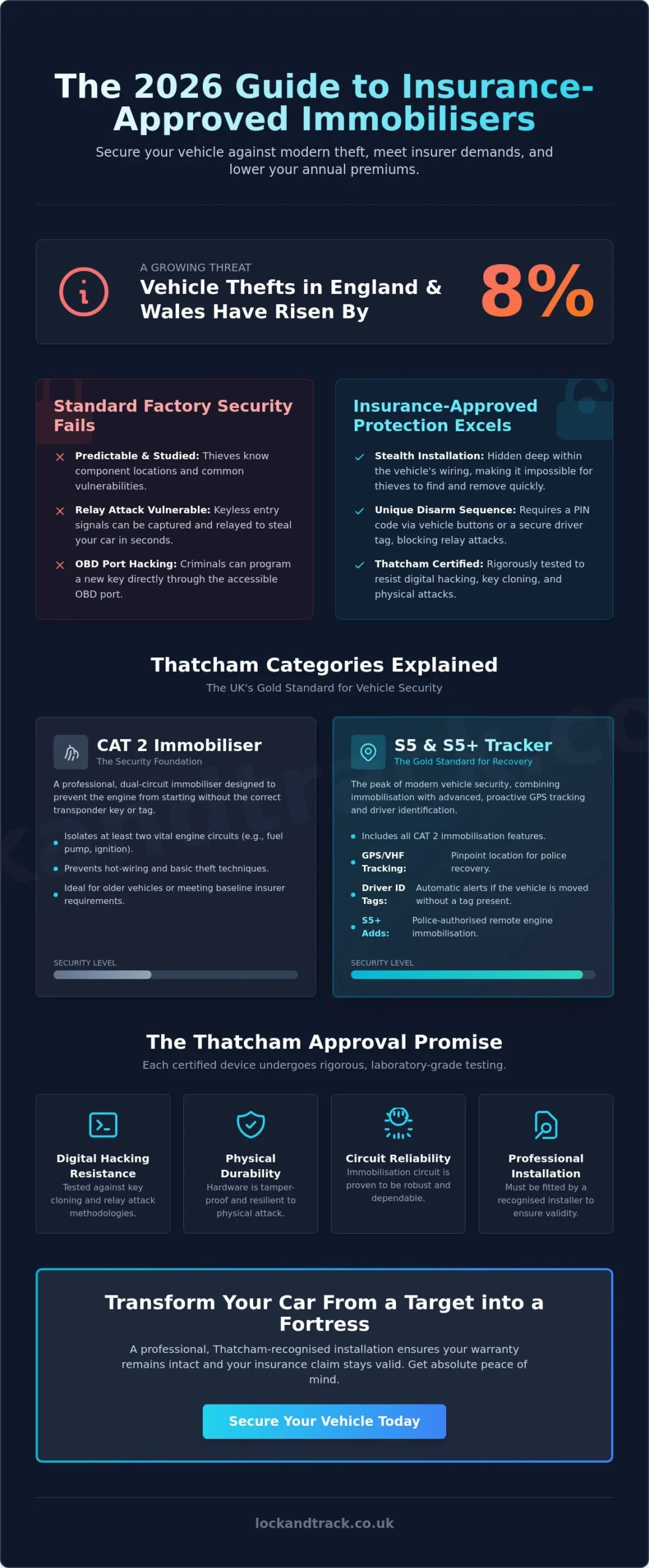
In 2024, the Office for National Statistics reported an 8% rise in vehicle thefts across England and Wales, a trend that continues to push UK insurance premiums to record highs. You’re right to be concerned about the vulnerability of modern keyless entry systems and the increasingly complex demands from your provider. It’s exhausting to navigate technical jargon while worrying if your car will still be on the drive tomorrow morning. Securing a professional insurance approved immobiliser for cars is the most effective way to lower your annual costs and stop sophisticated relay theft in its tracks.
This 2026 guide simplifies the security landscape, showing you exactly how to meet strict insurer requirements with professional, hidden technology. You’ll gain the absolute peace of mind that comes from using Thatcham-certified hardware that thieves cannot bypass. We’ll break down the vital differences between S5, S7, and CAT 2 standards so you can choose the right protection and ensure your vehicle remains exactly where you left it.
Key Takeaways
- Understand the hierarchy of Thatcham categories to ensure your vehicle security meets your insurer’s exact 2026 requirements.
- Learn why factory security often fails and how an insurance approved immobiliser for cars stops modern thieves from using OBD port hacking.
- Compare the stealth technology of the Ghost 2 and Scorpion X-Series to choose a system that remains invisible to criminals.
- Discover how professional, Thatcham-recognised installation ensures your warranty remains intact and your insurance claim stays valid.
What is an Insurance Approved Immobiliser for Cars?
An What is an immobiliser? At its most basic level, it is an electronic security device that prevents a vehicle engine from running unless the correct digital or physical key is present. While almost every car manufactured after 1998 includes a factory-fitted system, these are often insufficient against modern theft techniques. An insurance approved immobiliser for cars is a high-spec, aftermarket security layer that meets strict criteria set by industry regulators. It acts as a secondary digital deadbolt, ensuring that even if a thief gains entry to your cabin, they cannot drive the vehicle away.
Standard factory systems are predictable. Thieves study them. They know exactly where the components are located and how to bypass them using OBD port hacking or signal relaying. An insurance-approved device is different. These systems are hidden deep within the vehicle wiring, often requiring a unique PIN sequence or a secondary driver tag to disarm. This complexity is what provides the ultimate protection your insurer demands.
The Thatcham Approval Standard
In the UK, the gold standard for vehicle security is determined by Thatcham Research. Thatcham Research is the UK’s primary automotive risk intelligence centre. When a device is described as “insurance approved,” it almost always means it has achieved Thatcham accreditation. This certification isn’t handed out easily. Devices must undergo rigorous, laboratory-grade testing to prove they can resist professional attack methods for a specific duration.
The testing process evaluates several factors:
- Resistance to digital hacking and “key cloning” attacks.
- Physical durability and tamper-proofing of the hardware.
- The reliability of the immobilisation circuit.
- The requirement for professional, documented installation.
Why Your Insurer Requires an Aftermarket Device
Insurers are data-driven. They track theft-recovery statistics with precision. Recent data from the Office for National Statistics showed a 5% increase in vehicle thefts across England and Wales in 2023, largely driven by the “keyless theft” epidemic. Because factory security has struggled to keep pace with relay attacks, insurers now mandate an insurance approved immobiliser for cars for high-value models or vehicles located in high-risk postcodes.
Fitting an approved device directly impacts your premium calculations and your level of cover. If your policy documents state that a Thatcham-certified device is required, your insurance is effectively void without one. If a theft occurs and you cannot provide proof of professional installation, the insurer will likely reject your claim. We provide this peace of mind by ensuring every installation is recorded and certified, meeting the exact standards your provider expects. It’s a simple solution to a complex threat, transforming your car from a target into a fortress.
Thatcham Categories Explained: CAT 2, S5, and S5 Plus
Understanding the hierarchy of UK vehicle security is the first step toward securing your asset. Thatcham Research remains the gold standard for testing and certifying security products. If a device isn’t Thatcham-certified, most UK insurers won’t recognise it. Choosing an insurance approved immobiliser for cars ensures you meet policy mandates while providing a robust layer of protection against professional thieves.
The security landscape has shifted. Older classifications like Category 1 and Category 2 are still relevant for many vehicles. However, the rise of sophisticated relay attacks has forced a transition. The industry now prioritises ‘S’ series ratings, which focus on proactive tracking and remote intervention. This evolution is a direct response to new government laws to combat vehicle theft, which highlight the threat of electronic devices used to bypass factory systems. You need a solution that stays ahead of these criminal tactics.
CAT 2 Immobilisers: The Foundation
A Category 2 system is a professional-grade, dual-circuit immobiliser. It’s designed to isolate at least two vital electrical circuits, such as the ignition and the fuel pump. This prevents the engine from starting without the correct transponder key or electronic tag. These systems are ideal for older vehicles or policies that require a baseline level of electronic security. For a deeper look at how these systems defend your vehicle, check our Car Immobiliser Guide 2026. It provides a technical breakdown of how dual-circuit protection works in practice.
S5 and S5 Plus: The Gold Standard
The S5 category represents the peak of modern vehicle recovery. These systems combine GPS tracking with Automatic Driver Recognition (ADR) tags. If the car moves without the tag present, an immediate alert is sent to a 24/7 monitoring centre. It’s a proactive solution that identifies a theft before you even notice the car is missing. This technology is designed to counter keyless entry theft, which accounted for a significant portion of UK vehicle crimes in 2024.
The “S5 Plus” designation takes this protection further by adding active immobilisation. While a standard S5 tracker helps recover a vehicle, an S5 Plus system can actually prevent it from being driven away in the first place. Insurers frequently mandate this level of protection for luxury brands like Range Rover, BMW, and Audi. This hybrid approach of tracking plus immobilisation is now the industry benchmark. You can view our range of S5 systems to find the right fit for your specific policy requirements. Always check your insurance schedule to see exactly which category your provider demands. Failing to install the correct insurance approved immobiliser for cars could void your theft cover entirely.
Why Factory Immobilisers Fail Against Modern Thieves
Most UK car owners assume their vehicle is secure because it came with a factory-fitted security system. It’s a common misconception. While every car sold in the UK since 1998 has been legally required to feature an immobiliser, these systems are mass-produced. Thieves now study these standard blueprints to find universal vulnerabilities. Relying solely on factory security leaves your asset exposed to digital exploitation.
Modern car crime is no longer about smashing windows or hotwiring ignitions. It’s a silent, high-tech operation. Criminals use sophisticated devices to trick your car into thinking the legitimate owner is present. To counter this, an insurance approved immobiliser for cars provides a secondary, independent layer of protection that operates outside the standard manufacturer’s network.
Understanding the Relay Attack
Relay theft is the most common method for stealing keyless entry vehicles in the UK. It requires two people and two inexpensive electronic boxes. One thief stands near your front door to pick up the signal from your key fob inside the house. They transmit this signal to a second thief standing next to your car. The vehicle detects the “original” signal, unlocks the doors, and allows the engine to start.
- Standard factory security cannot distinguish between a relayed signal and the physical key.
- Thieves don’t need to touch your key or enter your home.
- Relay theft can take less than 60 seconds without any physical damage to the car.
While UK police vehicle theft prevention advice suggests using signal-blocking pouches, these are often bypassed if the pouch is low quality or left slightly open. A dedicated immobiliser stops the car from moving even if the signal is successfully relayed.
CAN Bus Hacking and Key Cloning
If a thief can’t relay your signal, they’ll target the car’s internal communication network, known as the CAN Bus. By accessing the On-Board Diagnostics (OBD) port, usually located in the footwell, criminals can plug in a handheld device and program a blank key in seconds. This bypasses the factory immobiliser entirely. Some thieves even access the CAN Bus by cutting through the vehicle’s bodywork to reach specific wiring looms.
The Ghost 2 system is specifically engineered to protect the CAN Bus. It doesn’t use radio frequency signals that can be jammed or intercepted. Instead, it requires a unique PIN code entered via the car’s existing buttons, such as those on the steering wheel or centre console. Without this code, the engine simply won’t start. Installing an insurance approved immobiliser for cars ensures that even if a thief clones your key, they still can’t drive the vehicle away. It transforms your car from a vulnerable target into a digital fortress.
Ghost 2 vs. Scorpion X-Series: Choosing the Right System
Choosing an insurance approved immobiliser for cars usually leads to a choice between two industry leaders: the Autowatch Ghost 2 and the Scorpion X-Series. Both systems provide the high-level security required to meet modern UK insurance standards. Thieves currently use relay theft to steal a car in under 60 seconds. These devices stop that process entirely. They use stealth technology, meaning they are hidden within the vehicle’s complex wiring. They don’t emit radio frequencies, so thieves using signal scanners won’t even know they are there.
The primary difference lies in how you interact with your vehicle. One relies on your memory, while the other relies on a physical tag. Both are highly effective, but your daily routine will dictate which is the better fit for your lifestyle. Our technicians install these units in varied, covert locations to ensure they remain impossible for a criminal to locate during a quick break-in.
The Autowatch Ghost 2 Immobiliser
The Autowatch Ghost 2 is the original pioneer of the CAN-bus immobiliser. It’s a discreet device with no key fobs or LED indicators to give away its position. You arm and disarm the system by entering a unique PIN sequence using the existing buttons on your steering wheel, door panels, or dashboard. This creates a bespoke layer of security that only the owner knows. If a thief clones your key, they still can’t drive away because they don’t have your sequence. For a deeper dive into this technology, read our Ultimate Ghost Immobiliser Guide.
Scorpion X-Series Immobiliser
The Scorpion X-Series offers a different user experience through Automatic Driver Recognition (ADR) tags. You keep a small, encrypted tag on your person. When you enter the car, the system detects the tag and disarms the immobiliser automatically. This is a popular choice for multi-driver vehicles or fleet managers. Scorpion is a UK-based company known for exceptional reliability and local support. Their Valet Mode is particularly robust. It allows you to hand over your keys for servicing or car washing without revealing your master security settings. The system remains active but won’t interfere with the technician’s work within specific speed and time parameters.
When deciding which system suits your make and model, consider these factors:
- User Preference: Do you prefer a hands-free experience (Scorpion) or a button-press sequence (Ghost)?
- Multi-Driver Access: Scorpion ADR tags are often easier to manage if several people drive the vehicle.
- Vehicle Compatibility: Most vehicles manufactured after 2010 are compatible with both systems, but high-end German and British brands often have specific CAN-bus protocols that our team must verify.
- Stealth Requirements: Both systems are equally difficult to find once installed by a professional.
Securing your vehicle shouldn’t be a hassle. Whether you choose the PIN-based Ghost or the tag-based Scorpion, you’re investing in a system that makes your car an unattractive target for professional thieves. These devices offer the ultimate peace of mind for owners of high-value or frequently targeted models.
Secure your vehicle today with an expert installation from Lock and Track.
Nationwide Professional Installation and Peace of Mind
A professional installation is the final link in your vehicle’s security chain. Without a Thatcham Recognised engineer, your insurance approved immobiliser for cars may not meet the strict criteria required by UK underwriters. Insurers demand verified proof of professional fitment to validate your theft coverage and process claims effectively. Lock and Track removes the complexity of finding a qualified specialist. Our mobile engineers operate nationwide, bringing expert security directly to your home, workplace, or dealership before you even take delivery of a new vehicle.
The Installation Process
Every appointment begins with a comprehensive vehicle health check. Our engineers confirm your car’s electrical systems are in peak condition before the installation begins. The fitting itself is a stealth operation. We purposefully hide the device in a non-standard location and never disclose its position to anyone. This prevents thieves from using known bypass methods or physical tampering. Most installations are completed within 60 to 90 minutes, minimizing any disruption to your day.
During the handover, we help you set a custom PIN code using the vehicle’s existing interior buttons. This sequence is unique to you and can be changed at any time. We also assist with downloading and syncing the mobile app, ensuring you are ready to drive away with immediate, proactive protection. You won’t just leave with a new device; you’ll leave with the confidence to use it.
Securing Your Investment with Lock and Track
We maintain a strict commitment to using only Thatcham-certified hardware and highly trained engineers. This ensures your vehicle is guarded by the most robust technology available in 2026. Professional installation delivers more than just hardware. It provides the long-term benefit of potential premium reductions and 24/7 protection that stays vigilant even when you aren’t. Our nationwide coverage ensures that every driver in the UK has access to elite security services regardless of their location.
We act as your vigilant partner, transforming complex technology into a simple, reliable solution for your peace of mind. Our engineers are experienced with all modern makes and models, ensuring a seamless integration with your car’s factory electronics. Don’t leave your vehicle’s safety to chance or uncertified installers who could void your warranty. Protect your vehicle today with a professional immobiliser installation.
Protect Your Vehicle Against Evolving Theft Tactics
Modern thieves use relay attacks to bypass factory security in seconds. Relying on basic tech isn’t enough to safeguard your asset in the current UK climate. You need a solution that meets strict Thatcham standards to ensure your car remains where you parked it. Installing an insurance approved immobiliser for cars is the most effective way to lower your risk profile and satisfy insurer requirements for 2026. It transforms your vehicle from a vulnerable target into a hardened asset that resists even the most sophisticated digital bypass methods.
Lock and Track provides a direct path to total security. Our nationwide network of Thatcham-approved engineers ensures your system is fitted correctly at your home or workplace. As authorised partners for Autowatch and ScorpionTrack, we deliver industry-leading Ghost 2 and Scorpion X-Series technology. You’ll benefit from expert UK-based support and the 24/7 peace of mind that comes from professional oversight. We’ve seen every tactic used by thieves; our systems are engineered to counter them all.
Secure your vehicle with a Thatcham-approved immobiliser from Lock and Track
Take control of your vehicle’s safety today and enjoy the confidence of a professionally protected car.
Frequently Asked Questions
Will an insurance approved immobiliser lower my car insurance premiums?
Installing an insurance approved immobiliser for cars typically reduces your annual premiums. Most UK insurance providers offer discounts ranging from 5% to 15% when you secure your vehicle with a Thatcham-certified device. These savings reflect the significantly lower risk of theft. Always confirm the specific discount with your provider to ensure your 2026 policy reflects your upgraded security status.
What is the difference between a car alarm and an immobiliser?
A car alarm acts as a noise-based deterrent to alert you and bystanders of a break-in attempt. An immobiliser is a digital safeguard that prevents the engine from starting unless the correct key or PIN code is present. While an alarm warns of an intrusion, the immobiliser provides the ultimate protection by physically stopping the thief from driving the vehicle away.
Can a Ghost immobiliser be detected by thieves using diagnostic equipment?
Thieves cannot detect a Ghost immobiliser using standard diagnostic tools or radio frequency scanners. The device operates silently on the vehicle CAN-bus data network and does not emit any detectable signals. This stealth technology ensures that even criminals using 2026 signal-grabbing equipment cannot locate or bypass the system during a theft attempt.
Do I need to tell my insurance company if I install an aftermarket immobiliser?
You must inform your insurance provider immediately after installing any aftermarket security system. Failing to disclose this modification can invalidate your policy and result in a rejected claim if your car is stolen. Provide your insurer with the installation certificate to ensure your 2026 coverage is accurate and that any eligible security discounts are applied to your account.
How long does it take to install a Thatcham approved immobiliser?
A professional installation of a Thatcham approved immobiliser usually takes between 1 and 3 hours. The exact time depends on your vehicle make and the complexity of its electronic system. Our expert engineers perform the installation at your home or office, ensuring your car is secure without causing major disruptions to your day.
What happens if I forget my Ghost immobiliser PIN code?
You can use a unique emergency override code if you forget your Ghost PIN. This secure code is provided on a card during the initial installation process. You should keep this card in a safe location outside of your vehicle. If you lose the override card, you must contact an authorised installer to reset the system using verified owner credentials.
Is the Ghost 2 immobiliser Thatcham approved?
The Ghost 2 immobiliser is TASSA verified, which is the industry standard that UK insurers recognise for this specific type of technology. While older systems used Thatcham categories, TASSA ensures both the device and the installer meet strict 2026 security regulations. Choosing this insurance approved immobiliser for cars provides a high level of protection that satisfies modern insurance requirements.
Can I move my immobiliser to a new car if I sell my current one?
You can move your immobiliser to a new vehicle, but the process requires a professional engineer to de-install and re-install the hardware. This ensures the device is compatible with the new car’s wiring and software. Transferring your existing unit is often more cost-effective than buying a new system, though you will pay a standard labour fee for the service.