
A professional thief can bypass your car’s factory security and drive away in under 60 seconds using a simple relay box. Recent UK industry data confirms that keyless theft accounted for 93% of premium vehicle thefts in 2024, proving that standard alarms are no longer a sufficient deterrent. You’ve likely felt the sting of rising insurance premiums or the constant worry that your driveway is being scouted by organised gangs.
It’s frustrating to invest in a high-value asset only to feel like you’re managing a target. We agree that absolute car security for high-risk vehicles requires more than just a loud siren; it demands a proactive, multi-stage barrier. This 2026 guide will teach you how to implement a layered defence strategy that combines Thatcham S5 tracking with advanced immobilisation to secure your vehicle and satisfy your insurer. We’ll examine the specific hardware and recovery protocols that guarantee your car stays protected, even against the most sophisticated criminal tactics.
Key Takeaways
- Master the 2026 “Layered Defence” framework to protect your high-value vehicle using a multi-stage strategy of Deter, Delay, Detect, and Deny.
- Identify why insurance providers demand Thatcham S5 or S7 certification and how these tracking shields facilitate professional theft recovery.
- Deploy advanced CAN bus immobilisation to stop keyless theft and relay attacks, making your vehicle invisible to modern diagnostic “sniffer” tools.
- Learn why professional nationwide installation is essential for car security for high-risk vehicles to safeguard your warranty and Thatcham status.
Why High-Risk Vehicles are Targets: Theft Trends in 2026
In 2026, the landscape of car security for high-risk vehicles has shifted from physical resilience to digital vulnerability. High-risk vehicles aren’t just luxury SUVs like the Range Rover or high-performance models like the BMW M-Series. They now include keyless EVs such as the Tesla Model 3 and Porsche Taycan. These vehicles are targets because of their high resale value and the ease with which their sophisticated systems can be exploited by those with the right tools. Professional gangs no longer rely on smashed glass or forced locks. They use technology to walk away with your car in seconds.
Factory-fitted security is no longer a deterrent for professional criminals. While every modern car includes a standard vehicle immobiliser, these systems are often bypassed using widely available software. The financial impact of theft is severe, but the emotional toll is often worse. Beyond the loss of a £60,000 asset, owners face the violation of their privacy and the logistical nightmare of insurance claims. In the UK, a theft claim can see your future premiums rise by over 35%, making proactive protection a financial necessity.
Modern Theft Methods: Relay Attacks and CAN Bus Injection
Relay attacks remain a dominant threat in 2026. Thieves use two devices to extend the signal from your key fob inside your home to the car on your driveway. This tricks the vehicle into thinking the owner is present, allowing the doors to unlock and the engine to start. CAN bus injection is the 2026 “headlight hack” that bypasses factory immobilisers by tapping into the vehicle’s internal communication network via external points. CAN bus injection is the primary threat to modern German and Japanese vehicles.
The Role of Organized Crime in the UK Car Market
High-risk vehicles are frequently “stolen to order” for international export to markets in Eastern Europe or North Africa. These aren’t crimes of opportunity; they’re coordinated operations. Professional gangs can strip a vehicle for parts or move it into a lead-lined container in under 2 hours. This speed makes traditional alarms irrelevant. A standard siren is usually ignored by bystanders, and professional thieves can silence them in moments. To protect your vehicle, you need a system that detects the threat before the car even moves.
- Luxury SUVs: High demand for parts and export.
- Performance Cars: Targeted for high-speed “joyriding” or use in further crimes.
- Keyless EVs: Vulnerable to sophisticated signal interception.
Lock and Track provides the authoritative response to these evolving threats. We don’t just offer hardware; we offer a guarantee that your vehicle remains yours. By understanding these 2026 theft trends, you can take the first step toward total peace of mind. It’s time to move beyond basic factory settings and implement a layered defence that actually works.
The Layered Defence Framework for Maximum Protection
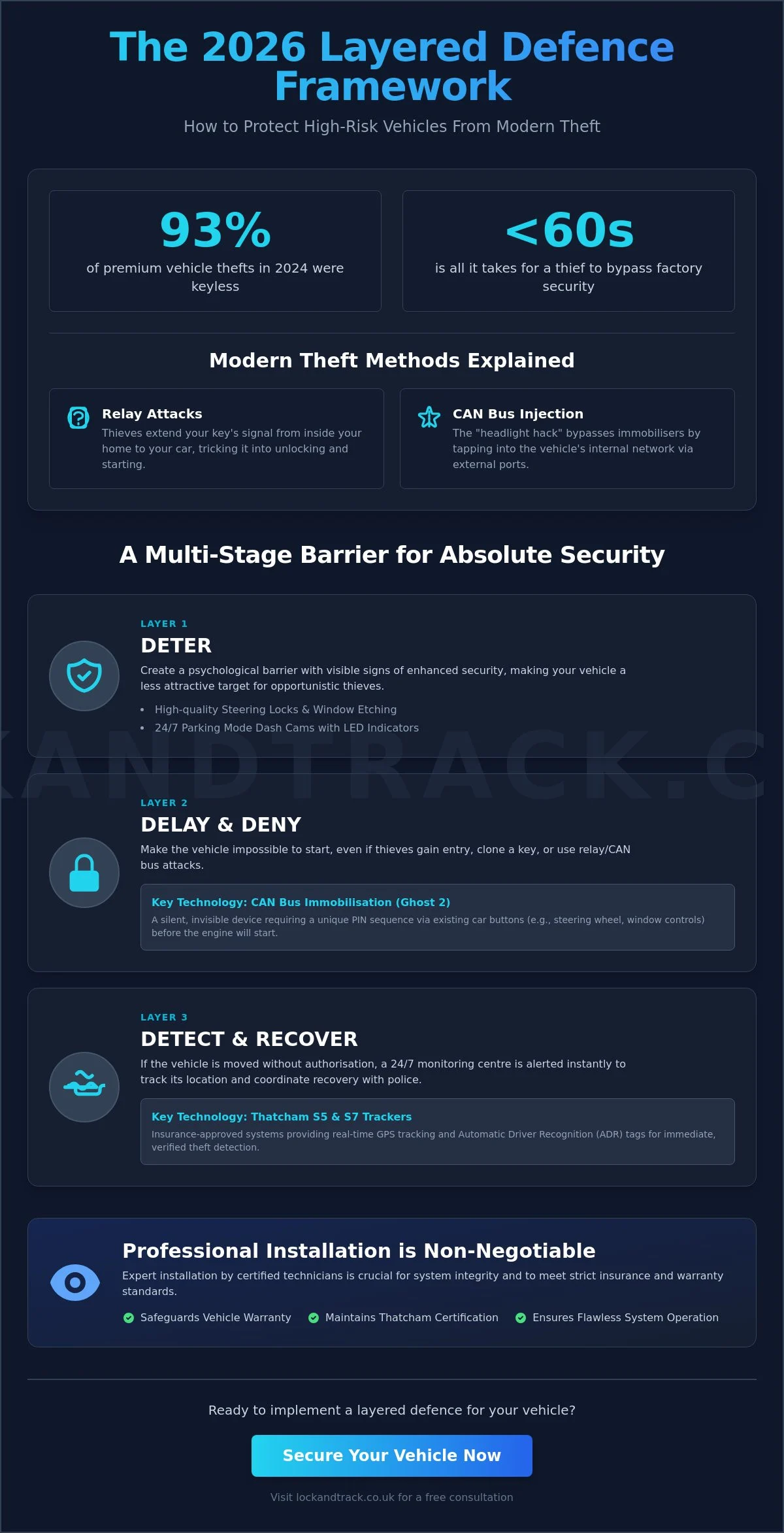
Relying on a single factory alarm is a critical mistake for owners of high-end assets. Professional thieves now use relay attacks and key cloning to bypass standard systems in under sixty seconds. Effective car security for high-risk vehicles requires a strategy of redundant protection: Deter, Delay, Detect, and Deny. A single device represents a single point of failure. If a criminal overcomes that one hurdle, your vehicle is gone. By stacking different technologies, you force a thief to solve multiple complex problems simultaneously, which usually leads them to abandon the attempt entirely.
This framework balances high-level security with daily usability. Modern systems work in the background, ensuring you don’t have to sacrifice convenience for safety. The goal is to create a synergy where physical barriers buy time for digital systems to alert the authorities.
Layer 1: Physical Deterrents and Visual Warnings
Visual cues are your first line of defence. They act as a psychological barrier that forces a thief to weigh the risk of being caught. Steering locks and window etching are simple but effective tools. They signal that the owner is proactive about security. High-quality dash cams with 24/7 parking mode serve as a digital witness, recording any movement near the cabin. Industry initiatives like National Vehicle Theft Prevention Month emphasise that making a car look difficult to steal is often enough to make a criminal move to an easier target on the same street.
Layer 2: Invisible Immobilisation (The Ghost 2 Method)
If a thief manages to enter the cabin, the second layer must stop the engine from starting. The Ghost 2 Immobiliser is the industry benchmark for this level of protection. It’s a silent guardian. Unlike traditional alarms, it emits no radio frequency signals that can be intercepted or “sniffed” by high-tech scanning tools. The system requires a unique PIN-code sequence, entered via existing buttons on your steering wheel or dashboard, before the vehicle will move. Even if a thief has stolen your physical keys, they cannot drive the car away.
Layer 3: Thatcham-Approved Recovery Tracking
The final layer addresses the worst-case scenario: the vehicle being physically towed or lifted onto a low-loader. Thatcham-approved S5 tracking systems provide the ultimate safety net. These devices offer real-time GPS monitoring linked to a 24/7 Secure Operating Centre (SOC). While Layers 1 and 2 focus on prevention, Layer 3 is about rapid recovery. A professional SOC coordinates directly with UK police to track and intercept the vehicle before it can be stripped for parts or exported. This proactive response is why high-risk vehicles equipped with S5 trackers have a recovery rate exceeding 90% in most UK theft cases.
Combining these layers creates a formidable shield around your asset. You can explore our range of integrated security packages to find the right balance for your specific model and location.
Thatcham S5 vs. S7 Trackers: Choosing Your Recovery Shield
Thatcham Research sets the benchmark for UK vehicle security. It isn’t just a label. It’s a rigorous testing process that ensures your security hardware can withstand sophisticated theft attempts. Insurers demand Thatcham-certified devices because they provide a verified level of protection. If your car lacks this certification, you’re likely paying higher premiums or, worse, risking a voided policy.
S7 trackers are the entry-level standard for theft recovery. They provide 24/7 monitoring and GPS location data. If your vehicle is moved without the ignition on, the system alerts the control centre. It’s a reactive solution that focuses on getting the car back after it’s gone. For many, this is the baseline requirement for car security for high-risk vehicles.
S5 trackers offer a more proactive defence. The key difference is Automatic Driver Recognition (ADR). You carry a small, encrypted tag separately from your keys. If the car starts and the tag isn’t detected, an immediate silent alert is sent to the monitoring team. This technology is specifically designed to stop a relay attack. Thieves can clone your key signal, but they can’t clone the ADR tag. This extra layer makes S5 the preferred choice for car security for high-risk vehicles.
When to Choose a Thatcham S5 Plus System
The S5 Plus standard is the pinnacle of tracking technology. It combines high-accuracy GPS tracking with remote engine immobilisation. If a theft is confirmed, the monitoring centre can remotely prevent the engine from being restarted. This effectively strands the thief. Owners of high-performance models like the Audi RS series or BMW M-Series often find this is a mandatory insurance requirement. When comparing the Thatcham approved vehicle trackers UK market, S5 Plus systems consistently deliver the highest recovery rates. They don’t just track; they stop the vehicle in its tracks.
Insurance Compliance and Premium Reductions
Securing your vehicle is a smart financial move. High-risk cars attract high premiums, but a Thatcham-certified tracker can lower these costs by 15% or more. The system often pays for itself within two years through these savings. You must check your specific policy wording before buying. Some insurers specify an S5 rating for vehicles valued over £50,000. Once installed, you’ll receive a Thatcham certificate. Keep this document safe. You’ll need to provide it to your insurer to validate your cover and secure your discount. Professional installation is mandatory; a DIY fitment won’t provide the certification you need for insurance compliance.
Advanced Immobilisation: Stopping Keyless Theft and Relay Attacks
Modern car thieves have abandoned the crowbar for the laptop. Relay attacks and signal jamming are now the standard methods for targeting luxury SUVs and performance saloons. To counter these digital threats, car security for high-risk vehicles must move beyond simple alarms. Advanced immobilisation uses the vehicle’s CAN bus (Controller Area Network) to block the engine from starting unless a specific sequence is entered. Systems like the Ghost 2 and Scorpion X-Series don’t emit radio signals. This makes them invisible to the diagnostic “sniffer” tools used by organised criminal gangs to locate and bypass traditional security.
The “Service Mode” feature is a critical component of these systems. It allows you to hand over your keys to a valet or mechanic without revealing your private security PIN. Once the vehicle exceeds a certain speed or distance, the system automatically re-arms, ensuring your protection is never compromised long-term. This keeps your security protocols secret during routine garage visits.
The Technical Advantage of the Ghost 2 Immobiliser
The Ghost 2 represents a significant leap in protection. It integrates directly with the vehicle’s ECU, requiring a unique PIN code entered via existing dashboard buttons or steering wheel controls. Because it uses the CAN bus, there are no wires to cut. This ensures your manufacturer warranty remains valid on new, high-risk vehicles. Professional, covert installation is vital. A hidden device is a functional device; if a thief can’t find it, they can’t bypass it. You can learn more about how this works in our car immobiliser guide.
Scorpion X-Series: The New Generation of Protection
The Scorpion X-Series offers a versatile alternative to the Ghost system. It features automatic arming and seamless smartphone integration. This allows you to use your phone as a deactivation tag, removing the need for manual button presses if you prefer a faster exit. Scorpion systems are often the preferred choice for specific vehicle makes where dashboard button integration is limited. Both brands provide robust car security for high-risk vehicles, but the choice often comes down to your preferred user experience.
The most common objection we hear involves the fear of being stranded. Drivers often ask what happens if they forget their PIN or lose their ADR (Automatic Driver Recognition) tag. Every system we install includes a secure emergency override code. This unique string of numbers allows you to regain control of your vehicle instantly. You’re never locked out, but your car is always protected against unauthorised starts.
Enquire about our immobilisation packages here.
Professional Nationwide Installation: Your Security Partner
High-end hardware requires expert hands. Attempting a DIY install on car security for high-risk vehicles is a gamble that rarely pays off. It voids Thatcham certification instantly, which means your insurance provider likely won’t honour your policy if you need to make a claim. Lock and Track provides a nationwide mobile installation service that brings the workshop to your doorstep. Whether you’re at home, at the office, or at the dealership before taking delivery, our engineers ensure your vehicle is protected from the moment the keys are in your hand.
A standard installation isn’t enough to stop a professional thief. Our engineers specialise in covert fitting. We hide tracking units and immobilisers deep within the vehicle’s internal wiring, making them virtually impossible for criminals to find during a rapid sweep. After the physical installation, we manage the technical setup, including:
- Pairing your Automatic Driver Recognition (ADR) tags to the system.
- Configuring the mobile app on your smartphone for real-time alerts.
- Registering your vehicle with our 24/7 Secure Operating Centre (SOC).
- Testing the immobilisation sequence to ensure total reliability.
What to Expect During Your Installation Appointment
Every Lock and Track engineer is Thatcham-approved. This certification is your guarantee that the person working on your car has the technical competence to handle complex modern electronics. Most installations for car security for high-risk vehicles take between one and three hours. This timeframe varies based on your specific vehicle model and the layers of defence you’ve chosen. Once the work is complete, the engineer provides a full demonstration. They’ll walk you through the app and ensure you’re confident using your new system before they leave.
Securing Your Peace of Mind with Lock and Track
We provide a complete security ecosystem rather than just a simple tracker. Our 2026-ready technology is engineered to stay ahead of evolving theft methods such as relay attacks and sophisticated signal jamming. Thousands of UK drivers trust us to safeguard their assets because we prioritise proactive protection and rapid recovery. We’ve seen every tactic used by thieves and our systems are the superior response to each one. Protect your high-risk vehicle today with Lock and Track.
Take Control of Your Vehicle’s Security Today
UK police data shows that relay attacks remain a primary threat to high-end models in 2026. Implementing a layered defence isn’t just an option; it’s a necessity for owners of high-value assets. By combining advanced immobilisation like the Ghost 2 with a Thatcham-approved tracker, you create multiple barriers that most thieves won’t even attempt to bypass. Professional installation ensures these systems integrate seamlessly with your car’s electronics.
Effective car security for high-risk vehicles relies on more than just hardware. It requires the backing of a 24/7 Secure Operating Centre (SOC) to manage recovery the moment a breach is detected. Lock and Track provides this expert level of vigilance across the UK. Our Thatcham-approved engineers specialise in Ghost 2 and Scorpion S5/S7 systems, delivering nationwide mobile installation directly to your home or workplace. You get professional-grade protection without the hassle of visiting a workshop.
Secure your high-risk vehicle with a Thatcham-approved system from Lock and Track
Your vehicle represents a significant investment. Take the proactive step today to ensure it stays exactly where it belongs and enjoy the peace of mind you deserve.
Frequently Asked Questions
What makes a vehicle “high-risk” for insurance purposes in 2026?
A vehicle is classed as high-risk if it features keyless entry or belongs to a model range with historically high theft rates. For example, the Land Rover Range Rover topped UK theft charts in 2024, leading to stricter requirements for owners. Insurers also look at performance parts and resale value on the black market. If your car sits in insurance groups 40 to 50, implementing car security for high-risk vehicles is often a mandatory requirement for coverage.
Can a professional thief bypass a Ghost 2 immobiliser?
A Ghost 2 immobiliser is virtually impossible to bypass using standard theft techniques like relay hacking or signal jamming. It doesn’t broadcast a radio frequency, so thieves can’t sniff out the signal with electronic tools. Because it communicates directly with the vehicle’s CAN-bus system, the engine won’t start without your unique PIN code. This hardware remains a gold standard for securing luxury vehicles against modern criminal tactics and sophisticated hacking attempts.
Do I need an S5 tracker if my car already has factory GPS?
You need an S5 tracker because factory GPS systems are usually integrated into the dashboard, making them easy for professional thieves to locate and disconnect. A Thatcham S5 tracker is hidden deep within the chassis and includes 24/7 police-linked monitoring. It provides a level of car security for high-risk vehicles that standard manufacturer systems can’t match. This ensures a rapid response if your vehicle moves without the authorised driver tag present.
What is the difference between a car alarm and a car immobiliser?
An alarm acts as a loud deterrent to scare off opportunists using sirens and flashing lights. However, an immobiliser provides the actual protection by cutting the fuel or ignition circuits. Even if a thief breaks into the cabin, they can’t drive away without deactivating the immobilisation system. Combining both creates a layered defence that stops a theft before the vehicle leaves your driveway, providing the ultimate peace of mind for owners.
Will installing an aftermarket security system void my vehicle manufacturer warranty?
Your manufacturer warranty stays intact as long as the installation is performed by a qualified, certified technician. In the UK, the Block Exemption Regulation ensures that third-party upgrades don’t automatically cancel your coverage. We use non-invasive installation techniques that don’t require cutting original wires. This maintains your vehicle’s integrity while significantly upgrading its resistance to sophisticated theft attempts. You get professional protection without compromising your manufacturer’s promises.
How does Automatic Driver Recognition (ADR) work in S5 trackers?
ADR utilises a discreet pocket-sized tag that communicates with the tracker via an encrypted signal. If the vehicle is started or moved without this tag being present, the system immediately alerts the 24/7 Secure Operating Centre. This technology is designed to combat relay theft, where criminals clone your key signal. It’s a proactive layer that identifies a theft in progress before you even realise the car is gone, ensuring a faster recovery.
Can I move my tracker or immobiliser to a new car in the future?
Your security investment is portable. If you change your car, a certified engineer can remove the device and install it into your new vehicle. You’ll simply need to update your subscription details and vehicle registration with the tracking provider. This makes high-end security a long-term asset rather than a one-time expense for a single car. It’s a cost-effective way to maintain professional protection across different vehicles as you upgrade.
How long does it take to recover a vehicle with a Thatcham S5 tracker?
Many vehicles equipped with an S5 tracker are located and recovered within 30 to 60 minutes of the theft being reported. Statistics show that tracked vehicles have a recovery rate exceeding 90% in the UK. The Secure Operating Centre works directly with local police forces to intercept the vehicle while it’s still in transit. This rapid intervention often prevents the car from being stripped for parts or exported overseas by organised criminal gangs.