
A professional thief can bypass your vehicle’s factory security in under 60 seconds using equipment that costs less than £100 on the dark web. This reality has left many UK owners feeling vulnerable. You want the convenience of modern technology without the constant fear of a silent driveway at 3:00 AM. It’s understandable to feel overwhelmed by Thatcham categories and rising insurance demands. Finding the best security for keyless entry cars is now a necessity rather than an upgrade.
We agree that your peace of mind is non-negotiable. You deserve a solution that works invisibly to safeguard your asset. This 2026 guide reveals the definitive layered security strategy to protect your keyless vehicle from relay theft and modern electronic bypass. We will examine how a combination of S5 tracking, advanced immobilisation, and physical barriers creates an impenetrable shield. You’ll learn exactly how to satisfy insurance providers while securing your car for the long term.
Key Takeaways
- Understand the mechanics of modern relay attacks and discover why a layered defense strategy provides the best security for keyless entry cars in 2026.
- Compare the UK’s leading Thatcham-approved immobilisers, including the Ghost 2 and Scorpion X-Series, to stop electronic bypass and unauthorised starts.
- Identify the critical differences between immobilisation and S5 tracking to ensure your vehicle meets strict insurance requirements and remains recoverable.
- Learn how to combine proactive prevention with real-time recovery through a professional “Ultimate” package installed at your convenience nationwide.
The Vulnerability of Keyless Entry: Understanding Relay Theft in 2026
Keyless entry systems offer undeniable convenience. Drivers unlock and start their vehicles without ever touching a fob. However, this convenience creates a critical security gap. Modern Smart key systems rely on low-frequency radio signals that thieves now exploit with ease. Standard factory-fitted immobilisers were designed for a physical key era. They’re often powerless against the digital tools used by organised gangs in 2026. While relay theft remains a dominant threat, we’re seeing a rapid rise in CAN bus injection. This method bypasses the key signal entirely by plugging directly into the car’s internal wiring. It’s the dangerous successor to traditional relay attacks. Finding the best security for keyless entry cars requires moving beyond basic factory setups to proactive, multi-layered protection.
How Relay Theft Happens in Seconds
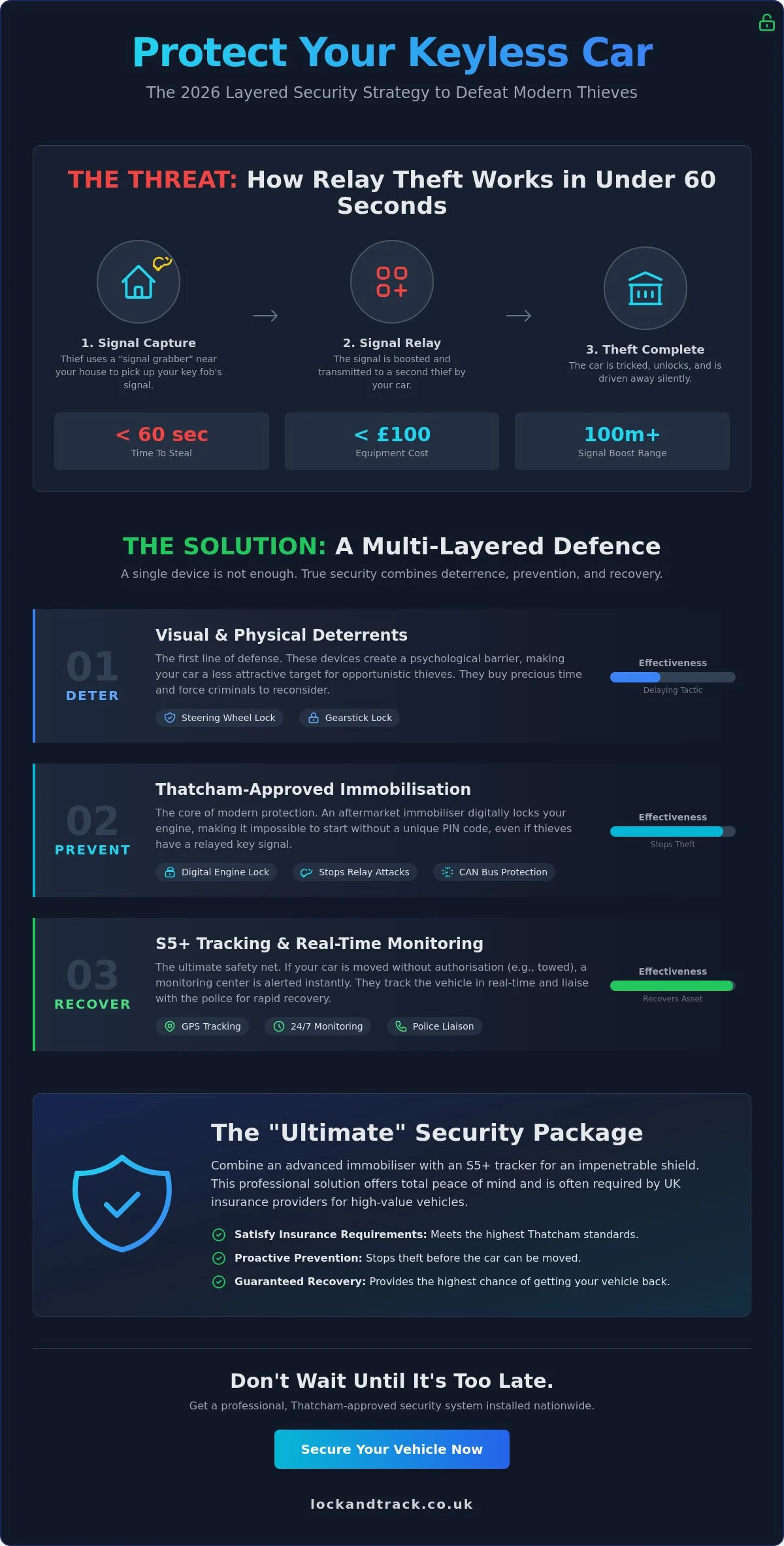
Relay theft is the electronic extension of a key fob signal to trick a vehicle into thinking the owner is standing next to it. The process requires two criminals working in tandem. The first thief stands near your front door or window with a “signal grabber” to pick up the fob’s transmission from inside the house. They instantly transmit this data to a second thief standing by the car with a “car receiver” device. Standard fobs usually have a range of just 2 to 5 metres. These electronic boosters overcome that limit, extending the reach to over 100 metres through walls and doors. The car unlocks, the engine starts, and the vehicle is gone in under 60 seconds.
The Limitations of Faraday Bags and Pouches
Faraday pouches are often marketed as a total solution, but they suffer from “Faraday fatigue.” Owners frequently forget to place their keys inside after a long day, leaving the vehicle vulnerable. These pouches also degrade physically over time. Constant use causes the metallic lining to crack or tear, which allows signals to leak through undetected. A pouch that worked six months ago might be completely useless today. Physical shielding is a useful secondary layer of defense, but it’s not a primary solution. To achieve the best security for keyless entry cars, you need Thatcham-approved hardware that doesn’t rely on human memory or cheap fabric. Consider these factors when evaluating your current setup:
- Material Wear: Micro-tears in the mesh lining can occur within 3 to 4 months of regular use.
- User Error: Leaving the pouch slightly open renders the shielding ineffective.
- Signal Strength: Modern high-gain boosters can sometimes penetrate low-quality shielding.
Relying on a £10 pouch to protect a £50,000 asset is a risk you don’t need to take. True peace of mind comes from active immobilisation and real-time tracking that works regardless of where your keys are stored.
The Security Hierarchy: From Physical Deterrents to Thatcham-Approved Tech
Effective vehicle protection follows a strict hierarchy: deterrence, prevention, and recovery. You shouldn’t rely on a single device to stop a determined thief. A layered strategy is the only way to achieve genuine peace of mind. In the UK, the gold standard for this equipment is Thatcham Approval. This certification ensures the hardware meets rigorous testing criteria for reliability and attack resistance. Most UK insurers require Thatcham-compliant systems before they’ll provide a quote for high-value keyless cars.
The UK government recently introduced new laws to ban vehicle theft equipment, focusing on the electronic tools used in relay attacks. While this legislation helps, the primary responsibility for protection remains with the owner. Professional installation is vital here. A DIY job can void your vehicle warranty or lead to electrical faults. Expert technicians ensure the system integrates perfectly with your car’s complex wiring. Finding the best security for keyless entry cars requires moving away from simple fobs toward integrated digital systems.
Layer 1: Visual and Physical Deterrents
Physical locks are your first line of defense. A high-quality steering wheel lock or wheel clamp sends a clear message to opportunistic thieves: move on. These devices have a massive psychological impact. Thieves want a quick, silent getaway. Seeing a Disklok or a gearstick lock makes your car a difficult target. However, these are delaying tactics. They don’t stop a professional with a power grinder, but they buy precious time and often force criminals to choose an easier target down the street.
Layer 2: Digital Immobilisation (The Prevention Layer)
This is the best security for keyless entry cars because it addresses the root of the problem. Modern vehicles use a Controller Area Network (CAN bus) to communicate between internal computers. Digital immobilisers don’t cut wires. They sit on this network and prevent the engine from starting until a unique PIN code is entered via the steering wheel or dashboard buttons. This technology is invisible to thieves. Unlike traditional alarms that can be bypassed by snipping a cable, digital systems are nearly impossible to detect or override without the code. It’s a silent guardian that keeps your car stationary even if the thief has cloned your key.
Investing in these layers ensures you aren’t just reacting to a theft, but actively preventing it. You can explore our range of Thatcham-approved immobilisers to see which system fits your specific make and model. This proactive approach turns your vehicle from a vulnerable target into a fortified asset.
Comparing the Best Immobilisers for Keyless Cars: Ghost 2 vs. Scorpion X-Series
Modern thieves use signal boosters to bypass factory security in seconds. To counter this, aftermarket immobilisers have become the best security for keyless entry cars across the UK. These systems don’t rely on traditional fobs that can be cloned or intercepted. Instead, they require a physical interaction within the vehicle before the engine will fire. This creates a secondary layer of protection that remains effective even if a criminal gains access to your keys or mirrors your remote signal.
The user experience is built around a “PIN sequence.” You use existing buttons on your steering wheel, door panels, or centre console to enter a unique code. Without this sequence, the car simply won’t start. It’s a simple, habit-forming action that provides total peace of mind. While physical deterrents are helpful, official Metropolitan Police prevention advice highlights that electronic compromise is a primary threat, making these digital safeguards essential for high-value vehicles.
The Autowatch Ghost 2: The Original CAN Bus Protector
The Ghost 2 is a sophisticated immobiliser that communicates directly with the engine control unit via the vehicle’s CAN Bus network. Because it doesn’t emit radio frequency signals, it’s invisible to the diagnostic tools used by professional car thieves. It prevents key cloning and relay starts by digitally “locking” the engine until your specific code is entered. For more detail on how this technology works, read our Ghost 2 Immobiliser guide.
Owners often worry about leaving their car at a garage. The Ghost 2 solves this with a dedicated “Service Mode.” You can temporarily disable the PIN requirement when the car is at a dealership for maintenance. This ensures mechanics can move the vehicle without you revealing your private code. It’s a practical feature designed for real-world ownership.
Scorpion X-Series: The High-Tech Alternative
The Scorpion X-Series provides a competitive edge for owners who prefer mobile connectivity. While it offers the same robust CAN Bus immobilisation as the Ghost, it adds a layer of convenience through a dedicated smartphone app. This allows your phone to act as a secure proximity tag. If your phone is in your pocket, the car disarms automatically, removing the need for manual button presses while maintaining the best security for keyless entry cars.
Choosing between the two often depends on your vehicle make and personal preference. Scorpion products are renowned for their UK-based support and high reliability across a wide range of European and Japanese models. Consider these factors when deciding:
- Ghost 2: Best for those who want a completely “off-grid” system with no fobs or apps.
- Scorpion X-Series: Ideal for tech-savvy drivers who want the option of app-based disarming.
- Compatibility: Both systems cover 95% of the UK car market, but certain luxury brands may have better integration with one over the other.
Both systems effectively neutralise the threat of relay theft. They ensure that even if a thief stands on your driveway with a signal amplifier, your car stays exactly where you parked it.
Advanced Recovery: Why S5 Trackers are Essential for Keyless Vehicles
Preventing a theft is the priority, but a robust security strategy must account for the worst-case scenario. While an immobiliser stops a car from starting, a tracker ensures you can find it if it’s towed or lifted. For owners seeking the best security for keyless entry cars, a Thatcham-approved tracking system is a non-negotiable layer of protection. Most UK insurance providers now mandate the installation of Category S5 or S7 trackers for high-value vehicles, particularly those with keyless systems that are vulnerable to relay attacks.
These devices don’t just broadcast a location; they provide a direct link to a 24/7 National Research Centre. When a thief bypasses your car’s factory security, the tracker becomes your only proactive tool for recovery. It transforms a stolen vehicle from a lost asset into a tracked target that the police can actively pursue.
S5 vs S7 Trackers: Which Should You Choose?
The Thatcham S5 category represents the gold standard for key-theft protection in the UK. The defining feature of an S5 system is Automatic Driver Recognition (ADR). You carry a small ID tag on your person, separate from the vehicle key. If the car moves without this tag present, the monitoring centre receives an immediate silent alert.
This feature is the ultimate foil for keyless theft. Even if a criminal successfully clones your key or uses a relay box to start the engine, the lack of an S5 ID tag triggers a security response before you even realise the car is gone. You can find more detail on these specifications in our Thatcham Approved Trackers guide. While S7 trackers offer excellent GPS location data, they lack the proactive driver identification that makes S5 systems so effective against modern relay tactics.
The Recovery Process in Action
Speed is the most critical factor in vehicle recovery. Professional thieves often move stolen cars to “cool down” locations within minutes to check for tracking devices. A Thatcham-approved S5 system streamlines the recovery timeline through a proven protocol:
- Instant Detection: The monitoring centre identifies an unauthorised movement or a missing ID tag.
- Owner Verification: A controller calls you immediately to confirm if the movement is legitimate.
- Police Coordination: Once confirmed as a theft, the centre provides real-time GPS coordinates to the police.
- Level 1 Response: Because the device is Thatcham-certified, UK police treat the incident as a Level 1 priority, significantly increasing the chances of a rapid intercept.
This system provides genuine peace of mind. You aren’t just buying a piece of hardware; you’re hiring a professional team to watch your vehicle every second of the day. In 2024, recovery rates for vehicles equipped with S5 tracking remained significantly higher than those without, often resulting in the car being returned within hours rather than days. For those investing in the best security for keyless entry cars, this rapid response is the difference between a recovered asset and a total insurance loss.
Secure your vehicle with the UK’s leading recovery technology. View our range of S5 and S7 trackers today.
Implementing Your Layered Security Strategy with Lock and Track
Effective protection requires more than a single deterrent. To achieve the best security for keyless entry cars, you must deploy a layered strategy that combines hardware immobilisation with real-time recovery. Lock and Track provides the “Ultimate” security package, integrating a Thatcham-approved immobiliser with an S5 GPS tracker. This combination ensures that even if a thief bypasses your keyless signal, the engine will not start without your unique PIN code. If the vehicle is moved by other means, such as a low-loader, the S5 tracker initiates an immediate recovery protocol with 24/7 monitoring.
- Total Immobilisation: Prevents the engine from starting regardless of signal relay or key cloning.
- S5 Recovery: Provides the highest level of UK police-supported tracking and driver identification.
- Insurance Compliance: Thatcham-approved hardware is often a mandatory requirement for UK insurers to validate high-value vehicle policies in 2026.
Thieves are fast, but our systems are faster. By integrating these technologies, you move from a state of vulnerability to a position of absolute control. We don’t just provide hardware; we provide a managed security response that watches over your asset when you can’t.
Professional Installation: Home, Work, or Dealership
Security is only as reliable as the installation. Our nationwide mobile service brings expert engineers directly to your driveway, office, or dealership. We guarantee a “Clean Install” with no visible wires, no dashboard damage, and no evidence of the device’s location. Choosing professional car immobiliser installation ensures your manufacturer’s warranty remains fully intact. Our Thatcham-certified technicians understand the complex CAN-bus wiring of 2026 models, providing a seamless integration that factory systems cannot match.
Securing Your Keyless Vehicle Today
Securing your asset shouldn’t be a complex process. Follow this final checklist to ensure your vehicle is protected against modern theft tactics:
- Confirm your tracking device is Thatcham Category S5 for the fastest recovery.
- Verify your immobiliser uses a non-broadcast PIN sequence rather than a radio signal.
- Ensure all hardware is fitted by a certified mobile engineer to maintain insurance validity.
Don’t wait for a theft attempt to test your car’s vulnerabilities. The best security for keyless entry cars is proactive, not reactive. Contact Lock and Track today for a bespoke quote tailored to your specific make and model. We provide the technical expertise and the peace of mind you need to leave your car anywhere with absolute confidence. Secure your vehicle now and eliminate the anxiety of keyless car ownership.
Future-Proof Your Vehicle Against Relay Theft
Relay theft is the primary threat to UK vehicle owners in 2026, but proactive protection shifts the power back to you. The most effective strategy combines a physical-digital barrier like the Ghost 2 immobiliser with the high-speed recovery capabilities of an S5 tracker. This layered approach ensures that even if a thief bypasses your keyless signal, they can’t start the engine or hide the vehicle’s location. Finding the best security for keyless entry cars requires moving beyond basic deterrents and implementing Thatcham-certified technology that meets strict insurance standards.
Don’t leave your asset to chance when expert help is available at your doorstep. We provide nationwide mobile installation by Thatcham-approved engineers who specialise in Ghost 2 and Scorpion S5/S7 systems. These solutions are trusted by insurance providers across the UK to deliver 24/7 vigilance and rapid recovery. It’s time to replace the anxiety of car theft with the absolute confidence of a professionally secured vehicle.
Secure your vehicle with the UK’s leading keyless security experts at Lock and Track
Take the first step toward total peace of mind today. Your vehicle deserves the highest level of protection available on the market.
Frequently Asked Questions
Do Faraday bags really work for keyless cars? (Best Security for Keyless Entry Cars)
Yes, genuine Faraday bags effectively block the radio frequency signals used in 94% of relay thefts reported in the UK. These pouches use a conductive mesh to shield your keys from external scanners. You must ensure the bag is fully closed and replaced every 12 months, as the internal lining can degrade through daily use and lose its effectiveness.
Will a Ghost 2 Immobiliser void my car manufacturer warranty?(Best Security for Keyless Entry Cars)
No, a Ghost 2 Immobiliser does not automatically void your vehicle warranty. Under the Consumer Rights Act 2015, a manufacturer cannot legally void your entire warranty unless they prove the aftermarket installation directly caused a specific fault. Because the Ghost 2 is a non-invasive system that doesn’t involve cutting wires, it remains a safe choice for new vehicles.
What is the difference between an S5 and S7 tracker for insurance?(Best Security for Keyless Entry Cars)
The primary difference is the Driver ID tag requirement found in S5 systems. An S5 tracker alerts a monitoring centre immediately if the car is moved without the tag, whereas an S7 tracker only provides location data after you report the vehicle as stolen. Many UK insurers now mandate S5 systems for vehicles valued over £50,000 to provide the best security for keyless entry cars.
Can thieves bypass a Ghost Immobiliser using relay equipment?(Best Security for Keyless Entry Cars)
No, thieves cannot bypass a Ghost Immobiliser using relay equipment. Relay attacks only work by tricking the car into thinking the key is present to unlock the doors and ignition. Even if a thief enters the cabin, the Ghost prevents the engine from starting until you enter a unique PIN code via the steering wheel or dashboard buttons.
How much does it cost to secure a keyless car professionally? (Best Security for Keyless Entry Cars)
Professional security costs vary based on the technology selected for your vehicle. Market data shows that a Thatcham-approved S7 tracker typically starts around £200, while a Ghost 2 Immobiliser installation averages approximately £450. High-specification packages combining S5 tracking and immobilisation can reach £800 to provide total protection against sophisticated theft methods.
Is a steering wheel lock enough to stop keyless car theft?(Best Security for Keyless Entry Cars)
A steering wheel lock is a useful visual deterrent but it isn’t enough to stop a professional thief on its own. Experienced criminals can cut through a standard steering wheel in under 30 seconds to remove the device. You should use physical locks as a secondary layer alongside electronic solutions for the best security for keyless entry cars.
What happens if I lose my Ghost Immobiliser PIN code?(Best Security for Keyless Entry Cars)
You can use the unique emergency override code provided on the security card you received during installation. This code allows you to reset the PIN sequence and regain access to your vehicle. If you lose both the PIN and the emergency card, you’ll need a verified technician to reset the system using specialized software, which requires proof of vehicle ownership.
Can keyless entry be turned off on most modern cars?(Best Security for Keyless Entry Cars)
Yes, many manufacturers including Ford, BMW, and Mercedes now allow you to disable keyless entry through the infotainment settings. Since 2023, several brands have also introduced motion-sensing fobs that enter a sleep mode after 40 seconds of inactivity. Check your owner’s manual or visit a dealer to see if your specific model supports these software-based security updates.