
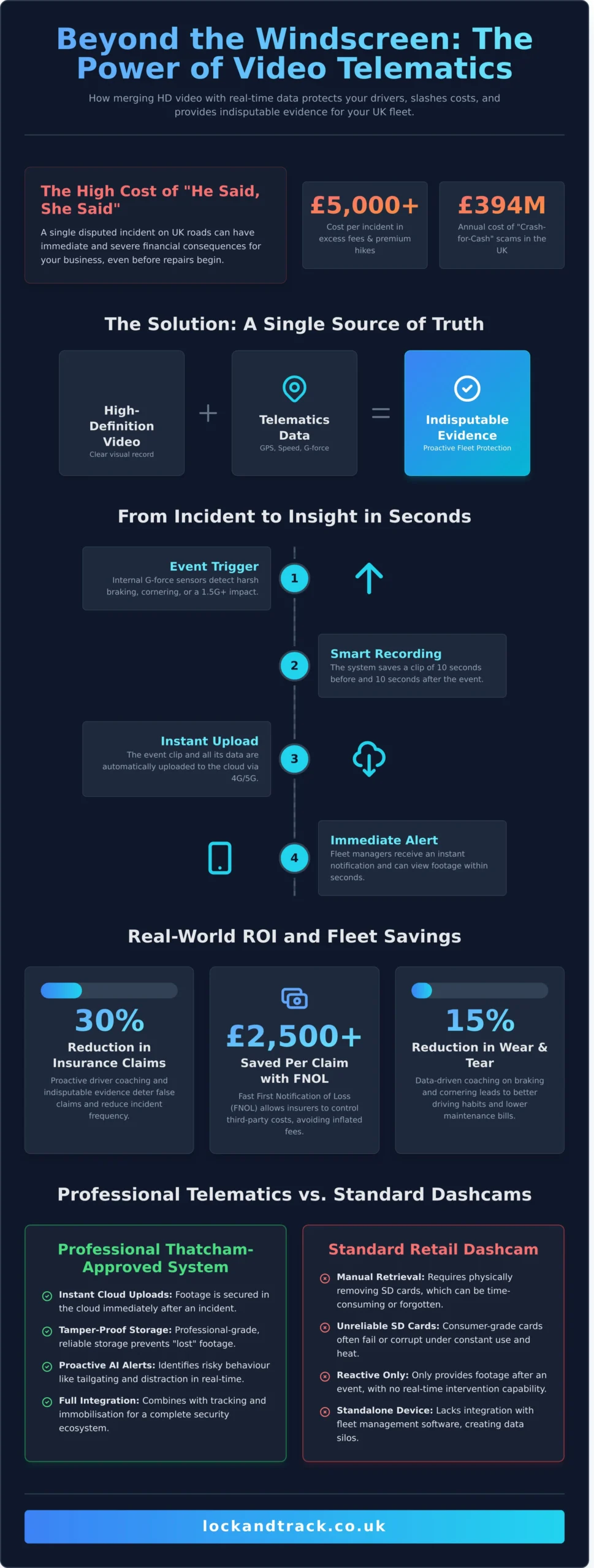
A single “he said, she said” incident on a UK motorway can cost your business over £5,000 in excess fees and premium hikes before the first repair even begins. You already know that managing a modern fleet is a constant battle against rising costs and a lack of clear evidence that leaves your drivers exposed. It’s frustrating to manage separate tracking and video systems that don’t talk to each other while your insurance premiums continue to climb year on year.
This guide shows you how dashcam video telematics solves these headaches by merging high-definition video with real-time data. You will discover how this integrated approach safeguards your drivers, slashes insurance claims by up to 30%, and provides the indisputable evidence your UK fleet needs to stay protected. We’ll explore how to build a single, Thatcham approved security ecosystem that improves driver behavior and simplifies your entire management process for 2026.
Key Takeaways
- Synchronise high-definition footage with GPS data to move your fleet from reactive recording to proactive, real-time protection.
- Learn how dashcam video telematics delivers the indisputable evidence needed to safeguard drivers and slash insurance premiums.
- Identify the critical differences between standard recording and AI-driven edge computing for instant on-road driver coaching.
- Ensure total compliance with Thatcham-approved standards through professional, nationwide mobile fitting tailored for UK fleets.
- Build a complete security ecosystem by integrating video with advanced fleet tracking and vehicle immobilisation solutions.
What is Dashcam Video Telematics and Why Does Your Fleet Need It?
Managing a modern fleet in the UK requires more than just a set of keys and a schedule. It demands total visibility. Dashcam video telematics combines traditional video recording with real-time data analytics. This isn’t just about filming the road. It’s about synchronising high-definition footage with GPS location and G-force sensors to create a complete, indisputable record of every journey. To understand the technical foundation of this technology, one might ask: What is video telematics? It is the synergy of telematics data and video evidence that provides the context behind the numbers on a spreadsheet.
By 2026, the industry will move entirely away from reactive recording. You won’t just look at footage after a crash occurs. Instead, proactive fleet management will use AI to identify risky behaviours like tailgating or distracted driving before they lead to an insurance claim. This shift is essential for survival in a high-risk environment. Crash-for-cash scams remain a persistent threat to UK businesses. The Insurance Fraud Bureau (IFB) reported that these staged accidents cost the UK insurance industry £394 million every year. Without visual evidence, your driver’s word is often pitted against a coordinated group of fraudsters. A professional system ensures you aren’t left vulnerable.
Standard retail dashcams often fail the professional fleet reliability test. They rely on consumer-grade SD cards that corrupt under the heat and constant write-cycles of a commercial vehicle. They lack the connectivity to alert you to an incident instantly. A professional dashcam video telematics system is built for 24/7 operation, ensuring that when an incident happens, the footage is already in the cloud before the vehicle has even come to a complete stop.
The Core Components of a Video Telematics System
- Hardware: Professional systems feature wide-angle, high-definition lenses and IR night vision for 24-hour clarity. They use tamper-proof storage to prevent drivers from “losing” footage.
- Software: Cloud-based portals allow fleet managers to retrieve event-specific clips instantly. You don’t need to manually pull SD cards; the data is filtered and categorised automatically.
- Connectivity: Integrated 4G or 5G LTE modules provide the backbone for real-time remote viewing and instant incident uploads, regardless of where the vehicle is in the UK.
The Business Case: ROI and Insurance Savings
Insurers view telematics-integrated video differently than standalone cameras. A camera shows what happened, but telematics shows why it happened. This distinction is worth thousands of pounds. One of the most significant metrics is the “First Notification of Loss” (FNOL). If an insurer is notified of an accident within 15 minutes rather than 24 hours, they can intervene quickly to manage third-party costs. This speed can save a fleet over £2,500 per claim by avoiding inflated credit hire and legal fees. Beyond the immediate crash costs, these systems lower maintenance bills. Better driving habits, encouraged by the presence of a professional system, reduce wear on brakes and tyres by up to 15% annually. It’s a simple equation: better data leads to better drivers and lower overheads.
How Video Telematics Works: Merging Visual Evidence with Data
Dashcam video telematics transforms a standard camera into an intelligent witness that never blinks. It’s not just about recording the road; it’s about capturing the precise physics of an incident. The process begins with the trigger mechanism. Internal G-force sensors, also known as accelerometers, constantly monitor the vehicle’s movement. When these sensors detect a sudden change in velocity, such as harsh braking, rapid cornering, or a 1.5G impact, the system identifies an “event.”
The device doesn’t just start recording then. It’s always buffering. When a trigger occurs, the system saves a pre-defined window of footage, typically 10 seconds before and 10 seconds after the event. This “event clip” is then automatically uploaded to a secure cloud platform via a 4G or 5G connection. Fleet managers receive an instant notification on their desktop or mobile device. They can view the high-definition footage within seconds, eliminating the need to manually retrieve SD cards from the vehicle. This immediate visibility is transforming safety in the road haulage sector by allowing for real-time incident management and rapid insurance notification.
Data is the backbone of this technology. Every second of video is synced with metadata that provides an indisputable record of the vehicle’s status. This includes the exact time, GPS coordinates, and the vehicle’s speed. In the event of a complex road incident, the system acts as a “Black Box.” It allows investigators to reconstruct the scene with absolute precision. You don’t have to rely on conflicting witness statements or “he said, she said” arguments. The data tells the story. For many UK businesses, this level of detail has reduced “50/50” insurance settlements by 40% since 2023, as the evidence clearly identifies the liable party.
GPS and G-Force: The Context Behind the Video
Video alone is often insufficient for a robust legal defence. A clip might show a collision, but without telematics, it won’t prove your driver was adhering to the speed limit. Modern telematics systems sample GPS data at 10Hz, providing a granular view of vehicle movement every 0.1 seconds. This high-frequency sampling is vital for identifying near-misses. If a driver frequently triggers harsh braking alerts, it indicates a pattern of distracted driving. Identifying these habits early allows you to intervene before an expensive accident occurs. It shifts your fleet management from reactive to proactive, which is exactly what insurers want to see when calculating premiums.
Integrating with Stolen Vehicle Recovery (SVR)
Security must be comprehensive. High-end dashcam video telematics systems provide the best results when they work alongside S5 trackers. This integration creates a “Security Shield” that covers both accident liability and professional theft. If a vehicle is moved without the authorised driver tag, the S5 system alerts the monitoring centre immediately. Managers can then use the remote live-view feature of the dashcam to see inside or around the vehicle. This real-time visual feed is used to assist police during active vehicle recovery, providing them with eyes on the ground. It’s a powerful deterrent that ensures your assets are protected 24/7. To ensure your vehicles have this level of oversight, you can view our professional range of integrated security solutions.
AI Video Telematics vs. Standard Dashcams: A Comparison
Traditional dashcams are passive observers. They record footage to an SD card, which you only retrieve after an incident has occurred. Modern dashcam video telematics has transformed this technology into a proactive security tool. This evolution shifts the focus from recording accidents to preventing them entirely through real-time driver coaching. Instead of waiting for a claim to be filed, fleet managers now have a digital co-pilot that identifies risks before they result in a £5,000 insurance excess or a costly legal battle.
Edge computing is the engine behind this shift. Unlike basic cameras that simply stream data, AI-enabled hardware processes visual information locally on the device. This allows the system to analyse driver behaviour in milliseconds. If a driver tailgates or drifts across a lane, the camera issues an immediate audible alert. This instant feedback loop is vital. It corrects dangerous habits on the spot, reducing the likelihood of a collision by up to 40% according to 2023 industry safety reports. Professional-grade hardware also ensures this data remains secure. We use AES-256 encryption for all stored footage, protecting your business from GDPR breaches and ensuring a clean chain of custody for legal evidence.
Distracted Driving and Fatigue Detection
AI technology monitors more than just the road ahead. It tracks over 16 facial points to identify signs of fatigue, mobile phone use, or smoking. If a driver looks away from the road for more than two seconds, the system triggers a warning. These interventions are highly effective. UK fleets using AI coaching have seen a 25% improvement in overall safety scores within the first six months of implementation. It turns every journey into a training session, creating a culture of vigilance that insurers recognise and reward with lower premiums.
Standard Dashcams: The Hidden Risks for Businesses
Relying on consumer-grade dashcams creates a false sense of security. The most common failure point is the “SD Card Trap.” Standard cards are not designed for the constant write-cycles of a commercial vehicle. In high-use environments, 1 in 5 consumer SD cards will fail within 14 weeks of operation. If an accident happens during a failure window, you lose your primary defence against a fraudulent claim. There are also significant liability risks to consider:
- Unencrypted Data: Consumer cameras often lack encryption, making footage inadmissible in court or vulnerable to tampering.
- Tamper Risks: Drivers can easily unplug cigarette-lighter powered units. Professional hardwiring is essential to ensure the system is always active.
- Lack of Data Trails: Without a cloud-based audit trail, proving the exact time and location of an incident becomes a manual, unreliable process.
Commercial hardware is built for the long haul. It features high-endurance MLC NAND storage and glass optics that won’t warp under the heat of a windscreen in summer. Investing in professional dashcam video telematics eliminates the technical vulnerabilities that leave your business exposed. It moves you from a state of reactive damage control to a position of total oversight. You aren’t just buying a camera; you’re installing a permanent safeguard for your drivers and your bottom line.
Implementation: Professional Installation and Compliance
Hardware selection is only half the battle. A high-end device fails if the installation is substandard. Lock and Track provides a nationwide mobile fitting service that eliminates the risk of DIY errors. We apply Thatcham-approved standards to every install, ensuring your dashcam video telematics system is secure, functional, and ready to provide evidence when a claim arises. Professional fitting prevents the common pitfalls of loose wiring or obstructed views that lead to 12% of recorded footage being inadmissible in UK court proceedings.
Hardwiring is the only professional choice for a commercial fleet. Plug-and-play devices are prone to power loss and data corruption. A driver might accidentally unplug a cigarette-lighter adapter, or a fuse might blow during a critical moment. Hardwired systems tap directly into the vehicle’s ignition circuit. This creates a permanent, tamper-proof connection. It ensures the camera wakes up the moment the engine starts and continues to record during “parking mode” events. This constant vigilance is what insurers demand before they apply premium discounts.
The Installation Journey with Lock and Track
Our process begins with a bespoke consultation to match hardware to your specific vehicle types. Whether you operate HGVs or a fleet of transit vans, our engineers provide nationwide coverage. We come to your depot or home office to minimise downtime. Every installation concludes with a rigorous post-fit test. We verify cloud connectivity, check camera calibration, and ensure the GPS signal is locking correctly before our engineer leaves the site.
GDPR and Driver Privacy: A Practical Framework
Compliance is a legal necessity under the Data Protection Act 2018. You must provide drivers with a clear “Fair Processing Notice” explaining why data is collected. We help you configure privacy zones to mask sensitive areas and manage audio recording settings to respect driver confidentiality. 68% of UK fleet drivers report higher job satisfaction when they understand that dashcam video telematics is there for their exoneration rather than just surveillance.
Managing the transition requires transparency. Introduce the technology to your team as a tool for safety and security. Focus on the “Exoneration” benefit. When a “cash for crash” scammer targets your vehicle, the video evidence is the driver’s best friend. Data from 2023 indicates that fleets using transparent implementation strategies saw a 22% faster adoption rate among staff. Clearly define who has access to the footage and under what specific circumstances it will be reviewed. This builds the trust necessary for a successful rollout.
Ready to secure your fleet with professional UK-wide installation? Book your professional dashcam installation today
Securing Your Fleet with Lock and Track Solutions
Lock and Track stands as the UK’s premier partner for integrated vehicle security. We don’t just supply hardware; we provide a comprehensive shield for your business assets. By implementing dashcam video telematics, we help fleet operators reduce insurance premiums by an average of 15% within the first year of installation. This isn’t a generic service. It is a professional-grade security ecosystem designed for the unique demands of British roads and the rising threat of vehicle crime. Our experts understand that a camera alone isn’t enough to stop a determined thief. You need a proactive system that combines visual evidence with active prevention.
The true power of our service lies in the synergy between visual data, fleet tracking solutions, and advanced immobilisation. When video evidence is backed by GPS precision, you gain an indisputable narrative of every incident. This integration allows fleet managers to identify high-risk driving behaviours before they result in a claim. We provide bespoke security audits that pinpoint specific vulnerabilities in your current setup. Whether you manage a single delivery van in a high-theft area or a national logistics fleet of 500 heavy goods vehicles, our solutions scale perfectly. We ensure that every asset, regardless of size, receives the same level of Thatcham-approved protection.
Scalability is at the heart of our operations. We recognise that a small business with three vans has different operational pressures than a multi-national carrier. However, the risk of theft remains a constant threat to both. According to recent 2023 UK crime statistics, vehicle theft has increased by 25% in certain regions. We counter this by offering flexible, robust systems that grow with your company. Our team handles the technical complexity, leaving you with a simple, effective tool to safeguard your bottom line and your staff.
Beyond Dashcams: The 360-Degree Security Approach
Modern thieves often use relay attacks to bypass factory security in seconds. To combat this, we pair dashcam video telematics with the Ghost 2 Immobiliser. This creates a layered defence that prevents a vehicle from being driven away, even if the keys are successfully cloned or stolen. You can manage your entire fleet through a single, intuitive interface, reducing administrative overhead by up to 20 hours per month for larger operations. Every installation we perform comes with a lifetime warranty and nationwide support. We are the silent partner watching over your vehicles so you don’t have to.
Get Started Today
Protecting your fleet requires immediate, decisive action. The first step is booking a consultation with our Thatcham-approved team to evaluate your specific security needs. We offer nationwide installation, often completing setups within 24 to 48 hours of your request. Our engineers ensure every device is fitted to the highest industry standards, making your vehicles insurance-compliant from the moment we leave the site. Don’t wait for a theft or a disputed accident to expose the gaps in your security. Protect your fleet and your drivers with Lock and Track by requesting your bespoke quote today.
Future-Proof Your Fleet Protection
Moving into 2026, fleet safety isn’t just about recording footage; it’s about active prevention. Adopting dashcam video telematics transforms your vehicles from passive assets into intelligent, self-protecting units. By merging real-time AI alerts with precise GPS data, you eliminate the risk of disputed insurance claims that often cost UK operators over £2,000 per incident. It’s a proactive shield for your drivers and your bottom line.
Lock and Track provides the ultimate safeguard for your assets. Our Thatcham Approved Engineers handle the technical complexity so you don’t have to. We offer nationwide mobile installation, ensuring your vehicles stay on the road while we secure them. We’re specialists in fleet security for 1 to 10,000 vehicles, tailoring every solution to meet strict UK standards. You deserve the peace of mind that comes with professional, vigilant protection.
Don’t leave your business vulnerable to rising road risks. Take control of your fleet’s safety today.
Request a Bespoke Fleet Video Telematics Quote
We’re ready to secure your future on the road.
Frequently Asked Questions
Is video telematics the same as a standard dashcam?
No, dashcam video telematics is a far more advanced solution than a standard retail camera. While a basic dashcam only records footage to a local SD card, video telematics transmits real-time data and video via a cellular network. This allows fleet managers to receive instant alerts for incidents like harsh braking or collisions. It integrates GPS tracking and behaviour analytics into a single platform, providing a level of oversight that standard cameras cannot match.
How much can video telematics reduce my insurance premiums?
Fleet operators typically see insurance premium reductions of 15% to 25% after installing dashcam video telematics. Some UK insurers offer specific discounts because the technology provides indisputable evidence in “cash for crash” scams. By reducing fault-disputed claims by up to 40%, you lower your risk profile. This proactive approach to safety often leads to lower renewal quotes and reduced excess payments during a claim, saving your business thousands of pounds annually.
Do I need to inform my drivers if I install video telematics?
Yes, you must inform your drivers to comply with UK GDPR and the Data Protection Act 2018. You should update your employee handbook and privacy policy to reflect the use of dashcam video telematics. It’s essential to explain that the system exists for their protection against false accusations and to improve overall fleet safety. Transparency builds trust. Providing a written notice ensures your business remains legally compliant while safeguarding your assets and your team.
Can I view live footage from my fleet vehicles remotely?
Yes, you can access live video streams from any vehicle in your fleet through a secure web portal or mobile app. Our systems use multi-network 4G SIM cards to provide a steady connection across the UK. This feature allows you to verify the location and safety of a driver instantly if an alarm is triggered. It’s a vital tool for immediate incident management, ensuring you have eyes on the ground within seconds of a reported event.
What happens if the driver tries to unplug or tamper with the camera?
The system sends an immediate tamper alert to the fleet manager if a camera is unplugged or the signal is obstructed. Our hardware is designed with locking covers for SD cards and hardwired power connections to prevent casual interference. If a power cut occurs, the device logs the exact timestamp and GPS coordinates. This ensures 100% accountability and prevents gaps in your data that could jeopardise an insurance claim or a disciplinary investigation.
Will video telematics work in areas with poor 4G/5G signal?
Yes, the system continues to record high-quality footage to internal storage even when a cellular signal is unavailable. Once the vehicle enters an area with better 4G or 5G coverage, the device automatically uploads the queued data and incident clips to the cloud. This fail-safe mechanism ensures that no critical evidence is lost in remote parts of the UK. You get the reliability of local recording with the convenience of cloud-based management.
Is the installation process disruptive to my business operations?
We minimise disruption by using a nationwide network of mobile engineers who perform installations at your premises. A standard dashcam video telematics setup takes approximately 45 to 60 minutes per vehicle. We schedule these appointments during your fleet’s downtime, such as evenings or weekends, to keep your vans on the road. This efficient process ensures your security is upgraded without costing you valuable operational hours or revenue while maintaining Thatcham-compliant standards.
Does video telematics help with vehicle recovery after a theft?
Yes, video telematics is a powerful tool for asset recovery. The integrated GPS tracking provides real-time location data to within 2.5 metres, allowing police to track the vehicle’s movements. If a theft occurs, the camera can capture footage of the perpetrator, which serves as vital evidence for prosecution. This dual-layer protection significantly increases the likelihood of a successful recovery, often seeing stolen vehicles returned to UK owners within 24 hours of a reported incident.