
Introduction
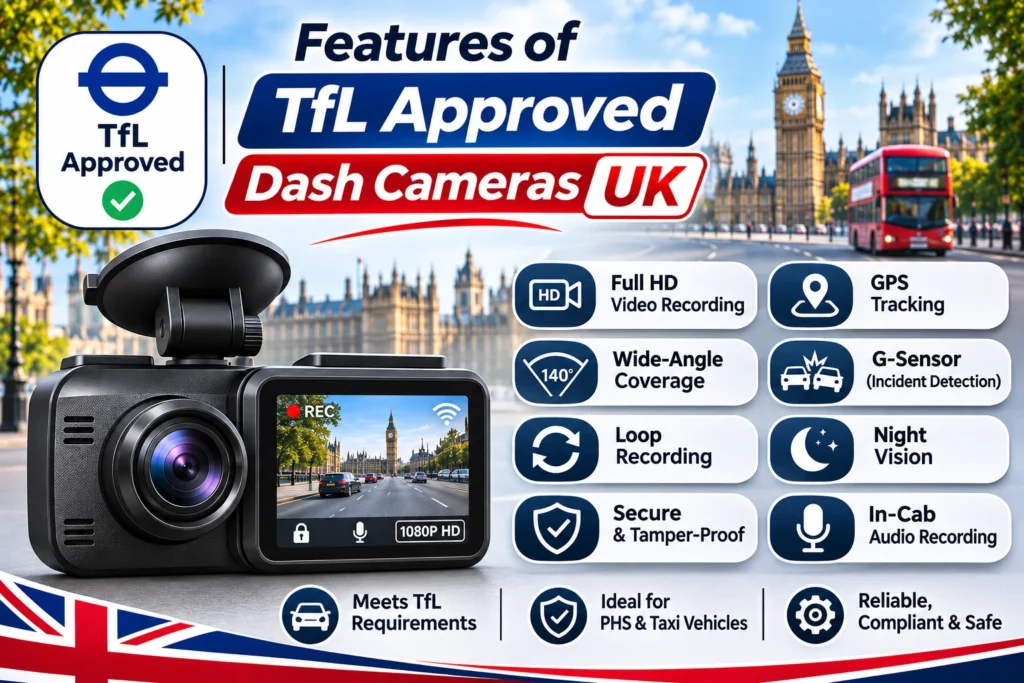
Choosing the right camera system is important for London taxi and private hire vehicle (PHV) drivers. The Features of TfL Approved Dash Cameras UK include more than video quality: drivers also need to consider camera coverage, incident recording, secure footage storage, privacy and safe installation.
Not every dashcam is approved for use in a licensed London taxi or PHV. TfL’s approved list identifies specific in-vehicle CCTV systems and the vehicle categories they are accepted for. Always check the exact model and its intended application before buying or arranging installation.
This guide explains the key Features of TfL Approved Dash Cameras UK, what to check before purchasing, and how to choose a system suitable for your vehicle.
What Are TfL Approved Dash Cameras UK?
The term TfL Approved Dash Cameras UK is often used to describe approved in-vehicle CCTV or incident-recording systems used in licensed London taxis and PHVs.
Depending on the model, a system may record the road ahead, the vehicle interior, or other areas covered by its approved configuration. Some systems are designed primarily for incident recording, while others provide interior CCTV.
An ordinary road-facing dashcam is not automatically the same as a TfL-approved in-vehicle CCTV system. For this reason, drivers should confirm the exact camera model and vehicle category on TfL’s current approved list.
10 Key Features of TfL Approved Dash Cameras UK
1. Forward-Facing Incident Recording
Forward-facing recording captures the road ahead. It can provide useful footage of a collision or other road incident, helping the driver or relevant authorities review what happened.
When comparing the Features of TfL Approved Dash Cameras UK, check whether the approved system includes a forward-facing camera and how it records and saves incident footage.
2. Interior-Facing CCTV
Some approved systems include an interior-facing camera. This can provide footage of activity inside the vehicle and may be useful if an incident or complaint occurs.
Interior CCTV is different from a road-facing dashcam. Check the specific model’s camera configuration and the rules for using and managing recordings.
3. Rear-Facing Camera Options
Certain camera configurations include rear-facing recording. Depending on the system, this may provide additional coverage behind the vehicle.
Not every approved model includes a rear camera. Check the manufacturer’s specification and TfL’s approved listing rather than assuming that all systems offer the same coverage.
4. Incident and Event Recording
Incident-recording features are intended to capture footage relevant to events such as collisions. How recording is triggered, protected and retrieved depends on the product.
Ask the supplier which events the system records, how footage is saved, and whether the feature is included in the approved configuration for your vehicle.
5. Audio Recording Controls
Some systems may include audio-recording capability, but audio raises additional privacy considerations. TfL’s guidance sets conditions around audio recording; it should not be assumed that continuous audio recording is appropriate.
Check whether the selected system includes audio, how it is activated and what instructions apply. Follow current TfL guidance and the system’s operating instructions.
6. Secure Footage Storage and Retention
Secure storage helps protect recordings from unauthorised access or loss. TfL’s published CCTV guidance also sets requirements for managing footage, including retention and deletion.
Before buying, ask how footage is stored, who can access it, how long it is retained and how deletion is handled. Confirm the current retention requirements rather than relying on an old or generic specification.
7. Clear Recording Signage
Passengers should be informed when in-vehicle CCTV is operating. Clear signage helps people understand that recording is taking place.
Ask which notices are required for your system and where they should be displayed. The signage should match the camera configuration and applicable TfL guidance.
8. Safe and Secure Installation
The camera system must be fitted securely and positioned so it does not obstruct the driver’s view or create a safety risk.
TfL says installed CCTV systems are checked during the annual licensing inspection to ensure they are approved and safely fitted. Choose an installer familiar with your vehicle and the specific approved system.
9. Footage Access and Evidence Handling
A camera system is useful only if authorised people can retrieve relevant recordings when needed. Check how footage is exported, who is permitted to access it and how it can be shared with the police or other appropriate parties.
Set clear procedures for handling recordings and limit access to authorised users. Follow the system instructions and applicable privacy requirements.
10. Vehicle-Specific Approval
One of the most important Features of TfL Approved Dash Cameras UK is whether the exact system is approved for your vehicle category.
TfL’s approved list identifies systems and the taxi or PHV categories for which they are accepted. A system listed for one category should not automatically be assumed to be approved for another.
TfL Approved Dash Cameras UK vs Ordinary Dashcams
An ordinary consumer dashcam is usually designed to record the road ahead. A TfL-approved in-vehicle CCTV or incident-recording system may include additional camera coverage and must meet the relevant requirements for use in a licensed London taxi or PHV.
Before purchasing, check the exact model against TfL’s current approved list and confirm that its configuration suits your vehicle. A product described as a “taxi dashcam” is not necessarily TfL-approved.
What to Check Before Buying
Use this checklist when comparing the Features of TfL Approved Dash Cameras UK:
- Confirm the exact model appears on TfL’s current approved list.
- Check that it is approved for your taxi or PHV category.
- Identify which cameras are included: forward-facing, interior-facing, rear-facing, or a combination.
- Ask how incident recording works and how footage is retrieved.
- Check whether audio recording is included and how it is controlled.
- Confirm storage, security, retention and deletion arrangements.
- Ask what signage is supplied and where it must be displayed.
- Confirm that installation will be safe and suitable for your vehicle.
- Keep the product and installation documentation.
Why the Right Camera System Matters
The Features of TfL Approved Dash Cameras UK can help drivers compare systems, but no single feature should determine the purchase. The right choice depends on the approved model, vehicle category, recording needs, privacy requirements and installation.
A camera system should be selected and operated in line with the relevant TfL guidance. Do not assume that a device is approved simply because it is marketed for taxis or private hire vehicles.
Final Thoughts
The Features of TfL Approved Dash Cameras UK vary by system. Important points to compare include camera coverage, incident recording, audio controls, secure storage, footage access, signage and safe installation.
For London taxi and PHV drivers, the essential step is to verify the exact model on TfL’s current approved list and confirm that it is accepted for the relevant vehicle category. Then choose a suitable configuration and make sure it is installed and operated according to the applicable guidance.
Looking for a TfL-Approved Camera?
Before booking, provide your vehicle make, model and licence category to a reputable supplier or installer. Ask them to confirm the exact approved system, camera configuration, installation requirements, signage, storage arrangements and aftercare.
FAQs About Features of TfL Approved Dash Cameras UK
What are the main features of TfL Approved Dash Cameras UK?
Depending on the approved model, features may include forward-facing incident recording, interior CCTV, rear-facing cameras, secure footage storage and tools for retrieving recordings. Check the exact system specification.
Are all dash Features of TfL Approved Dash Cameras UK?
No. Ordinary consumer dashcams are not automatically approved for use in licensed London taxis or PHVs. Check the exact model against TfL’s current approved list.
Do TfL-approved cameras record inside the vehicle?
Some approved systems include interior-facing CCTV, while others may provide forward-facing incident recording only. Confirm the configuration of the specific model.
Can TfL-approved camera systems record audio?
Some systems may include audio capability, but its use is subject to specific controls and privacy considerations. Check current TfL guidance and the instructions for your system.
How long can CCTV footage be kept?
TfL’s published guidance sets a retention period and deletion requirements. Check the current guidance for the applicable period and ensure the system is configured accordingly.
Does the camera need to be professionally installed?
The system must be fitted safely and securely. TfL says installed CCTV is checked during the annual licensing inspection, so use an installer familiar with your vehicle and the approved system.
How can I check whether a camera is approved for my vehicle?
Check the exact model and your vehicle category against TfL’s current approved CCTV list before purchasing or installing it.