
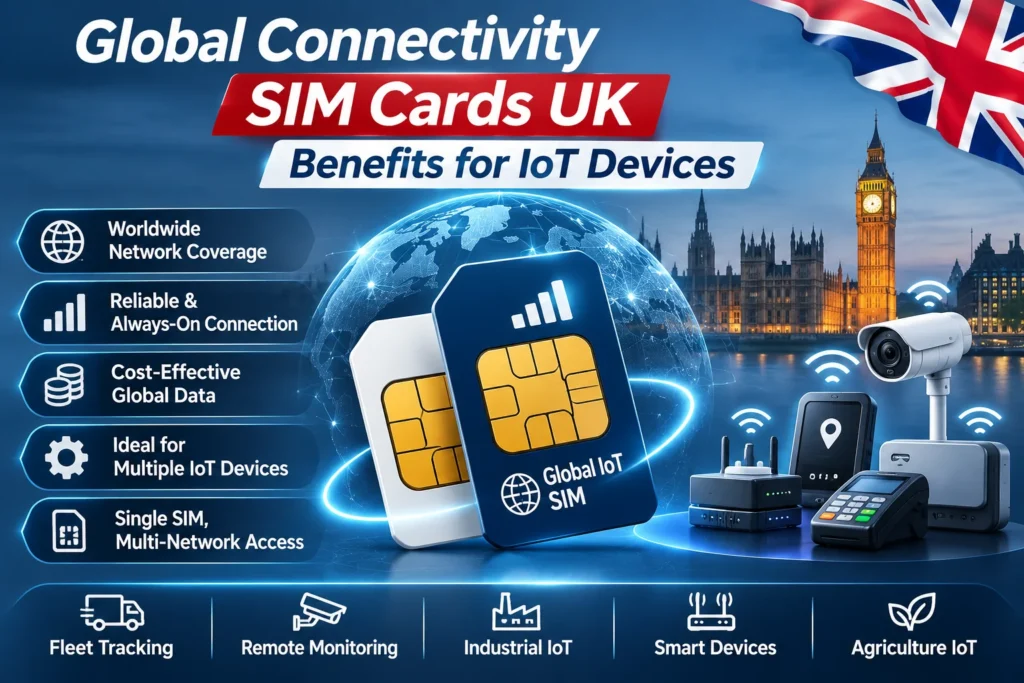
Connected technology is transforming how businesses monitor equipment, vehicles, machinery and remote devices. From GPS tracking systems and smart sensors to industrial monitoring equipment, reliable mobile connectivity is essential for many Internet of Things applications.
Global Connectivity SIM Cards UK businesses can use are designed to help connected devices communicate across different mobile networks and countries. They can simplify connectivity management for organisations operating equipment in multiple locations.
Understanding how these SIM cards work, what features they provide and how to choose the right service can help businesses make informed decisions.
What Are Global Connectivity SIM Cards?
Global connectivity SIM cards are designed to provide mobile network access for connected devices across multiple regions or countries.
Depending on the provider, the SIM may connect to different supported networks through roaming agreements or other connectivity arrangements.
Unlike a traditional consumer mobile SIM, an IoT SIM may be designed for long-term device deployment, remote management and automated data communication.
When comparing Global Connectivity SIM Cards UK, businesses should review supported countries, networks, data packages and device compatibility.
1. International Network Coverage
One of the main benefits of global IoT connectivity is the ability to support devices operating in different countries.
A connected device may use an available supported network rather than relying on a single domestic mobile provider.
Coverage depends on the SIM provider’s agreements, supported technologies and local network availability.
Before choosing Global Connectivity SIM Cards UK, check the coverage map for every country where your devices will operate.
2. Simplified Connectivity Management
Businesses operating devices across different regions may otherwise need multiple SIM providers and separate connectivity arrangements.
Global IoT SIM solutions can simplify this process by providing a central platform for managing connections.
Depending on the provider, businesses may be able to activate SIMs, monitor usage, review data consumption and manage connected devices from one account.
This can make Global Connectivity SIM Cards UK useful for organisations with large or geographically distributed IoT deployments.
3. Connectivity for GPS Trackers
Vehicle tracking systems often rely on mobile data to transmit location information to a tracking platform.
For trackers used internationally, a suitable IoT SIM can support communication across different countries, subject to network availability.
This can be useful for logistics businesses, fleet operators and asset management companies.
However, a global SIM does not guarantee uninterrupted connectivity. GPS reception and mobile network availability can still affect tracking performance.
4. IoT Connectivity for Remote Equipment
Many IoT devices operate in locations where regular manual access is difficult.
Examples include:
- Environmental monitoring sensors.
- Agricultural equipment.
- Industrial machinery.
- Smart energy systems.
- Remote security equipment.
- Connected vending machines.
- Asset tracking devices.
Global Connectivity SIM Cards UK can help businesses connect devices operating across different geographical areas, provided the relevant networks and technologies are supported.
5. Flexible Data Plans
IoT devices often have different data requirements from smartphones.
Some devices send small amounts of information periodically, while others transmit larger quantities of data.
Connectivity providers may offer different packages based on data usage, SIM quantity or deployment requirements.
Before choosing Global Connectivity SIM Cards UK, estimate how much data your devices use and review the pricing structure.
Check whether the package includes:
- Monthly or annual data allowances.
- Shared data pools.
- Pay-as-you-go options.
- Usage alerts.
- SIM management tools.
- International roaming.
6. Remote SIM Management
Some IoT connectivity platforms provide remote management tools.
Depending on the provider, businesses may be able to monitor SIM status, review usage, activate or deactivate connections and manage billing.
Remote management can reduce the need to physically access every device when connectivity administration is required.
When evaluating Global Connectivity SIM Cards UK, consider the platform’s usability, account permissions and security features.
7. Scalability for Growing IoT Businesses
IoT deployments can begin with a small number of devices and expand over time.
A connectivity provider should be able to support the business’s expected growth.
Consider whether the platform can manage hundreds or thousands of SIM cards, provide useful reports and support different data requirements.
The scalability of Global Connectivity SIM Cards UK can be an important factor for businesses planning long-term connected device deployments.
Choosing the Right IoT SIM Provider
Before purchasing IoT SIM cards, review the provider’s network coverage, supported technologies, pricing and support arrangements.
Check whether the SIM supports your device’s required network technology and whether the service is suitable for the deployment location.
Some devices require particular network technologies, while others may support several options.
It is also important to consider security. Businesses should use appropriate device authentication, access controls and secure data transmission arrangements.
Common IoT Connectivity Mistakes
Businesses should avoid choosing a SIM based only on its advertised international coverage.
Coverage does not automatically mean that every network or technology is available in every location.
Other common mistakes include underestimating data usage, ignoring roaming costs, failing to check device compatibility and overlooking platform management fees.
When selecting Global Connectivity SIM Cards UK, compare the complete service rather than focusing solely on the SIM purchase price.
Frequently Asked Questions
1. What are global IoT SIM cards?
They are SIM cards designed to provide connectivity for IoT devices across supported mobile networks and geographical regions.
2. Can global IoT SIM cards work in multiple countries?
Many are designed for international connectivity, but coverage depends on the provider’s network agreements and supported countries.
3. Are IoT SIM cards different from regular mobile SIM cards?
They may offer different data packages, management platforms, roaming arrangements and deployment features designed for connected devices.
4. Can I use a global IoT SIM in a GPS tracker?
Many GPS trackers support IoT SIM cards, but compatibility depends on the device and network technology.
5. Do IoT SIM cards require monthly subscriptions?
Pricing varies. Providers may offer monthly plans, annual packages, usage-based pricing or other arrangements.
6. Can businesses manage multiple IoT SIM cards?
Many providers offer management platforms that allow businesses to monitor and administer multiple connections.
7. What data allowance do IoT devices need?
Data requirements depend on the device, transmission frequency, application and amount of information being sent.
8. Are global IoT SIM cards suitable for vehicle tracking?
They can be suitable for compatible tracking devices operating in supported locations. Check network coverage, device compatibility and service terms.
Conclusion
Global IoT connectivity can help businesses operate connected devices across different regions without managing multiple connectivity providers.
Global Connectivity SIM Cards UK can provide benefits such as international network access, flexible data packages, centralised SIM management and scalability for growing IoT deployments.
Before choosing a provider, compare network coverage, supported technologies, data costs, device compatibility and management features. A suitable connectivity solution can help businesses maintain reliable communication between their connected devices and digital platforms.