
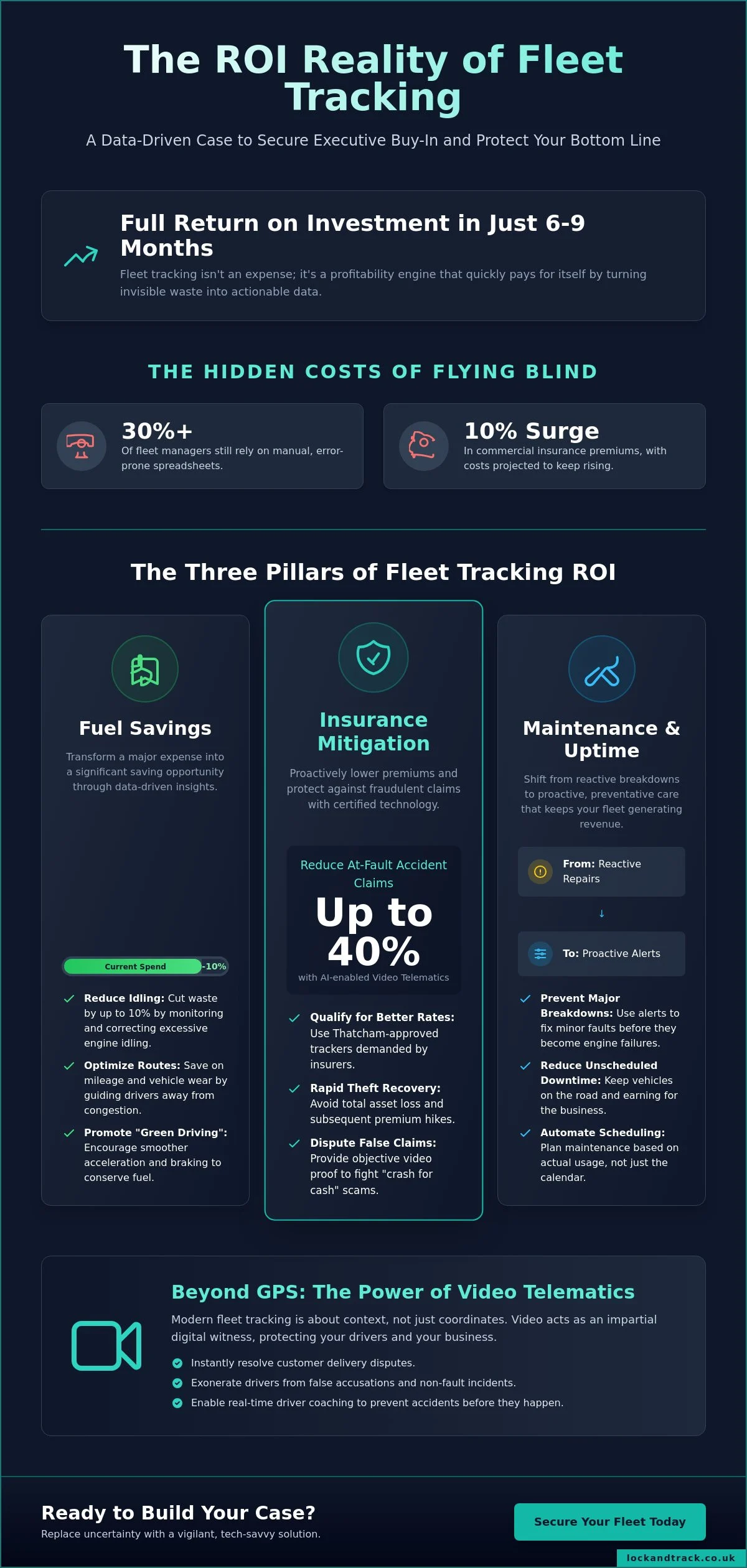
Over 30% of fleet managers still rely on manual spreadsheets in 2026, even as commercial insurance premiums continue to climb following a 10% surge in recent years. You understand that flying blind is a liability, but your leadership might still view GPS as a “big brother” expense rather than a vital security asset. It is frustrating to face rising fuel costs and delivery disputes without the data to fight back.
Learning how to convince my boss we need fleet tracking starts with shifting the focus from surveillance to absolute operational protection.
You can prove that fleet tracking is a profitability engine that typically pays for itself within nine months. This guide provides a professional, data-driven strategy to secure executive buy-in and protect your company’s bottom line.
We will examine a clear ROI roadmap, techniques to handle driver pushback, and how dashcam video telematics can reduce at-fault accident claims by up to 40%. It is time to replace uncertainty with a vigilant, tech-savvy solution that secures your assets and your reputation.
Key Takeaways
- Identify the three pillars of profit, fuel, insurance, and maintenance, to demonstrate how tracking pays for itself.
- Leverage video telematics to provide the context needed to resolve customer disputes and delivery complaints instantly.
- Reframe the internal conversation from surveillance to safety to protect drivers from false accusations.
- Follow a step-by-step roadmap on how to convince my boss we need fleet tracking using your company’s own data.
- Access nationwide mobile installation through Thatcham-approved engineers for a seamless, professional rollout.
The ROI Reality: Proving Fleet Tracking Pays for Itself
Your leadership team prioritizes the bottom line. When you are building a case for how to convince my boss we need fleet tracking, you must speak the language of Return on Investment (ROI). Fleet tracking is not a luxury; it is a direct response to the three pillars of profit: fuel, insurance, and maintenance.
In the current UK economic climate, where operational costs are volatile, these three areas represent the largest opportunities for immediate savings. Most businesses see a full return on their investment within six to nine months. This is because a professional Vehicle tracking system transforms invisible waste into actionable data.
Direct Fuel Savings and Idling Reduction
Excessive engine idling is a silent drain on company bank accounts. In the UK, fuel spend can be cut by up to 10% simply by monitoring and reducing unnecessary idling time. Every minute a van sits with the engine running is profit evaporating. Fleet tracking provides the visibility needed to identify these habits and correct them. Beyond idling, route optimization reduces total mileage across the UK road network.
By guiding drivers away from congestion and toward more efficient paths, you save on both fuel and vehicle wear. Implementing “green driving” scores also encourages smoother acceleration and braking. These small behavioral changes lead to significant long-term preservation of your fleet assets.
Insurance Compliance and Premium Mitigation
Commercial auto insurance premiums are projected to continue rising through 2026. This makes insurance mitigation a central part of your business case. Many insurers now demand the installation of Thatcham approved vehicle trackers UK to qualify for competitive rates.
These certifications prove to providers that you have taken professional steps to secure your assets. High-end trackers also offer a massive cost benefit when comparing recovery versus replacement. If a vehicle is stolen, a rapid recovery saves the business from the total loss of the asset and the subsequent premium hike. Integrated dashcam evidence also protects the firm from “crash for cash” scams; providing objective proof that can save thousands in legal fees.
Maintenance scheduling is the final piece of the ROI puzzle. Instead of reacting to breakdowns, you can use preventative maintenance alerts to identify minor faults. This ensures that a small oil leak doesn’t become a seized engine. Keeping your vehicles in peak condition reduces unscheduled downtime and keeps your team on the road, where they are actually generating revenue.
Beyond GPS: Leveraging Video Telematics and Security
Simple GPS coordinates provide location, but they rarely provide the whole truth. When you are exploring how to convince my boss we need fleet tracking, you must explain that modern telematics is about context. Video telematics acts as a digital witness for every mile your drivers travel. It transforms a simple dot on a map into a comprehensive record of service and safety.
This technology is a critical component in a broader guide for efficient fleet management, ensuring that your business is protected from both external threats and internal inefficiencies.
The Power of Dashcam Integration
Integrated dashcam video telematics is the ultimate tool for reducing liability. Statistics show that AI-enabled dash cams can reduce at-fault accident claims by 20-40%. This isn’t just about recording crashes. These systems use AI to detect events like harsh braking or tailgating, allowing for real-time driver coaching before an accident occurs.
When a non-fault incident does happen, having immediate video evidence speeds up the insurance claims process significantly. It eliminates the “he-said, she-said” disputes that often lead to expensive, prolonged legal battles. Your boss needs to know that this technology doesn’t just watch drivers; it exonerates them.
Total Asset Protection
Security goes beyond the vehicle itself. Your vans and HGVs often carry thousands of pounds in specialized tools and cargo. High-specification hardware like S5 and S7 trackers provide an essential layer of defense. These devices are monitored by professional centers, meaning your leadership team doesn’t have to manage alerts in the middle of the night.
If a theft is attempted, the system handles the response. For businesses facing keyless theft risks, the Ghost Immobiliser offers a sophisticated solution that prevents the engine from starting without a unique code. This proactive approach prevents theft-related downtime and the massive costs of replacing stolen equipment. You can explore integrated security options to see how these tools work together to create a fortress around your fleet.
By shifting the conversation from “tracking” to “total asset protection,” you address the boss’s fear of loss. You are offering a solution that preserves the company’s physical assets and its reputation.
This isn’t just a software subscription; it is a security strategy that ensures the business keeps moving without interruption. It represents a move toward a more resilient and tech-savvy operation.
Countering the ‘Big Brother’ Objection
The most common hurdle in any telematics rollout is the fear of “Big Brother” monitoring. When you are researching how to convince my boss we need fleet tracking, you must address this human element head-on. Leadership often worries that a new system will damage morale or cause valued drivers to leave. You can neutralize this concern by reframing the technology as a digital witness.
It is a tool designed to protect the driver’s reputation, not to spy on their every move. In an industry where “nuclear verdicts” and false claims are rising, having an objective record of a driver’s location and behavior is a massive security asset.
Tracking provides the definitive proof needed to dismiss false customer complaints. If a client claims a delivery was missed or a driver was reckless, the data provides the resolution. It transforms a stressful dispute into a simple verification of facts. Furthermore, the safety benefits are undeniable. If a vehicle breaks down in a remote location or an emergency occurs, the office knows exactly where to send help.
This proactive approach to safety builds a culture of security rather than one of suspicion. This U.S. DOT case study on fleet tracking ROI demonstrates that when data is used transparently, it creates a more efficient and protected environment for the entire workforce.
Framing Tracking as Driver Support
Modern systems actually reduce the administrative burden on your team. Automated timesheets eliminate the need for manual mileage logs, allowing drivers to focus on the road instead of paperwork. This also ensures they are paid accurately for every minute they work. For UK employers, tracking is a vital tool for fulfilling “Duty of Care” obligations. It ensures that no driver is left isolated in a high-risk situation.
To maintain trust, you can suggest implementing “Privacy Modes” for vehicles used for personal use outside of working hours. This allows the business to protect its assets during the day while respecting the driver’s personal time in the evening.
Rewarding Excellence
Data allows you to move beyond punishment and focus on recognition. You can use driver scores to identify the best performers in your fleet. This creates an opportunity for a “Driver of the Month” scheme or performance-based bonuses. By gamifying safety and efficiency, you turn tracking into a positive incentive. 85% of fleet managers report that GPS tracking has improved productivity, and much of that comes from empowering drivers to hit their targets. Recognizing excellence reduces staff turnover and encourages a higher standard of professional driving across the entire company. It turns a surveillance tool into a platform for career growth and rewards.
Building Your Business Case: A Step-by-Step Pitch
To successfully learn how to convince my boss we need fleet tracking, you must arrive at the meeting with hard evidence. Do not speak in generalities. Bring the last twelve months of fuel receipts and insurance claim logs. Highlight specific instances where a lack of visibility cost the company money. This might be a late delivery that resulted in a refund or a vehicle repair that could have been avoided with early diagnostic alerts. When you present these figures, you aren’t just asking for new software; you are offering a solution to existing financial leaks.
Focus on the pain points that leadership feels most acutely. Are you losing expensive tools from the back of vans? Are maintenance bills spiraling because drivers are ignoring warning lights? Frame the tracking system as a “Self-Funding” investment. Explain that the savings generated from reduced fuel waste and lower insurance premiums will cover the subscription costs. Position it as a way to reclaim lost revenue rather than an additional overhead expense. Scheduling a formal demo of the management platform can then prove how intuitive and time-saving the daily oversight will be.
The ‘Cost of Doing Nothing’ Analysis
The risk of inaction is far greater than the cost of implementation. Consider the financial reality: the monthly subscription for a professional tracker is a small fraction of the cost of losing a single vehicle and its contents to theft. Research indicates that fleet management systems typically reduce annual operating costs by 5% to 15% within the first year. Without real-time updates, you are also at a competitive disadvantage. Customers in 2026 expect precise delivery windows. Failing to provide them will eventually drive your clients toward more tech-savvy competitors who offer better transparency.
The Implementation Plan
A low-friction rollout is key to gaining executive approval. Suggest starting with a pilot group of vehicles to demonstrate immediate ROI. This limits the initial investment and allows you to refine your internal data policies before a full-scale launch. Our nationwide mobile installation service ensures that your fleet stays operational throughout the process. We install the hardware at your premises, meaning zero downtime for your drivers and no logistical headaches for the office.
Emotional weight often seals the deal in a pitch. Mention a recent car tracker success story where a high-value asset was recovered within hours of being stolen. This proves that the technology works in real-world scenarios to prevent catastrophic loss. You can book a professional consultation today to tailor a security plan that meets your specific fleet requirements and budget.
Partnering for Nationwide Implementation with Lock and Track
The final hurdle in learning how to convince my boss we need fleet tracking is proving that the transition will be seamless. Leadership often fears that installing new hardware will ground the fleet for days, leading to lost revenue and logistical chaos. Lock and Track eliminates this concern through a network of Thatcham-approved engineers who provide comprehensive nationwide coverage. We understand that your vehicles are only making money when they are on the road. Our team specializes in professional fitting that preserves your manufacturer warranties while ensuring every device meets the highest industry standards for security and compliance. Lock and Track engineers are security specialists who treat your fleet with the vigilance your business deserves.
When you explain this to your leadership, emphasize that our methods are non-invasive. We protect the vehicle’s electrical integrity, which is vital for maintaining the manufacturer’s warranty. This level of care transforms a technical upgrade into a long-term asset preservation strategy. We don’t just provide hardware; we provide the tranquility that comes from knowing your assets are monitored by experts. This proactive approach is the most effective way to turn a complex security need into a simple, reliable solution for the entire company.
Nationwide Installation, Locally Delivered
Our mobile units are designed for your maximum convenience. We reach any location across the UK, whether that is your main depot, a driver’s home, or a third-party dealership. This flexibility allows for a rollout that fits your specific operational schedule, not ours. Professional fitting is not just about convenience; it is a requirement for insurance validity. A poorly installed car immobiliser or tracker can lead to claim denials if a theft occurs. We provide the technical expertise to ensure your security stack is robust and recognized by major UK insurers. Additionally, our 24/7 technical support ensures that fleet managers are never left without guidance during the implementation phase.
Scalable Solutions for Any Fleet
No two businesses have identical requirements. We manage fleets ranging from a single van to 10,000 vehicles, offering hardware that scales with your growth. You might start with basic GPS for a small delivery team or require full S5 PLUS tracking systems for high-value HGVs and specialized equipment. Our reporting suites are fully customizable, providing the specific data UK business owners need to optimize their operations without unnecessary ornamentation. This tailored approach ensures you aren’t paying for features you don’t use while maintaining the vigilance required to protect your assets. Book a consultation with our fleet specialists today to finalize your implementation plan and secure your business case with absolute confidence.
Secure Your Fleet’s Future Today
The business case for 2026 is definitive. Fleet tracking is no longer just about location; it is a vital shield against rising fuel costs and soaring insurance premiums. By presenting a data-driven ROI roadmap and highlighting the protective power of video telematics, you shift the narrative from surveillance to absolute asset security. Understanding how to convince my boss we need fleet tracking is the first step toward a more resilient and profitable operation. You’re not just asking for a subscription; you’re proposing a strategy for long-term preservation.
Lock and Track provides the technical foundation for this transition. Our Thatcham-approved engineers offer nationwide coverage, managing fleets from 1 to 10,000 vehicles with professional precision. We handle the installation at your workplace or home to ensure your vehicles stay on the road while we secure them. This professional approach preserves your warranties and guarantees insurance compliance from day one. It is time to replace operational uncertainty with the tranquility of real-time monitoring and rapid recovery.
Get a bespoke fleet tracking quote for your business and start protecting your bottom line today. You have the facts and the plan to build a stronger, safer company.
Frequently Asked Questions
Will fleet tracking lower our business insurance premiums?
Yes, installing Thatcham-approved tracking systems often qualifies your business for insurance premium reductions. Insurers view these devices as a proactive risk mitigation strategy. It proves you have professional security measures in place to facilitate rapid recovery. This reduces the likelihood of a total loss claim. This is a major factor in how to convince my boss we need fleet tracking, as it directly cuts fixed annual overheads.
How do I explain the new tracking system to my drivers without causing friction?
Frame the system as a professional safety tool and a digital witness that protects them from false accusations. Explain how it automates administrative tasks like mileage logs. It also provides immediate support during breakdowns. Transparency is key to building trust. Share your data policies early to prove that the goal is asset preservation and driver security rather than invasive monitoring of their personal time.
Can fleet tracking help with HMRC mileage claims and compliance?
Automated fleet tracking systems generate precise, time-stamped logs that simplify HMRC mileage claims and ensure full regulatory compliance. These digital reports eliminate the errors associated with manual spreadsheets. You provide the tax office with accurate data on business versus private use. This precision is essential for protecting the company from audits. It also saves your team hours of frustrating administrative work every month.
What happens if a vehicle is stolen while a tracker is fitted?
The system immediately alerts a 24/7 monitoring center to initiate the recovery process. Professional security specialists coordinate with local police to track and restore the asset. This applies to high-spec hardware like Scorpion S5 or S7 trackers. This high-tech pursuit significantly increases the chances of a successful recovery. It prevents the vehicle from being stripped or moved before help arrives.
Is the installation process going to take our vans off the road for long?
No, professional mobile installation is designed to minimize operational downtime by fitting the hardware at your workplace or home. Our engineers work around your schedule. This ensures your fleet stays active and productive. This is a critical point when learning how to convince my boss we need fleet tracking. It proves the transition is efficient, professional, and entirely non-disruptive to your daily business flow.
Can we track vehicles in real-time on a mobile app?
Yes, modern fleet management platforms include dedicated mobile apps for real-time visibility from any location. You can monitor vehicle status and receive instant security alerts. You even view live dashcam feeds directly on your smartphone. This ensures you remain in control of your assets even when you aren’t at your desk. It provides a constant sense of security and oversight for your entire operation.
Do we need different trackers for vans, cars, and HGVs?
While the core GPS technology is similar, we provide specialized hardware like GPS Van Trackers and Truck Trackers tailored to specific vehicle needs. Different assets may require varying levels of security. For example, high-value HGVs often benefit from an S5 PLUS Tracker. This ensures you have the correct level of protection and data reporting for every specific vehicle type in your commercial fleet.