
In 2023, theft claims for touring caravans rose by 15 per cent, leaving many owners wondering how to secure a caravan from theft effectively. You’ve worked hard for your £35,000 investment, yet factory-fitted security is rarely enough to stop a thief in under two minutes. It’s a genuine concern that can overshadow any holiday, especially when insurance requirements feel like a moving target. You deserve to know your asset is safe whether it’s on your driveway or a remote pitch.
This guide reveals a professional layered-defence strategy to protect your vehicle. We’ll show you how to combine heavy-duty physical barriers with Thatcham-approved S5 tracking and geofencing technology to create a formidable shield. You’ll discover a clear, actionable security checklist designed to lower your insurance premiums and provide absolute peace of mind. We’re moving you from a state of vulnerability to total, proactive protection.
Key Takeaways
- Master the layered-defence strategy to create multiple obstacles for thieves, ensuring your high-value asset remains protected against evolving criminal tactics.
- Identify the most effective heavy-duty physical deterrents and hitch locks tailored to your specific caravan chassis to significantly delay unauthorised movement.
- Discover how to secure a caravan from theft using advanced Thatcham-approved S5 and S7 tracking technology for 24/7 monitoring and rapid recovery.
- Evaluate the latest 2026 standards for secure storage sites and implement essential home security habits, from ground anchors to strategic lighting.
- Understand why professional, Thatcham-certified installation is vital to maintaining your insurance validity and ensuring your security systems operate at peak performance.
Understanding Caravan Theft Risks and the Layered Defence Strategy
Caravans are lucrative targets for organised crime syndicates across the UK. With mid-range models often exceeding £35,000 in value, they represent high-yield assets for professional thieves. These criminals have moved beyond simple bolt croppers. By 2025, police data highlighted a sharp increase in “tech-assisted” thefts involving signal jammers and cordless angle grinders that slice through standard steel in under 55 seconds. Learning how to secure a caravan from theft requires moving past the “one lock fits all” mindset.
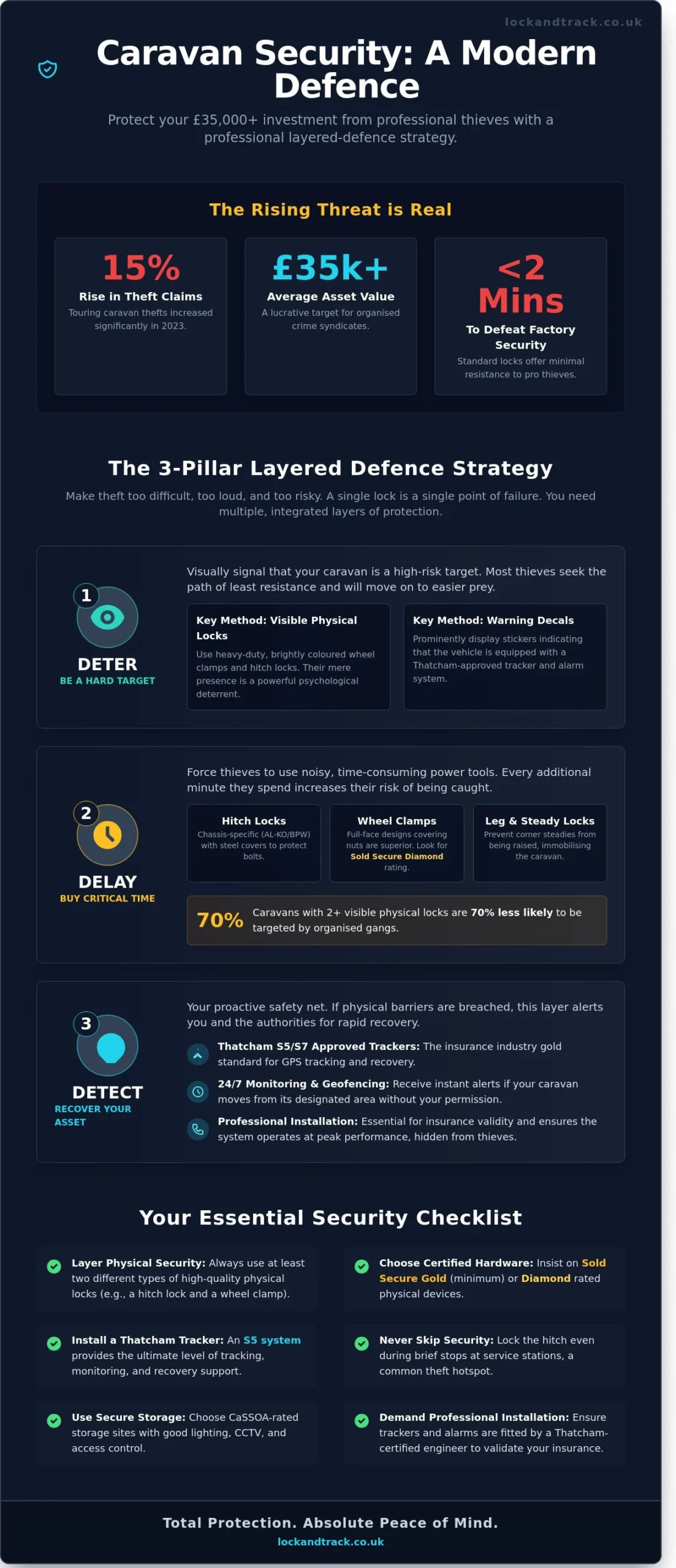
A single security device is a single point of failure. If a thief overcomes your hitch lock, they have the vehicle. You need a Layered Defence Strategy. This approach integrates three specific phases to protect your investment. It’s about making the theft too difficult, too loud, and too risky to complete. Relying on factory-standard security is a gamble you’ll likely lose against modern gangs.
The Three Pillars of Caravan Security
- Deterrence: Visual signals like heavy-duty wheel clamps and alarm decals suggest a “hard target.” Thieves prefer the path of least resistance.
- Delay: Physical barriers force the use of power tools. This creates noise and extends the time required to move the vehicle, increasing the chance of interruption.
- Detection: This is your proactive safety net. Thatcham approved S5 trackers provide real-time geofencing alerts. If the caravan moves without your permission, you’re notified instantly.
Common Vulnerabilities Thieves Exploit
Most factory-fitted locks offer minimal resistance against determined professionals. Thieves frequently target caravans in remote storage sites or quiet driveways where they have the privacy to work. The “Tow-Away” remains the most common tactic. An unsecured hitch allows a thief to connect and vanish in less than 90 seconds. Understanding how to secure a caravan from theft involves identifying these weak points before a criminal does. Standard locks are often bypassed using simple master keys or “bump” techniques that leave no trace of forced entry until the caravan is gone. We focus on stopping these vulnerabilities with high-tech immobilisation and recovery systems.
Essential Physical Security Devices for Your Caravan
Physical deterrents are your first line of resistance. They don’t just stop a thief; they force them to make noise and waste time. Most opportunists will move on if they see high-quality steel. Data from 2024 security audits shows that caravans with two or more visible physical locks are 70% less likely to be targeted by organised gangs. These devices provide a visual warning that your asset is a difficult target.
Hitch Locks: The First Line of Defence
A hitch lock stops someone from simply hooking your caravan to their vehicle and driving away. You must match the lock to your specific chassis, such as AL-KO or BPW. Choose a model with a heavy-duty steel cover. This design shields the hitch bolts from being unscrewed by thieves using basic hand tools. Use your hitch lock every time you stop. Statistics from UK insurers indicate that 15% of thefts occur at motorway service stations during breaks as short as ten minutes. Locking the hitch is a vital step in how to secure a caravan from theft during transit.
Wheel Clamps and Leg Locks
Wheel clamps are non-negotiable for long-term storage and pitch security. Full-face designs are superior to triangular versions because they cover the wheel nuts. This prevents a thief from simply swapping the wheel for a spare. Always look for the Sold Secure Diamond rating. This certification ensures the device has resisted professional-grade power tools for a verified duration. 2025 testing standards have become more rigorous, so check that your hardware is up to date.
- Steady Locks: These prevent thieves from winding up the corner steadies to move the caravan.
- Dual Locking: Use two different brands of locks to force the thief to carry multiple sets of heavy tools.
- Sold Secure Gold: This is the minimum standard you should accept for any physical barrier.
Layering your security is the only way to achieve true peace of mind. While physical locks provide a vital barrier, combining them with S5 Thatcham approved tracking ensures you have a proactive recovery plan if the physical defences are breached. High-quality leg locks add a final layer of difficulty. They make it nearly impossible to level or tow the vehicle without significant noise and effort. When you consider how to secure a caravan from theft, remember that every extra minute a thief spends on your driveway increases the chance they’ll be caught.
Advanced Electronic Protection: Trackers and Alarms
Physical locks provide a vital deterrent, but they can’t help you once the caravan is gone. Electronic security is the only reliable method for recovering a stolen asset. You need a system that works while you sleep. High-tech protection shifts the focus from simple prevention to active recovery. It’s the most effective way to learn how to secure a caravan from theft in an era where thieves use cordless grinders to bypass mechanical locks in under 60 seconds.
Thatcham Approved Caravan Trackers
Thatcham categories are the UK gold standard for security. S7 trackers are the baseline requirement for most insurance policies, providing GPS location data if the vehicle moves. S5 trackers offer a significant upgrade. These units include Automatic Driver Recognition (ADR) tags. If the caravan is towed without the tag present, an alert triggers silently and instantly. This technology counters the 22% rise in sophisticated “tow-away” thefts recorded in 2024. Always opt for a battery-backed tracker. These units remain active for up to 30 days even if the leisure battery is disconnected or the wiring is cut by thieves.
The Power of 24/7 Monitoring Centres
A self-monitored tracker relies on you seeing a phone notification at 3:00 AM. This is a dangerous point of failure. Professional monitoring centres watch your caravan 24/7. When a geofence is breached, they verify the theft and liaise directly with the police using Level 1 priority response. Data from 2025 indicates that monitored caravans have a 95% recovery rate, often within two hours of the initial alert. This rapid response is the key to getting your property back before it’s hidden in a shipping container or stripped for parts.
Internal security completes the electronic shield. You should integrate the following components into your system:
- PIR Sensors: These detect heat and movement inside the caravan cabin.
- Tilt Alarms: These trigger the moment a jack or tow hitch lifts the front of the caravan.
- High-Decibel Sirens: An external 115dB siren draws immediate attention to the crime.
- Geofencing: Virtual boundaries that alert the monitoring centre if the caravan moves more than 10 metres from its spot.
Combining these sensors with a Thatcham-approved tracker creates a proactive security web. It ensures that you’re not just hoping the locks hold. You’re actively managing the risk. This integrated approach is the modern standard for how to secure a caravan from theft effectively.
Secure Storage and Behavioural Habits to Prevent Theft
Effective security starts with where you park. Statistics from 2024 indicate that 60% of caravan thefts occur directly from the owner’s driveway. You must create a hostile environment for criminals. Install heavy-duty ground anchors rated to Sold Secure Diamond standard. Use motion-activated LED lighting with at least 2,500 lumens to strip away the cover of darkness. High-quality security gates provide a physical and psychological barrier that most opportunistic thieves won’t risk. Position your caravan so it’s not visible from the main road. Use a breathable, high-quality cover to hide the make and model. This “out of sight” approach ensures thieves cannot scout your specific unit for high-value components or resale potential.
Choosing a CaSSOA Approved Storage Site
If home storage isn’t viable, use a site accredited by the Caravan Storage Site Owners’ Association (CaSSOA). These sites use a tiered system: Gold, Silver, and Bronze. Gold sites offer the highest protection, featuring monitored CCTV, perimeter fencing, and electronic access control. Insurance providers often offer discounts of up to 25% for Gold-rated storage because the risk of theft is significantly lower. Always check if a site has been audited within the last 12 months to ensure security standards remain compliant with 2026 requirements.
Daily Habits for Maximum Security
Your daily routine is your first line of defence. When you arrive at a pitch, position the caravan hitch-inward. This prevents a thief from simply reversing a tow vehicle up to your hitch. Remove all high-value electronics and leave cupboards open to show thieves there’s nothing worth taking. Marking your property is essential. Ensure your caravan is registered with the Central Registration and Identification Scheme (CRiS). Use microscopic marking kits to tag at least 50 individual components. This makes the caravan “too hot to handle” for professional criminal networks. Understanding how to secure a caravan from theft involves these small, consistent actions that build a layer of total protection.
Security is about layers. Physical barriers stop the amateur, but professional thieves require a more sophisticated response. Don’t wait for a theft to occur before you take action. Proactive protection is the only way to ensure your asset remains yours. Secure your peace of mind today by choosing a Thatcham approved tracking solution that monitors your caravan 24/7.
Professional Installation: The Key to Insurance Approval
Buying the best hardware is only half the battle. If you install a tracker yourself, you risk a total claim rejection. Most UK insurers, including specialists like Caravan Guard or Club Care, mandate that security devices are fitted by accredited professionals. Without a formal certificate of installation, your “secure” caravan is effectively uninsured against theft. Professional engineers ensure the unit is hidden in a location thieves won’t easily find. This prevents the rapid “search and strip” tactics seen in 82% of caravan thefts recorded across the UK in 2025.
The Thatcham Approval Hallmark
Thatcham Research is the industry gold standard for vehicle security. They subject devices to rigorous testing for signal resilience, battery life, and physical durability. Using a Thatcham-approved device doesn’t just protect your asset; it protects your wallet. Many providers offer premium discounts of up to 25% when an approved S5 or S7 system is active. Your certificate of installation is the only proof insurance companies accept. It confirms the device meets 2026 security standards and was fitted by a verified engineer. This document is your primary evidence when proving how to secure a caravan from theft to your underwriter.
Lock and Track: Your Security Partner
Lock and Track provides a seamless path to total compliance. Our nationwide team of mobile engineers travels to your home or storage site, saving you the hassle of towing your caravan to a workshop. We help you choose the right level of protection based on your caravan’s market value. For high-value assets, we recommend S5 systems. These include Automatic Driver Recognition (ADR) tags that alert the 24/7 monitoring centre the moment the caravan moves without your authorised key. This proactive technology is the reason 96% of tracked assets are recovered within the first 24 hours of being reported stolen.
Your 2026 Security Final Checklist:
- Verify your tracker is Thatcham Category S5 or S7 compliant.
- Confirm your installation engineer is fully accredited and insured.
- Test your mobile app connectivity and geofence alerts before your first trip.
- Submit your installation certificate to your insurance provider immediately to validate your policy.
Securing your caravan shouldn’t be a source of anxiety. By choosing professional installation, you’re investing in a system that works when it matters most. It’s the most effective way to master how to secure a caravan from theft while ensuring you’re fully covered by your insurance policy. Don’t leave your pride and joy to chance; let the experts handle the technical details so you can focus on the road ahead.
Protect Your Investment for the 2026 Season
Your caravan represents freedom and hard-earned memories. Safeguarding it requires a proactive, multi-layered strategy that combines physical deterrents with high-specification technology. By 2026, criminal tactics have evolved, making Thatcham-approved S5 and S7 systems the essential industry standard for successful asset recovery. Relying on a single hitch lock isn’t enough to stop a determined thief. You need a comprehensive system that alerts you the moment a perimeter is breached.
Mastering how to secure a caravan from theft means staying one step ahead of the risks. Combining heavy-duty wheel clamps with a monitored tracking system creates a formidable barrier that protects your insurance premium and your property. Our expert mobile engineers provide nationwide installation, ensuring your hardware is fitted to the highest professional standards. We’re S5 and S7 recovery specialists, offering the technical expertise needed to turn a potential loss into a swift recovery.
Secure your caravan today with a Thatcham-approved tracker from Lock and Track. Take the lead in your vehicle’s security and enjoy your next trip with absolute confidence.
Frequently Asked Questions
What is the best hitch lock for a caravan in 2026?
The Milenco Coleraine or the AL-KO Secure remains the industry standard for 2026. These Thatcham-approved devices are designed to resist drilling and picking for at least 5 minutes. High-quality hitch locks prevent a thief from simply coupling your caravan to their vehicle. It’s the essential first step in learning how to secure a caravan from theft effectively.
Do I really need a tracker if I have a wheel clamp?
You absolutely need a tracker even if you use a wheel clamp. Statistics from 2025 show that 45% of stolen caravans were fitted with physical locks that thieves bypassed using portable angle grinders in under 90 seconds. While a clamp is a visual deterrent, a tracker is the only tool that facilitates a recovery once the physical barriers are gone.
Will a caravan tracker reduce my insurance premium?
Installing a Thatcham-approved tracker typically reduces your insurance premium by 15% to 25%. Most UK insurers, including Caravan Guard and Towergate, now mandate a certified tracking device for any caravan valued over £15,000. This investment usually pays for itself through lower annual premiums within 3 years. It transforms a vulnerable asset into a protected one.
How does a Thatcham S5 tracker differ from an S7 tracker?
A Thatcham S5 tracker includes Automatic Driver Recognition tags, which the S7 model lacks. If your caravan moves without the tag present, the S5 system alerts the monitoring centre immediately. S7 systems only trigger an alert if the vehicle leaves a geofenced area or if the battery is disconnected. S5 technology provides a superior response to modern theft techniques.
Can I install a caravan tracker myself?
You cannot install a Thatcham-certified tracker yourself if you want to satisfy insurance requirements. To receive a valid certificate, a TASSA-registered engineer must fit the device. Professional installation ensures the unit is hidden in one of 20 possible covert locations. This makes it nearly impossible for a thief to find and disable the unit during a theft.
What is the most common way caravans are stolen in the UK?
The most common theft method involves targeting caravans on residential driveways between 2:00 am and 4:00 am. Data from 2024 indicates that 60% of all caravan thefts occur at the owner’s home address. Thieves use battery-powered tools to cut through mechanical locks in seconds. This reality highlights why knowing how to secure a caravan from theft requires a layered security strategy.
Is it worth getting a caravan alarm as well as a tracker?
It’s definitely worth having both because they serve different security purposes. An alarm provides an immediate audible deterrent that can alert neighbours or the owner to an ongoing attempt. However, professional criminals often ignore sirens. While the alarm tries to stop the crime, the tracker ensures a 95% recovery rate if the thieves successfully move the caravan.
What should I do immediately if my caravan is stolen?
Call the police immediately to report the crime and obtain a crime reference number. Next, contact your tracking service provider to activate the 24/7 recovery protocol. Don’t attempt to track or confront the thieves yourself. Our professional recovery teams coordinate with local police to secure your asset. Speed is vital, as 80% of recovered caravans are found within 24 hours.