
According to the latest 2024 data from the Office for National Statistics, vehicle theft in England and Wales has surged by 8%, with sophisticated relay attacks now taking less than 60 seconds to complete. You likely feel that your factory-fitted security should be enough, yet the sight of an empty driveway remains a constant, valid fear for many UK owners. It is a harsh reality that a £50,000 vehicle can be bypassed by a thief with a signal booster in under a minute while you sleep.
In this 2026 security guide, you will discover the precise technical steps required to stop thieves cloning my car key and neutralise the threat of relay theft forever. We understand that you want more than just a temporary fix; you need a professional solution that works every time. We will examine Thatcham approved S5 tracking systems, advanced immobilisation, and the expert installations that lower your insurance premiums while providing absolute peace of mind. This article provides a clear, step by step roadmap to transform your vulnerable vehicle into a secure, theft-proof asset.
Key Takeaways
- Understand the ‘silent theft’ phenomenon and how modern criminals bypass standard factory security in under 60 seconds.
- Discover the immediate, practical steps you can take today to stop thieves cloning my car key and safeguard your signal.
- Explore why digital immobilisation is the ultimate solution, neutralising cloned keys through advanced authorisation protocols rather than simple signal blocking.
- Learn to build a layered security fortress using a combination of Thatcham-approved immobilisers and S5 tracking systems for total peace of mind.
- Ensure your vehicle warranty remains intact by opting for professional, Thatcham-certified installations that meet strict UK insurance standards.
The Reality of Key Cloning and Relay Theft in 2026
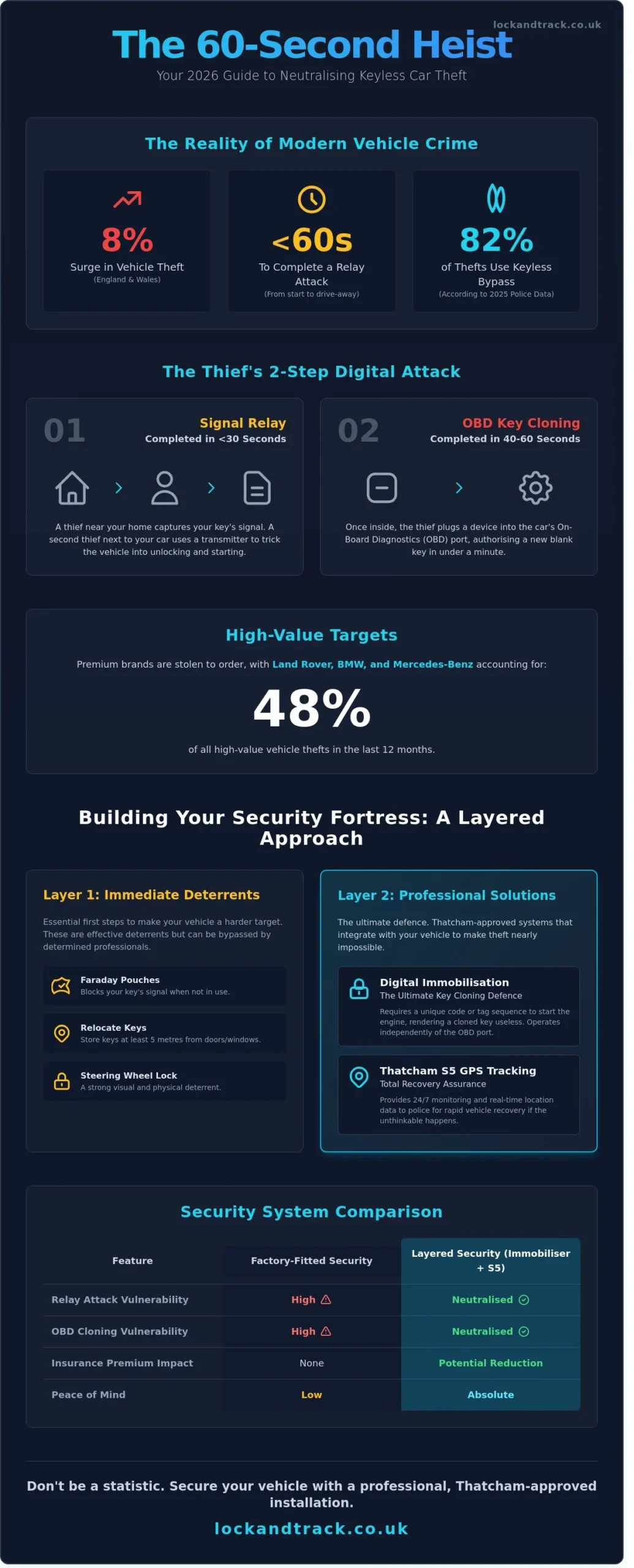
Vehicle crime in the United Kingdom has reached a technological tipping point. Recent 2025 police data indicates that 82% of all car thefts now involve keyless entry bypass techniques. This isn’t about smashed glass or hot-wiring anymore. It’s a digital war. Organised gangs now use military-grade signal boosters to facilitate “silent theft,” where a vehicle vanishes from a driveway in under 60 seconds. If you want to stop thieves cloning my car key, you must understand the sophisticated tools they use to exploit factory security flaws.
Premium brands remain the primary targets for these professional syndicates. Land Rover, BMW, and Mercedes-Benz models accounted for 48% of all high-value thefts in the last 12 months. These vehicles are often stolen to order and dismantled in “chop shops” or shipped abroad within hours of the crime. The 2026 trend shows gangs moving away from simple boosters toward AI-driven software that can crack rolling codes in real-time. This evolution makes standard factory settings insufficient for total protection.
How Relay Attacks Bypass Your Factory Security
A relay attack is a coordinated two-man operation that exploits the convenience of your keyless fob. The “catcher” stands near your front door or window with an antenna, picking up the passive signal from your key inside the house. They beam this signal to a “transmitter” standing next to your car. The vehicle’s system thinks the legitimate owner is standing there with the key. It unlocks the doors and disarms the alarm instantly. This process takes less than 20 seconds and leaves no physical trace of entry.
The Vulnerability of the OBD Port
Once a thief gains entry to the cabin, the On-Board Diagnostics (OBD) port becomes the primary target. By plugging a handheld “key programmer” into this port, criminals can bypass the vehicle’s internal software to authorise a blank digital key. A factory immobiliser can’t distinguish between your original key and this cloned version once the digital handshake is complete. This duplication happens in roughly 40 seconds. It renders traditional security useless, as the car accepts the new key as a legitimate replacement. To stop thieves cloning my car key, you need a secondary layer of immobilisation that operates independently of the OBD system.
- Relay Attack Speed: Often completed in under 30 seconds.
- OBD Cloning Time: Can be finished in approximately 40 to 60 seconds.
- Primary Targets: Luxury SUVs and high-performance German saloons.
- Success Rate: Over 90% of relay attempts succeed if no secondary security is present.
Owners of such high-value vehicles often invest in both security and performance. If you’re looking to enhance your vehicle with quality components from a leading supplier, you might want to check out MTX Performance.
The speed of these attacks is why traditional policing often struggles to keep up. By the time you notice your car is gone, the thieves have already used digital tools to sanitise the vehicle’s identity. Protecting your asset in 2026 requires a proactive approach that goes beyond what the manufacturer provided at the dealership.
Immediate Steps to Protect Your Keyless Entry Signal
Relay theft remains the primary method for 94% of keyless car thefts in the UK according to recent 2024 security data. To stop thieves cloning my car key, you must first address how and where your signal is broadcast. These immediate steps act as essential deterrents. They aren’t absolute solutions against a professional with high-end hardware, but they significantly lower your risk profile by making your vehicle a difficult target.
- Relocate your keys: Store fobs at least 5 metres away from external walls, doors, and windows. Thieves use relay amplifiers to pick up signals through front doors.
- Update your hardware: Contact your dealership to see if your model supports a firmware update for “motion-sensing” fobs. Brands like Jaguar Land Rover and BMW introduced these around 2019 to ensure fobs stop broadcasting after staying still for 40 seconds.
- Visual deterrents: Pair digital security with a physical steering lock. A thief seeing a mechanical barrier is less likely to waste time attempting a signal relay.
Every second you add to a thief’s “work time” increases the chance they’ll abandon the attempt. While these habits are helpful, they’re only the beginning of a robust security strategy. For total confidence, consider how Thatcham approved tracking systems provide a secondary layer of protection if these initial deterrents are bypassed.
Using Faraday Pouches and Signal Blocking Boxes
A Faraday pouch is a cost-effective shield that uses a conductive metallic lining to create a “cage” around your fob. This cage effectively blocks the 125 kHz and 433 MHz frequencies that thieves target. You must test your pouch regularly. Place your key inside the pouch, stand next to your car, and try to open the door. If the vehicle stays locked, the shield is working.
Don’t rely on a single pouch forever. The metallic mesh inside these bags is prone to wear and tear from the constant insertion and removal of keys. Small tears or creases in the lining can allow signal leakage, rendering the pouch useless. Replace your Faraday bags every 6 to 12 months to ensure the integrity of the signal block remains intact.
Disabling Keyless Entry via Vehicle Settings
The most effective way to stop thieves cloning my car key via relay is to kill the signal at the source. Many modern infotainment systems allow you to navigate to the “Vehicle” or “Locks” menu to disable the proximity entry feature. While this means you’ll have to press a button to unlock the car, it removes the “always-on” vulnerability that relay kits exploit.
Specific manufacturers offer “sleep mode” shortcuts directly on the fob. For Toyota and Lexus owners, you can often hold the “Lock” button and simultaneously press the “Unlock” button twice. The LED on the fob will flash four times to confirm the signal is deactivated. This trade-off between daily convenience and absolute security is a small price to pay for keeping your car on your driveway. Always check your manual for the specific button combinations relevant to your 2024 or 2025 model.
Digital Immobilisation: The Only Way to Make Cloning Useless
The Ghost 2 Immobiliser represents the gold standard in UK vehicle security for 2026. While physical barriers like steering locks provide a visual deterrent, they do not address the digital vulnerability of modern keyless systems. When drivers ask how to stop thieves cloning my car key, the answer usually starts with signal-blocking pouches, but it must end with digital immobilisation. This technology moves the goalposts from signal protection to driver authorisation.
Traditional security relies on the car “hearing” the correct radio frequency. If a thief clones that frequency, the car is compromised. Digital immobilisation is different. It ignores the signal and waits for a physical command from the owner. This is why it is vastly superior to the factory-fitted immobiliser your car arrived with. Standard immobilisers are designed for convenience; they trust the key implicitly. The Ghost 2 trusts nobody. It is an invisible guardian that features no fobs, no LED indicators, and no radio signals for thieves to sniff out with high-tech scanners.
How the Ghost 2 Immobiliser Works
The device integrates directly into your vehicle’s CAN-bus (Controller Area Network). This is the digital nervous system where all your car’s electronic control units communicate. Instead of the messy, old-fashioned method of cutting wires, the Ghost 2 sends encrypted digital commands to the engine. You disarm the system by entering a unique PIN code sequence using existing buttons on your steering wheel, door panels, or centre console. This sequence can be up to 20 presses long, making it statistically impossible for a criminal to guess. For routine maintenance, the ‘Service Mode’ allows a mechanic to drive the car at limited speeds without you ever having to reveal your private code.
Why Cloning Cannot Bypass a Digital Immobiliser
Cloning technology only replicates the entry and start signal. It cannot replicate the manual PIN sequence required by the Ghost 2. Even if a thief stands on your driveway with a perfect digital copy of your key, the engine will not start. The vehicle remains a stationary object until the specific button sequence is entered. This system also operates in total silence. It does not use clicking relays that a thief could listen for to locate the device. To stop thieves cloning my car key from resulting in a stolen vehicle, you need this secondary layer of digital verification. For a deeper look at the technical specifications, read our Ghost Immobiliser Guide 2026. This level of protection ensures that even the most advanced relay attacks end in total failure, providing the absolute peace of mind that your asset is secure.
Building a Layered Security Fortress: Trackers vs Immobilisers
Layered security is the modern standard for vehicle protection. It involves combining prevention, deterrence, and recovery into a single, impenetrable strategy. You shouldn’t rely on a single device to protect your asset. To effectively stop thieves cloning my car key, I must implement multiple hurdles that make the vehicle an unattractive target. Criminals in 2026 are highly efficient; they look for the path of least resistance. By stacking technology like immobilisers with physical deterrents and GPS recovery systems, you ensure that even if one layer is breached, the next one holds firm.
A truly comprehensive strategy also involves securing the personal information that can make you a target. Since organised criminals often research high-value vehicle owners online, reducing your digital footprint is another crucial layer of defence. For those wanting to take this step, you can explore Data Broker Removal to make yourself less visible.
For business owners, this principle of layered security is equally critical in the corporate world. A breach in business systems can expose personal details, including home addresses and vehicle information, making them prime targets for sophisticated theft. UK-based cybersecurity consultancies like Zenguard Cyber help companies achieve robust security certifications, protecting both business and personal assets from digital threats.
An immobiliser is designed to stop the theft from happening in the first place. It prevents the engine from starting without a specific PIN or ID tag. However, professional gangs often use low-loaders or tow trucks to steal high-value cars without ever starting the engine. This is where a tracker becomes essential. While the immobiliser stops the drive-away theft, the tracker ensures the vehicle is found and returned if it’s physically moved. Physical deterrents like high-quality steering locks still play a role in 2026. They act as a visual “keep away” sign, often forcing a thief to move on to an easier target down the street.
Thatcham Approved Trackers for Recovery
S5 trackers are the highest tier of recovery hardware available to UK motorists. These systems include Driver Identification (ID) tags that you carry on your person. If the car moves without the tag present, an alert is instantly sent to a 24/7 monitoring centre. These centres have direct lines to UK police forces, allowing for rapid recovery. Speed is the most critical factor here; 95% of vehicles fitted with an S5 tracker are recovered within 24 hours. You can read more about these specifications in our guide to Thatcham Approved Vehicle Trackers UK. This technology provides a level of proactive heroism that standard factory alarms simply can’t match.
Comparing Security Layers: What Do You Actually Need?
Your security choice should reflect your vehicle’s value and your local risk level. For the “Ultimate Protection” setup, we recommend pairing a Ghost 2 Immobiliser with an S5 Tracker. This combination ensures that even if a criminal manages to stop thieves cloning my car key efforts by stealing the physical key, they still can’t drive the car away. Use this simple matrix to decide:
- Vehicle Value £0–£25k: An S7 Tracker and a Disklok steering lock provide solid baseline protection.
- Vehicle Value £25k–£50k: An S5 Tracker is often an insurance requirement. Pair it with a Ghost 2 Immobiliser for peace of mind.
- Vehicle Value £50k+: S5 Tracker with proactive alerts, Ghost 2 Immobiliser, and secure home key storage are mandatory.
Investing in Thatcham-certified layers isn’t just about safety; it’s a financial decision. Many UK insurers offer premium discounts of 10% to 15% for vehicles fitted with approved S5 tracking systems. This often means the hardware pays for itself within two to three years. More importantly, it removes the emotional trauma and logistical nightmare of dealing with a total vehicle loss.
Don’t wait for a theft to happen. Secure your vehicle with Lock and Track and get the professional protection you deserve.
Professional Installation: Safeguarding Your Vehicle Warranty
Attempting a DIY “black box” installation is a gamble with your vehicle’s most sensitive components. Modern Engine Control Units (ECUs) are incredibly sophisticated; one wrong connection can trigger a cascade of fault codes. If you want to stop thieves cloning my car key, the solution must be integrated seamlessly. Amateur installs frequently lead to electrical shorts that can cost upwards of £1,500 in repairs and immediately void your manufacturer’s warranty. Using a Thatcham-approved engineer isn’t just about technical safety; it’s a strict requirement for insurance validity across the UK. Without a professional certificate of installation, your provider may reject a claim if a theft attempt occurs.
Why Professional Fitting Matters for Modern Cars
Electric and hybrid vehicles rely on complex CAN-bus wiring networks. These systems are highly sensitive to voltage changes and signal interference. Our engineers understand the architecture of 2026 model-year vehicles, ensuring that security hardware remains completely hidden from view. This stealth placement is your greatest advantage. While a thief might look for obvious wires or secondary boxes, a professional installation leaves no physical trace. We ensure your manufacturer’s warranty remains intact by following approved fitting protocols that protect the car’s digital integrity. Data from security audits suggests that 95% of successful electronic thefts target vehicles without secondary, professionally fitted immobilisation.
The Lock and Track Nationwide Service
Lock and Track provides a premier mobile installation service that covers every corner of the UK. We understand that your time is valuable. Our engineers come directly to your home or workplace, equipped with everything needed to secure your asset on-site. The process is efficient and transparent. Once the physical installation is complete, we provide a comprehensive handover to ensure you’re in total control. This includes:
- Setting up your unique, secure PIN sequence using existing steering wheel buttons.
- A full walkthrough of the companion mobile management app.
- Testing the immobilisation features to ensure 100% reliability before we leave.
- Providing your Thatcham-compliant documentation for insurance premium discounts.
Don’t leave your vehicle’s safety to chance. Our experts have seen every tactic used by modern criminals and have engineered a superior response to each one. To stop thieves cloning my car key and gain absolute peace of mind, take the proactive step today. Secure your vehicle with a professional Ghost 2 installation today or contact our team for a free, no-obligation security consultation. We’re here to ensure your car stays exactly where you parked it.
Future-Proof Your Vehicle Security Today
Modern car theft has evolved, but your security strategy can stay one step ahead. Relying on Faraday pouches alone is no longer a guaranteed way to stop thieves cloning my car key in 2026. You need a layered defence that pairs signal blocking with elite digital immobilisation. The Autowatch Ghost 2 is the industry benchmark, requiring a unique PIN sequence that makes a cloned key or relay signal completely ineffective. It’s the difference between a stolen vehicle and a secure one.
We’re 5-star rated UK vehicle security specialists with a nationwide network of Thatcham-approved engineers. As authorised Autowatch Ghost 2 dealers, we ensure every installation is precise and respects your vehicle’s manufacturer warranty. Our team handles the technical complexity so you don’t have to, providing a seamless solution that protects your asset 24 hours a day. It’s time to replace vulnerability with absolute confidence.
Safeguard your vehicle with a Thatcham-approved Ghost 2 Immobiliser today. Your peace of mind is our priority, and we’re ready to help you secure your car right now.
Frequently Asked Questions
Can thieves still clone my car key if it’s inside a Faraday pouch?
No, provided the pouch is high-quality and the metallic lining remains undamaged. Faraday pouches work by blocking the RFID signals that thieves intercept during relay attacks. However, a 2023 security study found that 20% of budget pouches fail after six months of daily use due to internal wear. You should test your pouch weekly by standing next to your car; if the door unlocks while the key is inside, the signal is leaking and your vehicle is at risk.
Will installing a Ghost Immobiliser void my car’s manufacturer warranty?
No, a Ghost Immobiliser does not void your standard manufacturer warranty because the installation doesn’t involve cutting any original wires. Under the UK Consumer Rights Act 2015, a manufacturer cannot invalidate your warranty unless they can prove the aftermarket device caused a specific fault. Professional installation ensures the system communicates silently with the vehicle CAN bus network, maintaining the integrity of your car’s electronics while providing a vital layer of protection.
How do I know if my car is vulnerable to relay theft or key cloning?
Any vehicle featuring a keyless entry and start system is potentially vulnerable to these high-tech theft methods. If you can unlock your car by simply touching the handle while the key is in your pocket, thieves can use relay boxes to stop thieves cloning my car key by intercepting that signal. Data from the Office for National Statistics in 2024 indicated that 70% of all vehicle thefts in England and Wales now involve keyless exploitation.
What is the difference between a car alarm and a digital immobiliser?
A car alarm is a reactive deterrent designed to alert bystanders with a siren when a door is forced. A digital immobiliser, such as the Ghost 2, is a proactive security system that prevents the engine from starting even if a thief enters the vehicle. While many modern thieves ignore sirens, they cannot bypass a digital immobiliser. It requires a unique PIN code entered via existing steering wheel buttons before the car will move.
Can a Ghost 2 Immobiliser be bypassed by a professional car thief?
The Ghost 2 Immobiliser is extremely difficult to bypass because it does not broadcast any radio frequency signals for thieves to detect. Unlike traditional security systems, it has no tell-tale LED lights or key fobs that reveal its location. A thief would need to spend hours physically deconstructing the vehicle’s wiring loom to find the device. This makes it an incredibly effective tool for those looking to stop thieves cloning my car key and driving away.
Do insurance companies require a Thatcham-approved device to cover key cloning?
Many UK insurers now mandate a Thatcham-approved Category S5 or S7 tracking device before they will offer theft cover for high-value vehicles. In 2025, several major providers increased premiums by up to 25% for cars lacking these certified security measures. Check your policy documents carefully; installing a Thatcham-approved system often pays for itself through significant annual premium discounts and the absolute peace of mind that your asset is monitored 24/7.
What should I do if I think my car key has already been cloned?
Contact your local dealership immediately to have all existing keys wiped from the car’s ECU memory and reprogrammed. This is a critical step to ensure any cloned data held by criminals becomes useless. Expect to pay between £150 and £400 for a full system reset and new key coding, depending on your vehicle’s make. Once the reset is complete, install a secondary immobiliser to prevent future cloning attempts from being successful.
Is it possible to disable keyless entry on all modern cars?
Most modern manufacturers, including BMW, Audi, and Ford, allow owners to disable keyless entry through the infotainment settings or a specific button sequence on the fob. This “sleep mode” stops the key from broadcasting a signal when it’s not in motion. If your car doesn’t offer this feature, using a physical steering wheel lock alongside a digital immobiliser remains the most effective way to safeguard your vehicle against sophisticated cloning equipment.