
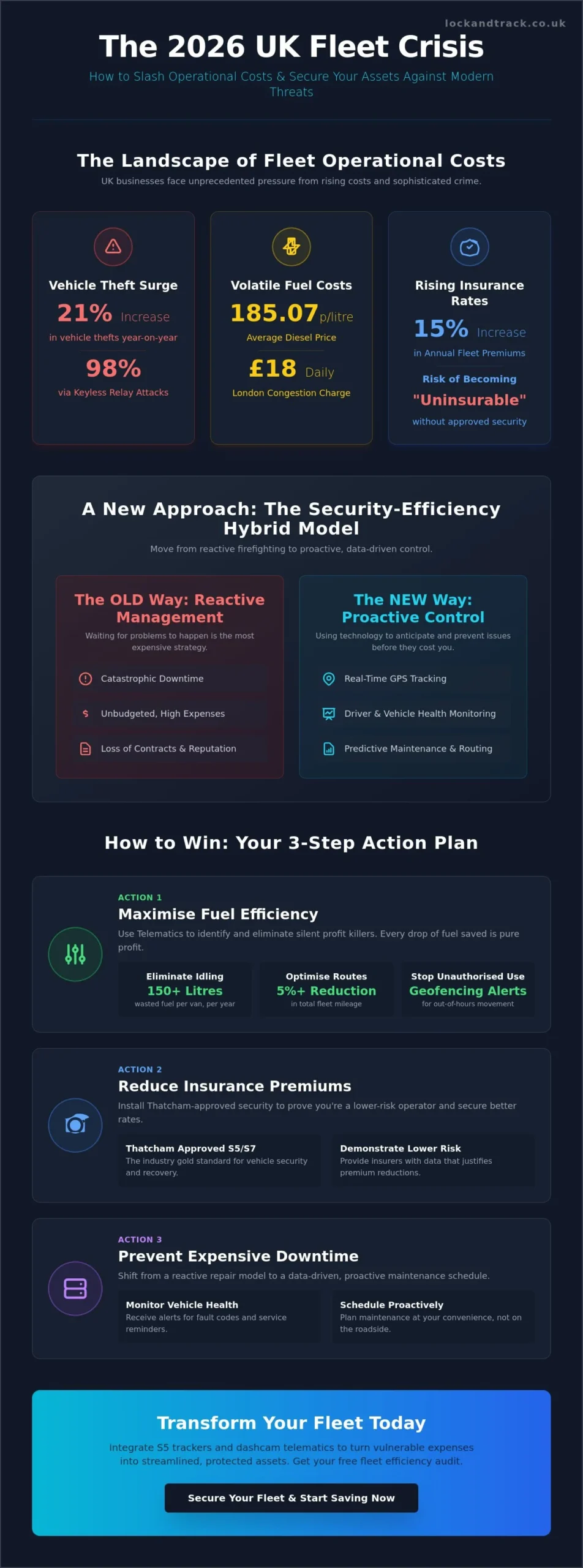
Did you know that 98% of modern vehicle thefts are now executed via keyless relay attacks? With vehicle thefts up 21% in the last year, your strategy for reducing fleet operational costs uk must start with total asset security. You’re likely feeling the strain of diesel prices at 185.07 pence per litre and insurance premiums climbing by 15%. It’s a heavy burden to carry while you’re simply trying to keep your drivers on the road and your business profitable.
We understand the anxiety of watching your margins shrink due to factors that feel outside your control. This 2026 guide will show you exactly how to slash fuel, insurance, and maintenance overheads while securing your fleet against sophisticated theft. We’ll explore how integrating S5 trackers and dashcam telematics can transform your fleet from a vulnerable expense into a streamlined, protected asset that gives you absolute peace of mind.
Key Takeaways
- Identify the specific 2026 economic pressures that make reducing fleet operational costs uk a critical priority for your business survival.
- Eliminate fuel wastage from idling and poor routing by implementing real-time GPS tracking and precision route optimization.
- Lower your annual insurance premiums by securing your assets with Thatcham-approved S5 or S7 tracking systems.
- Prevent expensive vehicle downtime by transitioning from reactive repairs to a data-driven proactive maintenance model.
- Ensure your security upgrades are installed correctly and efficiently through nationwide mobile engineer services at your depot.
The Landscape of Fleet Operational Costs in the UK for 2026
Managing a commercial fleet in 2026 requires a precise understanding of five core pillars: fuel, maintenance, insurance, labour, and depreciation. For UK businesses, these pillars are currently under significant economic strain. With diesel prices averaging 185.07 pence per litre and unleaded petrol at 158.78 pence, fuel remains the most volatile variable in your ledger. However, simply focusing on the pump price is a mistake. True success in reducing fleet operational costs uk requires a shift from reactive management to a proactive “Security-Efficiency Hybrid” model.
Reactive management is the most expensive way to run a business. Waiting for a vehicle to break down or an asset to be stolen before taking action leads to catastrophic downtime and unbudgeted expenses. In contrast, a hybrid model uses Telematics and Route Optimisation to monitor vehicle health and driver behaviour in real time. This technical oversight ensures that every mile driven contributes to the bottom line rather than eroding it through idling, poor routing, or preventable mechanical failure.
The Escalating Cost of Vehicle Theft in the UK
Vehicle theft in England and Wales increased by 21% in the year ending March 2025. This trend has continued into 2026, driven by sophisticated “stolen-to-order” gangs. The financial impact of a stolen vehicle extends far beyond the physical asset. You must account for the loss of specialized equipment, the cost of temporary rentals, and the potential loss of long-term contracts due to missed service windows. These rising risks have caused fleet insurance rates to spike by up to 15%. If your fleet lacks Thatcham-approved security, you risk becoming “uninsurable” as providers move away from high-risk, unprotected operators.
Fuel and Emissions: The Constant Budget Pressure
Fuel price volatility is now a structural risk for UK firms. Beyond the cost at the pump, emissions compliance has become a major financial factor. With the 2026 ZEV mandate requiring 24% of new van sales to be electric, and stricter London Congestion Charges now at £18 daily, the cost of non-compliance is high. Implementing fleet tracking solutions UK provides the granular data needed for environmental audits and route planning. By identifying fuel-wasting habits like excessive idling or harsh braking, you can reclaim lost margins and ensure your fleet remains compliant with evolving UK regulations.
Maximising Fuel Efficiency Through Telematics and Route Optimisation
Fuel remains the most significant variable expense for any UK operator. With diesel prices holding at 185.07 pence per litre in May 2026, every drop of wasted fuel directly erodes your profitability. True success in reducing fleet operational costs uk depends on both software and hardware optimizations. Integrating services like mobile engine remapping northumberland allows you to improve engine efficiency at the source, while telematics systems provide the technical oversight needed to identify behavioral inefficiencies that are otherwise invisible to fleet managers.
Data consistently shows a direct correlation between smoother driving styles and lower fuel consumption. High-tech monitoring detects harsh braking, rapid acceleration, and speeding. These habits don’t just burn more fuel; they accelerate vehicle wear and increase maintenance frequency. By implementing a system of accountability, you can foster a culture of efficiency that preserves both your fuel budget and your assets. Many businesses are also looking toward government incentives for fleet efficiency to support the transition to more sustainable, cost-effective transport models.
Eliminating Idling and Unauthorised Use
Excessive idling is a silent profit killer. If a single van in your fleet idles for just 30 minutes a day, it can waste over 150 litres of fuel annually. For a fleet of 20 vehicles, this equates to thousands of pounds in avoidable expenditure. Geofencing technology adds another layer of protection by creating digital boundaries around approved routes and depots. If a vehicle deviates for an unauthorised detour or is used outside of working hours, you receive an immediate alert. This prevents fuel theft and ensures your vehicles are only moving when they are generating revenue. Setting up automated alerts for out-of-hours movement is a simple, proactive step toward total cost control.
Route Planning: Reducing Miles, Not Deliveries
AI-driven routing is essential for navigating the complex UK road network. These systems account for real-time traffic patterns, M25 bottlenecks, and scheduled roadworks to ensure your drivers take the most efficient path possible. Reducing your total fleet mileage by even 5% has a massive cumulative effect. It lowers your fuel bill, reduces tyre wear, and slows vehicle depreciation, which helps maintain higher resale values. Integrating dashcam video telematics allows you to verify route efficiency and provides visual evidence in the event of an incident. This combination of visual and GPS data ensures your fleet operates at peak performance. If you want to see how these technologies work together, exploring professional fleet tracking options is the best place to start.
Reducing Insurance Premiums with Thatcham Approved Security
Insurance is no longer a static expense in your ledger. In 2026, UK fleet insurance rates have spiked by up to 15%, driven largely by the 21% increase in vehicle thefts. If you’re serious about reducing fleet operational costs uk, you must address your fleet’s risk profile. Insurers reward operators who implement Thatcham-approved hardware because it drastically reduces the likelihood of a total loss payout. Standard GPS tracking is often insufficient for modern underwriting. You need certified systems that provide active recovery capabilities and driver identification.
A comprehensive UK fleet efficiency guide often highlights the importance of risk management as a pillar of cost control. Beyond the premium itself, the hidden cost of theft is the “downtime” expense. When a vehicle is stolen, your business stops. You lose the asset, the specialized tools inside, and the billable hours for that day and the weeks following. High security ratings act as a financial shield against these catastrophic disruptions. Secure your assets now to ensure your business remains profitable and resilient.
Understanding S5 and S7 Tracker Standards
Thatcham security standards are divided into categories that dictate how a vehicle is monitored and recovered. S7 trackers provide essential GPS tracking and are the baseline requirement for most commercial policies. However, for high-value assets or vehicles operating in high-risk areas, insurers typically mandate the S5 standard. S5 trackers include Automatic Driver Recognition (ADR) tags. These tags identify authorised drivers and alert the monitoring centre immediately if the vehicle moves without one. This prevents “key theft” scenarios where a thief steals physical keys to bypass standard security measures. Choosing the right standard depends on your vehicle type and the level of risk your insurer identifies.
The Ghost 2 Immobiliser: Preventing Total Asset Loss
While trackers help recover a vehicle after the fact, the Ghost 2 Immobiliser prevents it from being moved in the first place. This device is a critical tool for reducing fleet operational costs uk because it neutralises relay attacks and key cloning. It doesn’t use radio frequency signals that can be jammed or intercepted. Instead, it requires a unique PIN code entered via the vehicle’s existing buttons. Even if a thief has your keys, the engine will not start. Professional, nationwide installation is vital for insurance validity. Insurers only recognize these upgrades when fitted by certified engineers, ensuring the system is integrated correctly into the vehicle’s CAN-bus network.
Proactive Maintenance: Preventing Expensive Downtime
Every hour a vehicle spends in the workshop is an hour it isn’t earning revenue. In the context of reducing fleet operational costs uk, the “Van Off Road” (VOR) status is one of the most significant hidden expenses an operator faces. A reactive “break-fix” approach often results in emergency repairs that cost significantly more than a scheduled service. By using telematics to track engine hours and mileage in real time, you can move to a data-driven proactive model. This ensures that maintenance is performed exactly when needed, rather than waiting for a component to fail and cause a cascade of secondary issues.
The DVSA updated its inspection manuals for HGVs and PSVs on April 1, 2026, clarifying standards for critical components like sideguards and brake systems. Compliance is no longer just about safety; it’s about financial preservation. Monitoring tyre pressure and brake wear via telematics doesn’t just prevent accidents. It extends the life of your consumables. When you maintain optimal tyre pressure, you improve fuel economy and prevent premature replacement. This level of technical oversight transforms your maintenance department from a cost centre into a streamlined efficiency engine.
Automating Service Schedules
Driver Behaviour and Vehicle Longevity
There is a direct link between how a vehicle is driven and how long its parts last. Harsh braking, rapid acceleration, and aggressive cornering put immense stress on the drivetrain and suspension. Implementing driver league tables incentivises “mechanical sympathy” across your team. When drivers know their behaviour is monitored, they naturally adopt smoother styles that preserve the vehicle. The return on investment for driver training is immediate when informed by actual telematics reports. You can target specific bad habits that are causing excessive wear. To begin automating your maintenance and protecting your bottom line, explore our fleet tracking solutions today.
Lock and Track: Your Partner in UK Fleet Efficiency
Lock and Track acts as a specialized guardian for your mobile assets. We recognize that reducing fleet operational costs uk requires more than just software; it demands a physical infrastructure of security and support. By integrating high-spec telematics with Thatcham-certified immobilisation, we eliminate the fragmented approach that often leaves fleets vulnerable. Our goal is to provide a single, manageable solution that protects your vehicles while optimizing their performance on the road. We don’t just provide hardware; we provide the tranquility that comes with total asset oversight.
Most fleet management strategies overlook the fact that Thatcham-approved hardware is a primary negotiating tool for lower insurance premiums. When you present your insurer with a fleet-wide S5 or S7 certification, you force a re-evaluation of your risk profile. This technical credibility is a powerful lever for reducing fleet operational costs uk. It transforms your security spend from a sunk cost into a strategic investment that pays dividends through lower annual overheads and the elimination of theft-related downtime.
Nationwide Installation Without Operational Downtime
Scalability is a primary concern for growing UK businesses. Our engineers travel directly to your location, whether that’s a central depot, a driver’s home, or a dealership. This mobile service ensures your vehicles remain productive without the need for time-consuming workshop visits. Every installation is performed by a Thatcham-approved engineer. This is critical for preserving your manufacturer’s warranty and ensuring your insurance provider accepts the security upgrade. We provide consistent, high-standard service for fleets of all sizes, from a single van to 10,000 HGVs.
Custom Security Packages for Diverse Fleets
Not every vehicle faces the same level of risk. A truck carrying high-value electronics requires a different level of protection than a local delivery van. We tailor our car trackers and immobilisation systems to match your specific risk profile. Choosing high-spec hardware like the Scorpion S5 PLUS provides long-term value by offering the highest level of recovery support available. It’s a proactive response to the sophisticated tactics used by modern thieves.
UK operators have successfully used our systems to reclaim lost margins and secure their future growth. One logistics firm reported a significant reduction in overheads after deploying Scorpion tracking across their 50-vehicle fleet. They eliminated “moonlighting” and reduced their fuel spend by identifying idling hotspots that were previously invisible to management. This integrated approach is the most effective way to protect your bottom line in 2026. Contact us for a fleet security audit to start your transition to a more secure, efficient operation.
Future-Proof Your Fleet Strategy for 2026 and Beyond
The path to reducing fleet operational costs uk is no longer just about monitoring fuel prices. It requires a total commitment to asset security and data-driven efficiency. By integrating Thatcham-approved S5 or S7 trackers and automating your maintenance schedules, you transform your fleet into a resilient, streamlined operation. You’ve seen how route optimization and theft prevention directly protect your bottom line. Now’s the time to move from a state of vulnerability to one of complete control.
We are specialists in S5 and S7 insurance-approved trackers, providing nationwide Thatcham-approved installation at your location. Whether you manage a single van or a massive fleet of 10,000 vehicles, our engineers ensure your security upgrades meet the highest industry standards. Don’t leave your assets to chance in a high-risk environment. Secure your fleet and reduce costs with a Lock and Track consultation today. Take the lead in efficiency and watch your margins grow as you secure your business’s future.
Frequently Asked Questions
How much can fleet tracking actually save my UK business?
Fleet tracking provides the technical oversight needed to reclaim lost margins from fuel wastage and vehicle downtime. By identifying excessive idling and optimizing delivery routes, you can see immediate reductions in your daily fuel spend. It also eliminates the massive capital expense associated with replacing stolen vehicles and equipment.
Will installing trackers and immobilisers lower my fleet insurance premiums?
Yes, insurers reward operators who implement Thatcham-approved security measures. By installing S5 or S7 trackers, you demonstrate a proactive approach to risk management. This allows you to negotiate lower annual premiums based on a significantly reduced likelihood of total asset loss.
What is the difference between an S5 and an S7 tracker for a business fleet?
The primary difference is the level of driver identification. S5 trackers include Automatic Driver Recognition (ADR) tags to prevent theft via stolen keys. S7 trackers provide standard GPS tracking and recovery assistance. S5 is generally the required standard for high-value assets or vehicles operating in high-risk UK regions.
Can fleet tracking help reduce fuel consumption even with rising prices?
Yes, it addresses the driver behaviors that contribute most to fuel wastage. Monitoring for harsh acceleration, speeding, and idling is a primary lever for reducing fleet operational costs uk. Correcting these habits ensures your vehicles achieve maximum fuel economy regardless of the price at the pump.
Does Lock and Track offer nationwide installation for large commercial fleets?
Yes, we provide nationwide mobile installation services at your depot, workplace, or dealership. Our engineers are Thatcham-approved, ensuring every device is fitted to professional standards. This service is designed to be scalable for fleets ranging from a single van up to 10,000 commercial vehicles.
How does a Ghost Immobiliser integrate with existing fleet telematics?
The Ghost 2 Immobiliser operates independently on the vehicle’s CAN-bus network to prevent unauthorized engine starts. It acts as a physical security layer that complements your telematics software. While your tracking system monitors location and health, the immobiliser ensures the vehicle cannot be moved without a unique PIN.
What is the most common cause of high fleet operational costs in the UK?
Fuel inefficiency and rising insurance premiums are the leading drivers of high operational costs. In 2026, the 21% increase in vehicle thefts has made insurance a major financial burden. Implementing a strategy focused on reducing fleet operational costs uk through security and telematics is the only way to counteract these external pressures.
Can telematics data be used to defend against false insurance claims?
Yes, GPS and dashcam video telematics provide objective evidence of vehicle speed, location, and driver behavior. This data is vital for disputing “crash for cash” scams and false accident reports. Having a digital record of every incident protects your claims history and prevents unjustified premium hikes.