
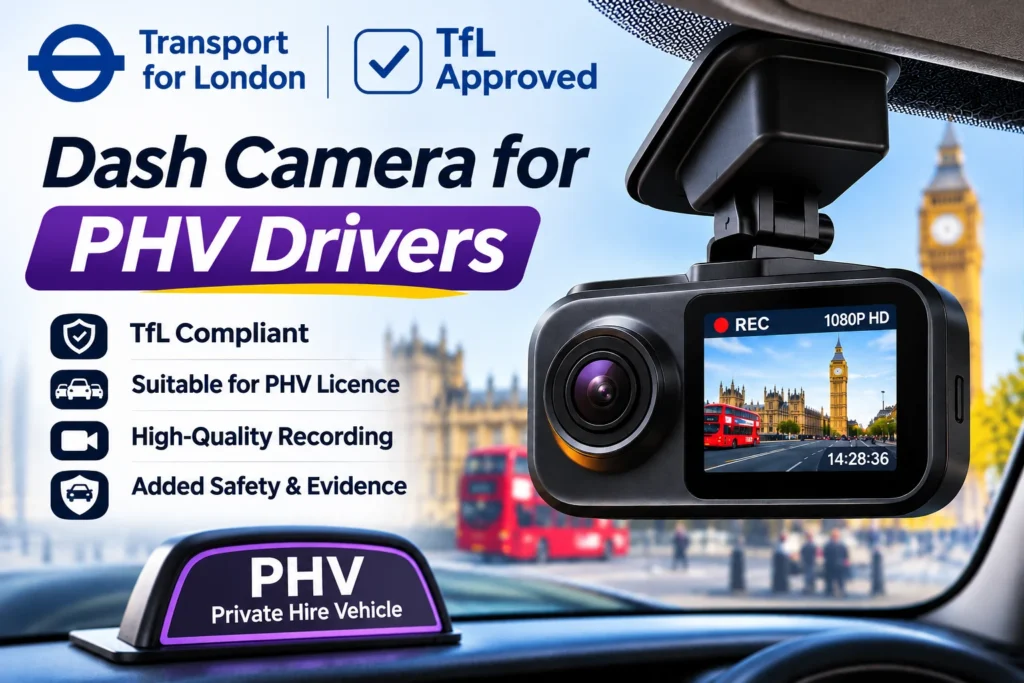
Choosing the right TfL Approved Dash Camera for PHV Drivers is an important consideration for private hire vehicle owners and drivers operating in London. Spending long hours on the road and regularly transporting passengers can expose drivers to different risks, including road accidents, passenger disputes and unexpected incidents.
A suitable in-vehicle CCTV system can help improve security, protect drivers and passengers, and provide useful evidence when incidents occur. However, not every dash camera available in the UK meets Transport for London (TfL) requirements.
Before purchasing a camera, PHV drivers should understand the approved equipment options, recording features, installation requirements and privacy responsibilities.
This guide explores the main features and benefits of a TfL Approved Dash Camera for PHV Drivers, helping you make an informed decision when choosing a suitable CCTV system for your licensed vehicle.
1. What Is a TfL Approved Dash Camera for PHV Drivers?
A TfL Approved Dash Camera for PHV Drivers is an approved in-vehicle CCTV or incident-recording system suitable for installation in a London-licensed private hire vehicle.
Transport for London provides specific guidelines for CCTV systems installed in licensed taxis and private hire vehicles. These guidelines cover approved equipment, camera positioning, installation, recording and footage management.
Depending on the approved configuration, a system may include:
- Forward-facing incident cameras.
- Interior passenger-facing cameras.
- Rear-facing cameras.
- Digital video recording equipment.
- Secure footage storage.
- Incident recording and retrieval facilities.
It is important to understand that a normal consumer dashcam is not automatically TfL-approved. Drivers should check the exact camera model and its PHV approval status before purchasing.
2. Why Do PHV Drivers Need an Approved Dash Camera?
Private hire drivers work in different locations, transport passengers throughout the day and may encounter unexpected situations. An appropriate CCTV system can provide several useful benefits.
Improved Driver Security
Driver safety is an important consideration for anyone working in the private hire industry.
A suitable interior CCTV system can record incidents involving threatening behaviour, passenger disputes or attempted theft. Having recorded evidence may help when reporting an incident or responding to a complaint.
Better Passenger Protection
CCTV can also help create a safer environment for passengers.
Visible camera equipment and appropriate signage can discourage inappropriate behaviour and help passengers understand that recording is taking place.
Evidence After Road Accidents
Road accidents can happen unexpectedly, even when a driver follows traffic regulations.
A forward-facing incident camera can capture events around the vehicle and provide useful information when reviewing an accident.
Support During Passenger Disputes
Disagreements about journeys, passenger behaviour and incidents inside a vehicle can sometimes be difficult to resolve.
Where footage is lawfully available, an appropriate CCTV recording may help establish what happened.
Greater Confidence While Working
PHV drivers may work during busy periods, late evenings and overnight hours. Having an appropriate camera system can provide additional reassurance while transporting passengers.
3. Essential Features of a TfL Approved Dash Camera for PHV Drivers
When comparing camera systems, PHV drivers should look beyond the advertised price. The equipment should provide suitable recording capabilities and meet the applicable TfL requirements.
Here are some important features to consider.
Forward-Facing Camera
A forward-facing camera records the road ahead and can capture information about traffic conditions, vehicle movements and potential collisions.
This feature can be useful when reviewing road accidents or incidents involving other vehicles.
Interior-Facing Camera
An interior-facing camera records activity inside the vehicle.
For PHV drivers, this can be an important feature because it may provide evidence when an incident involves a passenger or driver.
Check that the exact interior camera arrangement is included in the approved system.
Rear-Facing Camera
Some approved camera configurations include an additional rear-facing camera.
This can provide another viewing angle and may help capture events behind the vehicle.
However, rear-facing camera approval and positioning depend on the exact system listed by TfL.
High-Quality Video Recording
Clear footage is essential when reviewing incidents.
Look for a camera system that provides suitable image quality in different lighting conditions. Consider resolution, image clarity, camera positioning and recording reliability.
Night-Time Recording
Many private hire drivers work after sunset or during early morning hours.
A camera with suitable low-light recording capabilities can help capture clearer footage when visibility is limited.
Reliable Storage Capacity
Storage capacity determines how much footage can be retained before older recordings are overwritten.
Check the approved system’s storage specifications and ensure that the recording arrangements meet the applicable TfL requirements.
Secure Footage Access
Recorded footage may contain personal information about drivers and passengers.
A suitable system should provide secure access and help prevent unauthorised viewing, copying or sharing.
4. Important TfL Requirements for PHV Dash Cameras
Understanding the applicable requirements is essential before purchasing a TfL Approved Dash Camera for PHV Drivers.
TfL publishes approved CCTV systems and supplier information specifically identifying equipment suitable for private hire vehicles.
Drivers should consider the following areas.
Approved Camera Systems
Check the latest TfL-approved CCTV information before purchasing equipment.
Approval applies to specific systems and configurations. A camera from an approved manufacturer is not automatically approved in every configuration.
Correct Camera Positioning
Camera placement must follow the applicable installation requirements.
The equipment should be positioned securely without obstructing the driver’s visibility or creating unnecessary risks for passengers.
Safe Installation
CCTV equipment should be fitted securely, with appropriate cable routing and electrical connections.
TfL guidance states that installed systems are inspected as part of the vehicle licensing inspection to check that they are safe and securely fitted.
Required CCTV Signage
Drivers should display the appropriate notices informing passengers that CCTV recording is taking place.
The signage arrangements include an interior notice containing data controller information and an exterior-facing notice indicating that recording is taking place.
Responsible Footage Management
The person responsible for the CCTV system must understand their responsibilities for accessing, storing, retaining and sharing recordings.
Installing approved equipment does not remove the need to follow applicable data protection requirements.
5. Features vs Benefits of a TfL Approved Dash Camera for PHV Drivers
Understanding the difference between camera features and their practical benefits can help you select a suitable system.
| Camera feature | Main benefit |
|---|---|
| Forward-facing camera | Records road incidents |
| Interior-facing camera | Helps document passenger-related incidents |
| Rear-facing camera | Provides an additional viewing angle |
| High-quality recording | Makes footage easier to review |
| Low-light recording | Supports recording during night shifts |
| Secure storage | Helps protect recorded information |
| Incident retrieval | Makes relevant footage easier to access |
| Professional installation | Supports safe and reliable operation |
The best TfL Approved Dash Camera for PHV Drivers is not necessarily the system with the most features. It is the one that meets the relevant requirements and suits your vehicle and working needs.
6. Different Types of Approved CCTV Systems for PHV Drivers
TfL’s published approved equipment information includes several types of camera arrangements.
Examples appearing in its May 2025 approved systems information include:
Forward and Interior Camera Systems
These systems combine a road-facing camera with an interior camera.
They can record road incidents and activity inside the vehicle.
Multi-Camera CCTV Systems
Some systems offer forward-facing, rear-facing and interior cameras.
These arrangements provide additional recording coverage, depending on the approved configuration.
Incident Recording Systems
Incident cameras focus on capturing events associated with driving and potential road incidents.
Some approved systems combine incident recording with an interior-facing camera.
Examples listed in TfL’s published information include Exeros Trackeye Nano, VisionTrack VT5500, VisionTrack VT2200, Nauto and Crystal Ball Smart Cam.
Always check the latest official list, exact model number and PHV approval status before buying. The list can change, and approval for one vehicle category does not automatically mean approval for another.
7. How to Choose the Right TfL Approved Dash Camera for PHV Drivers
Choosing the right system requires careful comparison.
Consider these factors before purchasing:
Confirm Your Vehicle Licensing Category
First, check that your vehicle is licensed by TfL for private hire use.
The approved camera information identifies different vehicle categories, so make sure you select a system specifically approved for PHVs.
Compare Approved Suppliers
Check the current TfL-approved supplier and installer information.
Contact suppliers to confirm the exact camera model, recording configuration and installation arrangements.
Consider Your Recording Requirements
Think about the type of recording you need.
For example, you may want a system with forward-facing and interior recording, or a multi-camera configuration that also includes rear-facing coverage.
Make sure the configuration is approved.
Compare Installation Costs
The total purchase cost may include:
- Camera equipment.
- Digital recording unit.
- Storage media.
- Installation and wiring.
- Required CCTV signage.
- Additional accessories.
- Maintenance and technical support.
Request a complete quotation before making a decision.
Check Warranty and Technical Support
Professional drivers depend on their equipment working reliably.
Ask about warranty coverage, repairs, replacement equipment and technical support if the camera develops a fault.
8. Passenger Privacy and Data Protection
Passenger privacy is an important part of choosing a TfL Approved Dash Camera for PHV Drivers.
An interior CCTV system can capture identifiable images and other personal information. The person or organisation responsible for the system must understand the relevant data protection responsibilities.
Important considerations include:
- Displaying the appropriate CCTV notices.
- Identifying the data controller.
- Explaining the purpose of recording.
- Keeping footage secure.
- Restricting access to authorised people.
- Following applicable retention requirements.
- Sharing recordings only when there is a lawful reason.
- Avoiding unnecessary audio recording.
Audio recording requires particular care because it can capture private conversations.
TfL’s CCTV guidance and data protection rules should be checked before enabling any audio-recording function. Drivers should not assume that continuous audio recording is automatically permitted.
9. Why Professional Dash Camera Installation Matters
Professional installation helps ensure that your camera system operates correctly and follows the applicable requirements.
A suitably qualified installer familiar with the approved equipment can help with:
- Correct camera positioning.
- Secure mounting.
- Safe cable routing.
- Reliable electrical connections.
- Recording configuration.
- Storage setup.
- Required signage.
- Testing and footage retrieval.
Incorrect installation can affect the safety and reliability of the system.
After installation, check that the cameras record correctly and that you understand how to retrieve footage when needed.
Keep your installation documents and equipment information for future reference.
10. Common Mistakes to Avoid When Buying PHV Dash Cameras
Before purchasing a TfL Approved Dash Camera for PHV Drivers, avoid these common mistakes.
Buying an ordinary consumer dashcam: A standard dashcam is not automatically suitable as a TfL-approved CCTV system.
Ignoring the PHV approval category: Some systems are approved for specific taxi models but not for PHVs.
Choosing only by price: A low-cost system may not provide the required features or installation arrangements.
Forgetting CCTV signage: Make sure the appropriate notices are provided and displayed.
Ignoring passenger privacy: Footage must be managed responsibly and lawfully.
Installing the system incorrectly: Poor positioning or insecure wiring can create safety and compliance problems.
Not checking storage arrangements: Confirm that the system supports the applicable recording and retention requirements.
Avoiding these mistakes can help prevent unnecessary costs and problems with your vehicle’s CCTV arrangements.
Conclusion
Choosing the right TfL Approved Dash Camera for PHV Drivers can provide important benefits for private hire vehicle owners and drivers. From forward-facing incident recording to interior CCTV and secure footage storage, suitable equipment can help improve safety and provide useful evidence when incidents occur.
However, selecting a camera requires more than comparing advertised features. Drivers should verify the exact TfL-approved system, check its PHV compatibility and ensure that installation follows the relevant requirements.
By considering video quality, camera coverage, storage, privacy, signage and professional installation, you can make a more informed decision and choose a suitable CCTV solution for your private hire vehicle.
Frequently Asked Questions (FAQs)
1. What is a TfL Approved Dash Camera for PHV Drivers?
It is an approved in-vehicle CCTV or incident-recording system suitable for installation in a TfL-licensed private hire vehicle. The exact camera model and configuration must meet the applicable TfL requirements.
2. Is a dash camera compulsory for every PHV driver in London?
TfL’s published position allows licensed taxi and PHV owners to choose whether to install in-vehicle CCTV. However, if CCTV is installed, the system must meet the relevant requirements.
3. Can I use a normal dashcam in my private hire vehicle?
A normal consumer dashcam is not automatically TfL-approved. Check the exact equipment and installation arrangement against the official approved information before using it as a taxi or PHV CCTV system.
4. What features should a PHV dash camera have?
Important features include suitable video quality, forward-facing and interior recording where required, reliable storage, low-light performance and secure footage access.
5. Can a TfL-approved camera record inside the vehicle?
Yes, some approved systems include interior-facing cameras. However, the exact recording arrangement depends on the approved model and configuration.
6. Do PHV drivers need CCTV signage?
TfL’s CCTV guidance specifies signage arrangements for vehicles fitted with approved systems. Drivers should confirm the required interior and exterior notices with their supplier.
7. How long can PHV CCTV footage be stored?
TfL’s published guidance specifies a normal maximum retention period of 28 days. Footage may be retained longer where there is a justified reason, such as an investigation or insurance claim.
8. Can PHV dash cameras record passenger conversations?
Audio recording requires additional care because it can capture private conversations. Drivers should check the relevant TfL and data protection requirements before enabling audio recording.
9. Where can I find TfL-approved CCTV suppliers?
Check Transport for London’s latest approved CCTV systems and suppliers information. Make sure the selected equipment is specifically approved for private hire vehicles.
10. Does TfL inspect installed CCTV systems?
TfL guidance states that installed CCTV systems are inspected during the vehicle licensing inspection to ensure that they are safely and securely fitted.
11. Can I install a CCTV system myself?
You should follow the approved installation requirements and use an appropriately qualified installer familiar with the selected system. Incorrect installation can create safety and compliance problems.
12. What is the difference between a taxi CCTV system and a PHV CCTV system?
TfL’s approved list identifies which camera systems are suitable for different vehicle categories. A system approved for one taxi model is not automatically approved for private hire vehicles.