
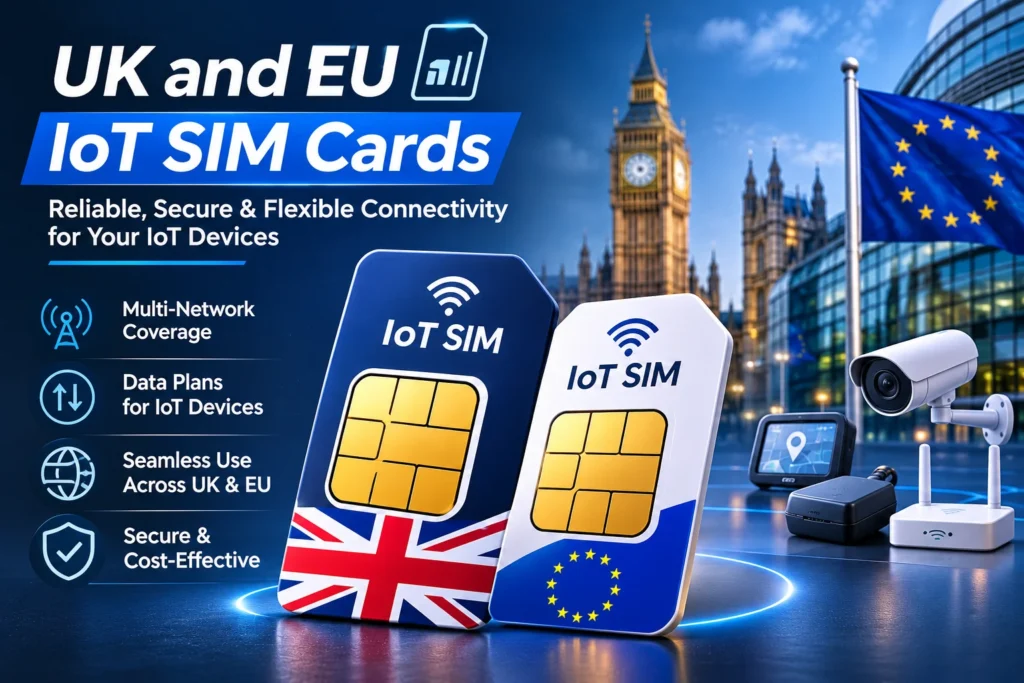
Modern businesses increasingly depend on connected devices to monitor equipment, track vehicles, collect information and manage operations remotely. As businesses expand beyond one country, maintaining a reliable internet connection becomes even more important. UK and EU IoT SIM Cards provide a practical connectivity solution for organisations that need their devices to communicate across international borders.
Whether you operate a vehicle tracking company, manage industrial equipment, install smart monitoring systems or manufacture connected products, choosing the right IoT SIM card can make a significant difference to your operations. Instead of relying on separate connectivity arrangements in every country, businesses can use UK and EU IoT SIM Cards to simplify connectivity across multiple markets.
This guide explains how UK and EU IoT SIM cards work, their main benefits, available technologies, important features and how to choose the right solution for your business.
What Are UK and EU IoT SIM Cards?
UK and EU IoT SIM Cards are specialised SIM cards designed to provide mobile network connectivity to Internet of Things (IoT) devices across the United Kingdom and European countries.
Unlike ordinary smartphone SIM cards, IoT SIM cards are developed for connected equipment that may need to operate continuously for months or years. They are commonly used in devices that collect, transmit and receive information without requiring regular human interaction.
These SIM cards can support different mobile network technologies, depending on the provider, device and selected data plan.
Common applications include:
- Vehicle tracking and fleet management systems.
- GPS tracking devices.
- Industrial monitoring equipment.
- Smart meters and energy management systems.
- Security alarms and surveillance equipment.
- Remote sensors and monitoring devices.
- Payment terminals and connected vending machines.
With suitable international roaming agreements, UK and EU IoT SIM Cards can allow devices to connect to supported mobile networks in multiple countries using one connectivity solution.
Why Are UK and EU IoT SIM Cards Important for Businesses?
Businesses operating across different countries need dependable communication between their devices and central management systems. Managing separate SIM cards, contracts and network providers for every location can increase administrative work and operational complexity.
UK and EU IoT SIM Cards help simplify this process by providing access to supported mobile networks across different countries.
1. Reliable Cross-Border Connectivity
One of the biggest advantages of UK and EU IoT SIM Cards is their ability to support international connectivity.
For example, a logistics company may operate vehicles travelling between the UK, France, Germany, Spain and other European destinations. Its tracking devices need to transmit location information even when vehicles cross national borders.
An IoT SIM with the appropriate international coverage can help maintain communication as devices move between supported networks.
However, actual connectivity depends on the provider’s roaming agreements, country coverage, network availability and SIM configuration.
2. Reduced Connectivity Management
Managing individual mobile subscriptions for devices in different countries can become complicated.
UK and EU IoT SIM Cards can simplify this process by allowing businesses to manage multiple devices through one connectivity provider or management platform.
Depending on the service, businesses may be able to:
- Activate and deactivate SIM cards.
- Monitor data consumption.
- Check device connection status.
- Manage multiple subscriptions.
- Review usage information.
- Control connectivity across different locations.
Centralised management can save time and make large IoT deployments easier to operate.
3. Better Network Flexibility
A device connected to only one mobile network may experience connectivity problems in areas where that network has limited coverage.
Some UK and EU IoT SIM Cards support multiple network operators through roaming agreements. This gives compatible devices the ability to connect to more than one available network.
Multi-network connectivity can be particularly useful for equipment installed in remote areas, industrial facilities, warehouses and vehicles travelling across different regions.
It is important to remember that multi-network access does not automatically guarantee the strongest signal or uninterrupted service. Network selection depends on the SIM profile, device capabilities and provider configuration.
How Do UK and EU IoT SIM Cards Work?
UK and EU IoT SIM Cards work by allowing a compatible device to authenticate with a mobile network and exchange data with a remote server or application.
The process is straightforward:
- SIM installation: The IoT SIM card is inserted into a compatible device or supplied as an embedded SIM.
- Network registration: The device connects to an available supported mobile network.
- Data transmission: The device sends information through the mobile network to a server or cloud platform.
- Remote monitoring: Users access the information through software, dashboards or connected applications.
- International roaming: When the device moves into another country, it can register on an approved roaming partner network if the SIM plan supports that destination.
This process allows businesses to monitor devices without needing someone to operate them manually.
Key Features to Look for in UK and EU IoT SIM Cards
Not every IoT SIM card offers the same capabilities. Before selecting UK and EU IoT SIM Cards, businesses should compare the features that directly affect their connectivity requirements.
1. UK and European Network Coverage
Coverage should be one of the first considerations when choosing UK and EU IoT SIM Cards.
Check which countries are included in the coverage plan and which mobile networks are supported in each destination.
A provider may advertise European coverage, but the exact list of supported countries and operators can differ between plans.
Always confirm coverage for the countries where your devices will operate.
2. Multi-Network Connectivity
Multi-network functionality allows a SIM card to access more than one supported mobile network.
This can improve connectivity options when a device travels between locations or operates in areas with varying network coverage.
For businesses that depend on continuous communication, choosing UK and EU IoT SIM Cards with suitable multi-network access can help reduce reliance on a single operator.
3. Flexible Data Plans
Different IoT devices consume different amounts of data.
For example, a basic tracking device may transmit small amounts of location information, while a connected camera or industrial monitoring system may require considerably more data.
Look for data plans that match your expected usage.
Useful options may include:
- Small monthly data allowances.
- Larger monthly data packages.
- Pooled data plans for multiple SIM cards.
- Pay-as-you-go arrangements.
- Custom enterprise data packages.
Selecting the right plan can help control connectivity costs and prevent unnecessary data charges.
4. SIM Management Platform
A SIM management platform allows businesses to monitor and control their connected devices from one central location.
Depending on the provider, the platform may display activation status, data usage, network information, connection history and subscription details.
For organisations managing hundreds or thousands of devices, this feature can make UK and EU IoT SIM Cards easier to manage.
5. Security Features
Security is essential when connected devices transmit business information over mobile networks.
Depending on the provider, available security features may include:
- Private Access Point Names (APNs).
- VPN connectivity.
- Private network configurations.
- SIM authentication.
- Usage monitoring.
- Data consumption alerts.
- Device and SIM access controls.
Businesses should select a security configuration based on the sensitivity of their data and the risks associated with their IoT applications.
UK and EU IoT SIM Cards for Different Industries
UK and EU IoT SIM Cards are suitable for many industries that require mobile connectivity outside traditional office environments.
Vehicle Tracking and Fleet Management
Transport and logistics companies use IoT SIM cards in GPS tracking devices to monitor vehicle locations, journeys and fleet activity.
When vehicles travel internationally, cross-border connectivity helps businesses maintain access to tracking information.
UK and EU IoT SIM Cards can support fleet management systems operating across multiple European destinations, provided the selected plan includes the required roaming coverage.
Industrial Monitoring
Manufacturing facilities use connected sensors to monitor equipment, temperature, pressure and other operational conditions.
IoT SIM connectivity allows equipment to transmit information to central monitoring platforms.
Businesses operating industrial equipment across different countries can use international IoT connectivity to simplify remote monitoring.
Smart Metering
Smart meters collect information about electricity, gas and water consumption.
IoT SIM cards can provide mobile connectivity for meters installed in locations where a suitable wired connection is unavailable.
With the right network support, UK and EU IoT SIM Cards can help organisations manage connected metering equipment across different markets.
Security and Alarm Systems
Connected security systems may use mobile networks to send alerts and communicate with monitoring platforms.
An IoT SIM can provide an additional communication route where supported by the alarm hardware and service provider.
Businesses should check network compatibility, data requirements and any specific monitoring service requirements before choosing a SIM.
Connected Healthcare Equipment
Some healthcare devices use mobile connectivity to transmit monitoring information to authorised systems.
For these applications, organisations should pay particular attention to data protection, security, reliability and applicable healthcare requirements.
Physical IoT SIM Cards vs eSIM Technology
When selecting UK and EU IoT SIM Cards, businesses may also need to decide between a traditional physical SIM and an embedded SIM solution.
Physical IoT SIM Cards
Physical IoT SIM cards are removable cards installed in compatible devices.
They are available in different sizes, including standard, micro and nano SIM formats.
Their main advantages include:
- Easy installation in compatible hardware.
- Straightforward replacement.
- Wide device compatibility.
- Availability in different industrial SIM specifications.
Physical SIM cards can be a suitable choice for tracking devices, routers, sensors and other connected equipment.
eSIM and eUICC Technology
An embedded SIM, commonly called an eSIM, is integrated into a device rather than being inserted as a removable card.
eUICC technology enables compatible SIMs to store and manage multiple operator profiles remotely.
This can be useful for businesses deploying devices in different countries because supported operator profiles may be updated without physically replacing the SIM.
However, eSIM and eUICC are not identical terms. eSIM generally describes the embedded form factor, while eUICC describes the capability to manage multiple SIM profiles.
Both physical and embedded solutions can be suitable for UK and EU IoT SIM Cards, depending on device compatibility and deployment requirements.
How to Choose the Best UK and EU IoT SIM Cards
Choosing the right connectivity solution requires more than comparing monthly prices. Businesses should consider where their devices will operate, how much data they will use and how important connectivity is to their operations.
Here are some important factors to consider.
1. Identify Your Coverage Requirements
Make a list of every country where your devices will be used.
Check that the provider supports those destinations and confirm the available mobile networks in each country.
2. Check Device Compatibility
Make sure your IoT hardware supports the SIM card format and mobile technologies offered by the provider.
Check whether your device requires 2G, 3G, 4G, 5G, LTE-M or NB-IoT connectivity.
Network availability and roaming support for these technologies can vary by country and operator.
3. Calculate Your Data Requirements
Estimate how much data each device will consume.
Consider how frequently devices transmit information, whether they send images or large files, and whether they need continuous connections.
This helps you select an appropriate data plan.
4. Understand Roaming Conditions
International roaming is not always unlimited or permanently available.
Some providers apply fair-use conditions, country restrictions, usage limits or permanent-roaming policies.
Before purchasing UK and EU IoT SIM Cards, ask the provider whether long-term operation outside the SIM’s home network is permitted.
5. Compare Pricing and Support
Compare monthly subscription fees, data allowances, activation charges and any additional service costs.
Also consider technical support and SIM management facilities.
A suitable provider should be able to explain coverage, compatibility and roaming conditions clearly.
Common Challenges When Using UK and EU IoT SIM Cards
Although international IoT connectivity offers significant benefits, businesses should understand some potential challenges.
Network coverage differences: Mobile coverage varies between countries and locations. Remote areas may have limited service.
Roaming restrictions: Some mobile operators restrict permanent roaming or apply specific commercial conditions to international IoT connections.
Device compatibility: Not every device supports all mobile technologies or frequency bands.
Data usage: Devices transmitting large amounts of information may require more expensive data plans.
Security risks: Poorly configured devices and insecure data connections can expose business systems to potential threats.
Businesses can reduce these challenges by testing their devices, checking provider documentation and selecting a connectivity plan that matches their operational requirements.
Why Invest in UK and EU IoT SIM Cards?
Investing in suitable UK and EU IoT SIM Cards can help businesses simplify international connectivity and manage connected devices more effectively.
Key advantages include:
- Cross-border mobile connectivity.
- Access to supported international networks.
- Centralised SIM management.
- Flexible data packages.
- Support for different IoT applications.
- Options for physical SIM and eSIM technology.
- Easier expansion into European markets.
For businesses operating vehicles, industrial equipment, monitoring systems or connected products, the right IoT connectivity solution can support more efficient operations.
Conclusion
Reliable connectivity is essential for businesses that depend on connected devices across different countries. UK and EU IoT SIM Cards offer a practical way to connect tracking systems, industrial equipment, smart devices and remote monitoring solutions across supported international mobile networks.
By choosing a suitable SIM provider, checking country coverage, understanding roaming conditions and selecting the right data plan, businesses can build a more flexible IoT connectivity solution.
Whether you are managing a small number of tracking devices or deploying thousands of connected products, investing in the right UK and EU IoT SIM Cards can help simplify cross-border operations and support future business growth.
Frequently Asked Questions (FAQs)
1. What are UK and EU IoT SIM Cards?
UK and EU IoT SIM Cards are specialised SIM cards designed to connect IoT devices to supported mobile networks across the United Kingdom and European countries. They are commonly used in tracking systems, sensors, industrial equipment and remote monitoring devices.
2. Can UK and EU IoT SIM Cards work in multiple countries?
Yes. UK and EU IoT SIM Cards can work across multiple countries when the provider has the necessary roaming agreements and the selected plan includes those destinations. Always check the coverage list before purchasing.
3. Are IoT SIM cards different from normal SIM cards?
Yes. IoT SIM cards are designed for connected devices and long-term machine-to-machine communication. They may include centralised management, international roaming, flexible data plans and specialised security options.
4. Can I use one IoT SIM card across the UK and Europe?
A single IoT SIM card can support connectivity across the UK and multiple European countries if its roaming coverage includes those destinations. The exact coverage depends on the provider and subscription.
5. Do UK and EU IoT SIM Cards support GPS tracking?
Yes. They can provide mobile data connectivity for compatible GPS tracking devices. The GPS receiver determines the device’s location, while the IoT SIM transmits that information to a tracking platform.
6. Do IoT SIM cards automatically switch networks?
Some UK and EU IoT SIM Cards support access to multiple networks. However, automatic network selection depends on the SIM profile, device settings, available networks and provider configuration.
7. Are UK and EU IoT SIM Cards suitable for fleet management?
Yes. They can support vehicle tracking and fleet management systems by transmitting location and operational information across supported mobile networks.
8. What is the difference between an IoT SIM and an eSIM?
An IoT SIM describes a SIM designed for connected devices. An eSIM is an embedded SIM form factor. An eSIM with eUICC technology can support remote management of operator profiles, depending on the device and provider.
9. How much data does an IoT SIM card need?
Data requirements depend on the device and application. Basic sensors and tracking devices may use relatively little data, while cameras and systems transmitting large files may need much larger allowances.
10. Are UK and EU IoT SIM Cards secure?
They can support security features such as SIM authentication, private APNs and VPN connectivity. However, overall security also depends on device configuration, application security and the provider’s network services.
11. Can IoT SIM cards be used permanently in Europe?
Some providers allow long-term international IoT deployments, while others apply permanent-roaming restrictions or additional conditions. Businesses should confirm the provider’s policies for each destination before deploying devices.
12. How do I choose the best UK and EU IoT SIM Cards?
Compare international coverage, supported mobile networks, device compatibility, data allowances, roaming conditions, security features, pricing and management facilities. Choose a solution that matches your devices and operating locations.