
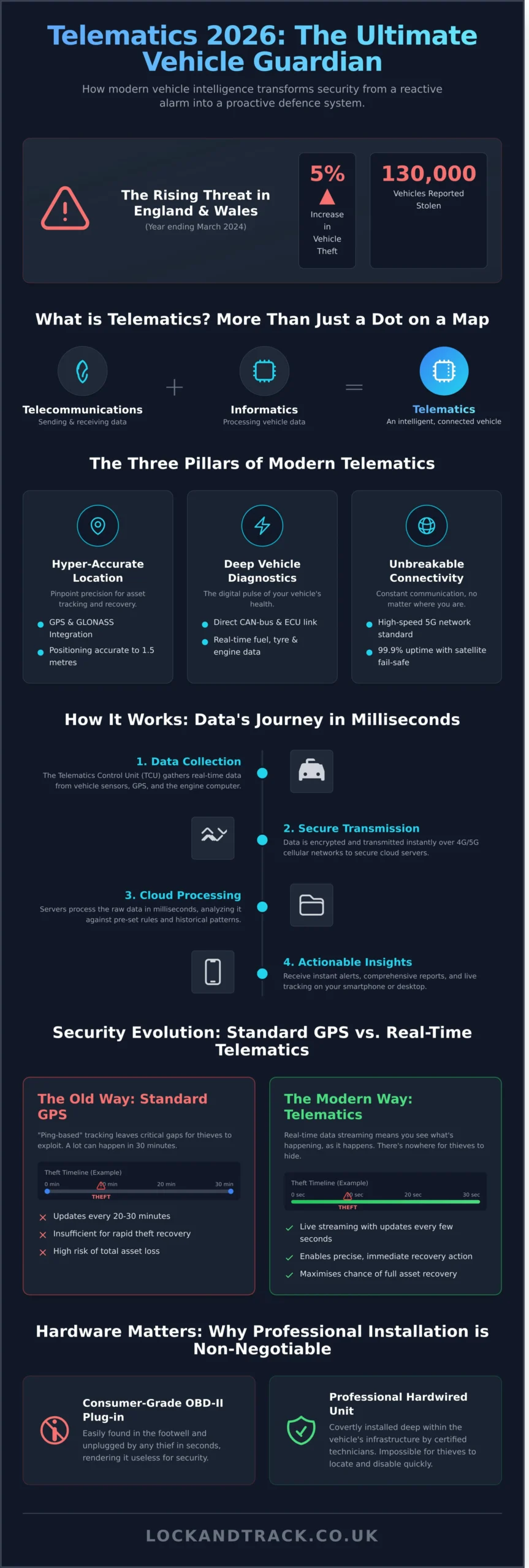
Vehicle theft in England and Wales rose by 5% in the year ending March 2024, with nearly 130,000 vehicles reported stolen. It’s a sobering figure that proves traditional locks are no longer enough to stop determined criminals. Modern security requires telematics, a sophisticated technology that does far more than just plot a point on a map. By integrating live GPS tracking with on-board diagnostics, you gain a vigilant, 24/7 guardian for your most valuable assets. It’s about turning your vehicle into an intelligent system that communicates its status directly to your smartphone.
You likely already feel the pressure of rising fuel prices and the sting of insurance premiums that never seem to drop. We agree that protecting your livelihood shouldn’t be a constant source of stress. This guide promises to show you how vehicle intelligence safeguards your assets, slashes operational costs, and provides total peace of mind. We’ll explore how Thatcham-approved hardware and real-time data recovery can transform your approach to security and maintenance in 2026.
Key Takeaways
- Understand how the convergence of telecommunications and informatics creates a digital brain for your vehicle that goes far beyond simple location tracking.
- Learn why standard GPS is no longer enough and how active security features like remote cut-off provide a superior defense against modern vehicle theft.
- Discover how telematics technology identifies hidden costs like excessive idling to significantly reduce business overheads and boost your fleet’s ROI.
- Identify why professional Thatcham-certified installation is non-negotiable for maintaining insurance compliance and preventing thieves from bypassing your security hardware.
- Gain total peace of mind by transforming raw vehicle data into actionable insights that safeguard your assets and protect your bottom line.
Defining Telematics in 2026: More Than Just GPS
The term telematics represents the sophisticated marriage of telecommunications and informatics. It is the science of sending, receiving, and storing information via telecommunication devices in conjunction with effecting control on remote objects. In 2026, this technology has evolved far beyond simple dots on a map. It is now a high-speed data exchange that transforms your fleet vehicles into intelligent, communicative assets. For a UK fleet manager, it acts as a digital nervous system; it provides the pulse of every van, truck, and car under your supervision.
The modern “black box” has shed its intimidating reputation. It is no longer a tool for surveillance, but a silent guardian. These compact devices are now standard in 85% of commercial vehicles across the UK. They work by capturing engine data, driver behaviour, and precise coordinates, then beaming that information to a secure cloud platform. This happens in milliseconds. It gives you the power to safeguard your drivers and your bottom line simultaneously. You aren’t just watching your vehicles; you’re protecting your investment.
It’s vital to distinguish between consumer and commercial systems. Consumer telematics often focuses on insurance premiums for young drivers. Commercial telematics is built for the rigours of asset management and theft recovery. While a consumer device might monitor speed to lower a monthly bill, a fleet system provides deep-tier diagnostics and Thatcham-approved security. It ensures your vehicles remain on the road and your business stays operational. This distinction is the difference between a simple gadget and a professional security ecosystem.
The Three Pillars of Modern Telematics
Location accuracy is the first pillar. By 2026, systems integrate both GPS and GLONASS, providing positioning accurate to within 1.5 metres. The second pillar is diagnostics. Devices communicate directly with the vehicle’s ECU via the CAN-bus. This reveals real-time fuel levels, tyre pressures, and engine fault codes. Finally, connectivity ensures this data reaches you. High-speed 5G networks are the standard; however, satellite fail-safes now guarantee 99.9% uptime even in the most remote areas of the Scottish Highlands or the Welsh valleys.
Why the Term is Trending in the UK
The UK security market has shifted. We’ve moved from reactive theft alarms to proactive security ecosystems. With vehicle theft rising by 12% in early 2025, fleet owners demand more than just a siren. Modern telematics hardware is now 40% smaller than models from five years ago. This makes units nearly impossible for thieves to locate and neutralise. These systems are also essential for the UK’s EV transition. By January 2026, electric vehicles make up over 30% of many commercial fleets. Telematics is the only way to effectively monitor battery health and charging cycles. This technology ensures your electric transition is profitable rather than a logistical burden. It provides the ultimate protection and the peace of mind you need to run a secure, efficient operation.
How Telematics Systems Work: From Hardware to Insights
The Telematics Control Unit (TCU) acts as the vehicle’s central nervous system. It continuously gathers data from the Global Navigation Satellite System (GNSS) and the engine’s internal computer. This data travels via 4G or 5G cellular networks to secure cloud servers, where it is processed in milliseconds. The journey of a single data packet is rapid. A coordinate is captured, encrypted, and transmitted to your screen before the vehicle has moved another five metres.
Data frequency determines the effectiveness of your security. Many basic systems use “ping-based” tracking, which only updates every 30 minutes to save battery. This is insufficient for theft recovery. If a van is stolen in London, it can be stripped or hidden in a shipping container within twenty minutes. Lock and Track prioritises real-time streaming. This ensures that the vehicle’s location is visible every few seconds, allowing recovery teams to act with precision. Raw coordinates are combined with fuel levels and engine diagnostics to create actionable reports. This transition toward data-driven mobility allows fleet managers to spot idling patterns or unauthorised fuel drains immediately.
The Hardware: What Gets Installed?
Hardware choice defines your level of protection. While OBD-II plug-in devices are common for simple mileage tracking, they are easily spotted and removed by thieves. Lock and Track prefers hardwired units hidden deep within the vehicle’s dashboard. These units include internal accelerometers that detect impacts at 10Hz frequency, capturing the exact force of a collision. Integrated gyroscopes detect tilt and motion, triggering an alert if a vehicle is lifted onto a low-loader. For insurance validity in the UK, hardware must be Thatcham-approved. This certification ensures the device meets rigorous 2024 security standards for signal resilience and power consumption.
The Software: Making Sense of the Noise
Software transforms thousands of data points into a clear operational picture. The user dashboard provides a high-level view of fleet health, showing which vehicles are active and which require maintenance. Geofencing is a critical feature for asset protection. You can draw a digital perimeter around a construction site or a depot. If a vehicle crosses that boundary after 6:00 PM, the system sends an automated alert to your phone within 10 seconds.
Mobile apps put this control in your pocket. You can check the live status of your telematics system, immobilise an engine remotely, or review historical routes from any location. This proactive approach reduces the anxiety of vehicle management. Security is no longer a reactive process; it is a constant, visible shield. You can view our range of Thatcham-approved trackers to see which hardware configuration suits your specific fleet requirements.
Efficiency relies on accuracy. When raw GPS data is cleaned and mapped against UK road networks, it reveals more than just location. It identifies aggressive braking, speeding, and inefficient routing. By 2025, fleet operators using these insights expect to reduce fuel costs by 15% through improved driver behaviour. The telematics system doesn’t just watch your vehicles; it understands them.
Telematics vs. Standard GPS Tracking: The Security Evolution
A common misconception among UK fleet owners is that a basic GPS tracker offers the same protection as a full telematics suite. It doesn’t. A standard tracker is a passive device. It records where a vehicle has been or where it currently sits. If a thief steals your van at 3:00 AM, a passive tracker might show you its location an hour later, once the damage is already done. This technology is an active security ecosystem that intervenes before the vehicle even leaves the depot.
The distinction lies in the ability to communicate and react. While a tracker waits to be polled, a professional system is constantly vigilant. It monitors driver identity, signal integrity, and hardware health. Understanding how telematics systems work involves looking at the integration of hardware and 24/7 monitoring. This technology is the most effective way to combat relay theft, which now accounts for 36% of all vehicle thefts in the UK according to 2023 crime data. By the time a thief clones a keyless entry signal, the system has already flagged the unauthorised access.
The real power behind this technology is the Secure Operating Centre (SOC). These centres provide 24/7 monitoring by trained security professionals. They don’t just wait for you to call. They receive instant alerts the moment a security boundary is breached, allowing for a level of protection that a smartphone app cannot match. This creates a circle of safety around your assets that passive tracking cannot replicate.
Advanced Theft Prevention Features
Modern security systems include Driver Recognition tags. These small fobs must be present for the engine to start. Even if a thief steals your keys or uses a relay device to trick the car into opening, the vehicle remains immobilised without that specific tag. It is a physical layer of digital security that stops 99% of key-cloning attempts. You don’t have to worry about sophisticated electronic bypasses because the system requires a secondary, physical authentication.
Thieves often use signal jammers bought online for as little as £20 to block GPS signals. Professional systems feature jamming detection. If the device senses an attempt to scramble the frequency, it triggers a silent alert to the monitoring centre. Similarly, if a thief attempts to cut the vehicle’s power, battery disconnect alerts provide an immediate notification. The system switches to an internal backup battery, ensuring the vehicle remains visible on the map during the most critical moments of a theft.
The Recovery Advantage
When a theft occurs, every second is vital. We provide UK police forces with precise, real-time data including the vehicle’s “last seen” location and its current heading. This high-resolution data is why Thatcham S5 approved systems boast recovery rates far higher than standard factory-fitted alarms. In many cases, assets are recovered within 20 minutes of the initial alert, often before the thief has even reached a “chop shop” or shipping container.
There is also a powerful psychological deterrent at play. Professional criminal gangs recognise the hardware associated with top-tier security providers. They know that a vehicle equipped with active monitoring and remote immobilisation is a high-risk target. Most will move on to an easier, unprotected vehicle. This proactive protection ensures your fleet stays on the road and your insurance premiums remain manageable. You aren’t just buying a piece of hardware; you’re securing your business’s continuity and your own peace of mind.
Maximising ROI: How Telematics Transforms Fleet and Private Management
Many owners view vehicle tracking as a luxury or an unnecessary overhead. This perspective ignores the silent financial drain of an unmanaged fleet. Aggressive driving, excessive idling, and unauthorised vehicle use strip away profit margins every day. Implementing a robust telematics solution isn’t an expense; it’s a strategic move to reclaim lost revenue and secure your assets against rising operational costs.
Insurance providers prioritise risk management. By installing Thatcham-approved systems, you demonstrate a commitment to security that directly influences premium calculations. Many UK insurers offer discounts of up to 15% for fleets using active tracking and immobilisation technology. This reduction often covers the annual subscription cost of the hardware itself, creating a self-funding security model from day one.
Reducing Operational Overhead
Fuel waste is the primary culprit in inflated fleet budgets. UK data shows that a single van idling for just one hour a day can waste over £1,200 in fuel per year. Monitoring software identifies these patterns, allowing managers to implement strict anti-idling policies backed by real-time data. You stop paying for fuel that literally disappears into thin air.
Predictive maintenance prevents the catastrophe of a roadside breakdown. Systems that read engine fault codes allow you to identify a failing £80 sensor before it causes a £3,000 engine failure. This proactive approach keeps your vans on the road and your delivery schedules intact. Reliability is the foundation of customer trust.
Precise route optimisation is another major win for the bottom line. Reducing a driver’s daily mileage by just 10% through smarter navigation significantly cuts down on tyre wear and brake replacements. For a fleet of 10 vehicles, these small gains compound into thousands of pounds in annual savings. Efficiency becomes your competitive advantage in a crowded market.
Enhancing Driver Safety and Compliance
Driver behaviour scoring is a powerful tool for reducing accident rates. Monitoring harsh braking, rapid acceleration, and speeding allows you to coach drivers based on facts rather than assumptions. Statistics indicate that fleets using driver feedback see a 20% reduction in accidents within the first six months. Safer drivers mean lower repair costs and fewer insurance claims.
Legal protection is vital in the modern “cash for crash” climate. Using video telematics provides First Notification of Loss (FNOL), giving your team immediate access to dashcam footage when an incident occurs. This evidence is indisputable. It protects your drivers from false accusations and ensures that insurance claims are settled quickly and accurately, preventing long-term premium hikes.
HMRC compliance is a significant administrative burden that technology simplifies. Automated mileage logs distinguish between business and private use with 100% accuracy. This removes the need for manual spreadsheets and protects your business from heavy fines during a tax audit. You gain total visibility over how your vehicles are used, ensuring every mile driven is accounted for and authorised.
Securing your fleet requires a proactive stance that balances technical expertise with practical management. Don’t wait for a theft or a financial audit to expose the vulnerabilities in your current setup. Take control of your assets and start seeing a return on your investment today.
Ready to protect your bottom line? Explore our Thatcham-approved tracking solutions and secure your fleet today.
Implementing Telematics: Why Professional UK Installation is Non-Negotiable
Cheap, plug-and-play trackers are a liability for any serious fleet manager. These devices usually plug directly into the OBD II port, making them the first thing a professional thief looks for and discards. In 2023, UK vehicle thefts rose by 5 percent according to ONS data, with criminals becoming increasingly tech-savvy. Relying on a visible, easily removed device isn’t just a security risk; it’s a waste of your budget. Professional telematics installation ensures the hardware is covertly hidden deep within the vehicle’s wiring, making it nearly impossible for thieves to locate or disable during a rapid theft attempt.
Insurance compliance is another critical factor. Most UK insurers require hardware to be fitted by Thatcham-certified engineers to validate high-value asset policies. Without this certification, you risk a rejected claim if a vehicle is stolen and not recovered. Lock and Track uses a nationwide network of expert engineers who understand the intricate electrical systems of modern vans, HGVs, and plant machinery. We bring the workshop to you, providing mobile installation at your home or workplace. This approach eliminates the 4 to 6 hours of downtime typically lost when driving a vehicle to a static garage, keeping your fleet on the road and earning.
The Layered Security Approach
Top-tier fleet protection requires more than just a GPS signal. We recommend a “Detect, Delay, Defend” strategy that pairs telematics with physical and digital barriers. This works best when you integrate a Ghost 2 Immobiliser. While the tracker handles the “Detect” and “Defend” phases via real-time alerts, the immobiliser “Delays” the thief by preventing the engine from starting without a unique PIN code. You can customise your setup further, choosing between S7 entry-level tracking or advanced S5 systems with driver ID tags and full video telematics for maximum oversight.
Getting Started with Lock and Track
Securing your fleet follows a streamlined, three-step process designed for busy business owners. First, we conduct a consultation to identify whether your primary risk is theft, fuel efficiency, or driver safety. Second, our engineers perform a covert, professional installation at a time that suits your operational schedule. Finally, you gain 24/7 peace of mind with ongoing technical support and active monitoring. Our systems don’t just watch your vehicles; they provide a proactive recovery service that significantly increases the chances of getting your property back. Protect your assets with Lock and Track’s fleet solutions today to ensure your business remains resilient against rising crime rates.
Professional installation is the difference between a total loss and a successful recovery. By choosing Thatcham-approved hardware and expert fitting, you safeguard your vehicles, your reputation, and your bottom line. Don’t leave your most valuable assets to chance with DIY alternatives that offer a false sense of security. Trust the specialists who understand the UK’s unique security landscape and provide the ultimate defence for your fleet.
Take Control of Your Fleet Security Today
Vehicle security in 2026 requires more than simple GPS tracking. It demands a sophisticated telematics strategy that integrates real-time intelligence with robust physical protection. You’ve seen how these systems transform operational efficiency and safeguard against increasingly technical theft methods. Effective security isn’t a DIY project; it’s a professional necessity that ensures your assets remain exactly where they belong.
Lock and Track provides the ultimate safeguard for your investment. Our nationwide team of engineers brings over 20 years of security experience to every job, ensuring every installation meets rigorous Thatcham-approved standards. We scale our solutions to fit your specific needs, whether you’re protecting a single luxury car or managing a fleet of 10,000 commercial vehicles. You’ll gain absolute peace of mind knowing your recovery strategy is backed by the UK’s leading specialists.
Don’t wait for a security breach to upgrade your technology. Secure your fleet with Lock and Track’s expert telematics solutions and experience the confidence of total asset visibility. It’s time to put your vehicle security in expert hands.
Frequently Asked Questions
What is the main difference between GPS tracking and telematics?
GPS tracking identifies a vehicle’s location, but telematics provides a complete data ecosystem for your fleet. While GPS is the foundation, telematics integrates vehicle diagnostics, driver behaviour, and fuel consumption into one platform. It turns simple location data into actionable insights for managers. This technology allows you to monitor engine health and idling times, helping you reduce operational costs across your entire fleet through a single interface.
Can telematics really lower my UK van insurance premiums?
Yes, installing a telematics system can reduce your annual van insurance premiums by up to 20 percent. UK insurers like Aviva and Allianz often offer discounts because these devices lower the risk of total loss through theft. By providing real-time data and improving driver safety, you demonstrate a lower risk profile to underwriters. A Thatcham-approved tracker is frequently a mandatory requirement for high-value commercial vehicle policies in the UK.
Is my data private? Who can see where my vehicles are?
Your data is protected under UK GDPR regulations and is only accessible by authorised users within your business. Secure servers encrypt all transmitted information, ensuring that only you and your designated fleet managers can view vehicle locations. We don’t share your movement history with third parties without your explicit consent. This level of security ensures your operational privacy while providing the oversight needed to safeguard your assets from unauthorised use.
What happens if a thief uses a GPS jammer on a telematics device?
If a thief uses a GPS jammer, our high-spec devices detect the interference and trigger an immediate alert to our monitoring centre. Advanced S5 tracking systems include sophisticated anti-jamming technology that maintains a secure link even during an electronic attack. Our 24/7 monitoring centre receives a notification the moment a signal is compromised. This proactive response ensures that recovery teams are deployed before the vehicle can be hidden or dismantled.
Do I need telematics if I only have one or two vehicles?
Telematics is vital even for a single vehicle because it protects your primary business asset. Recovering a stolen van costs an average of £15,000 when you factor in lost tools and business downtime. For a small business, this loss can be devastating. Implementing a system provides the same professional-grade security and fuel efficiency benefits enjoyed by large national fleets, ensuring your livelihood remains secure and operational at all times.
How long does it take to install a telematics system in a car or van?
A professional engineer typically completes a telematics installation in 45 to 90 minutes per vehicle. We schedule these appointments at your location to minimise disruption to your workday. Our engineers ensure the hardware is hidden covertly within the dashboard or engine bay, making it nearly impossible for thieves to find. Once the unit is powered up, the system begins transmitting live data to your dashboard immediately for instant peace of mind.
What is a Thatcham-approved telematics device and why does it matter?
A Thatcham-approved device has passed rigorous testing by the Motor Insurance Repair Research Centre to ensure it meets strict UK security standards. These devices are categorised into ratings like S5 or S7, which determine their level of theft resistance and recovery speed. Choosing Thatcham-certified hardware is often a requirement for insurance validity. It guarantees that your security system is built to withstand professional criminal tactics and provides the ultimate protection for your fleet.
Can telematics help me manage my electric vehicle (EV) fleet?
Telematics systems are essential for managing electric vehicles as they provide real-time data on battery state-of-charge and remaining range. You can monitor charging sessions to ensure your vans are ready for the morning shift, avoiding costly downtime. This technology also helps you identify the best locations for charging stops based on live vehicle data. Managing an EV fleet without these insights often leads to range anxiety and inefficient routing that hurts your bottom line.