
The sophisticated GPS tracker you installed to protect your vehicle is almost certainly not the reason your battery is flat. It’s a common misconception that high-end security hardware is the primary cause of car tracker battery drain issues. You’ve likely felt the frustration of a recurring dead battery or the anxiety of being stranded, wondering if your peace of mind is costing you your mobility. We understand that technical jargon often makes these electrical problems feel more complex than they actually are.
It’s time to regain confidence in your vehicle’s reliability. You’ll learn how to distinguish between a healthy 50 to 85 milliamp draw and a genuine parasitic drain. We’ll explain why Thatcham S5 and S7 systems, like the Scorpion S5 or Metatrak s5, are engineered with advanced sleep modes to preserve your power. This article provides clear steps to identify the real source of power loss, ensuring your security system remains a silent guardian. We also examine the impact of the Crime and Policing Act 2026 and how professional installation protects both your asset and its starting power.
Key Takeaways
- Learn why high-quality security systems are rarely the primary cause of a flat battery and how to distinguish between normal standby draw and a genuine fault.
- Follow a clear, step-by-step diagnostic process using a multimeter to accurately identify and resolve car tracker battery drain issues.
- Understand the 50mA Rule and why Thatcham-approved hardware, such as the Scorpion S5 or Metatrak s5, is engineered for superior power management.
- Discover practical prevention methods, including the use of battery maintainers for seasonal vehicles and adjusting tracker reporting frequencies.
- See how professional installation by Thatcham-certified engineers eliminates the risk of electrical shorts and improper power tapping.
Common Causes of Car Tracker Battery Drain
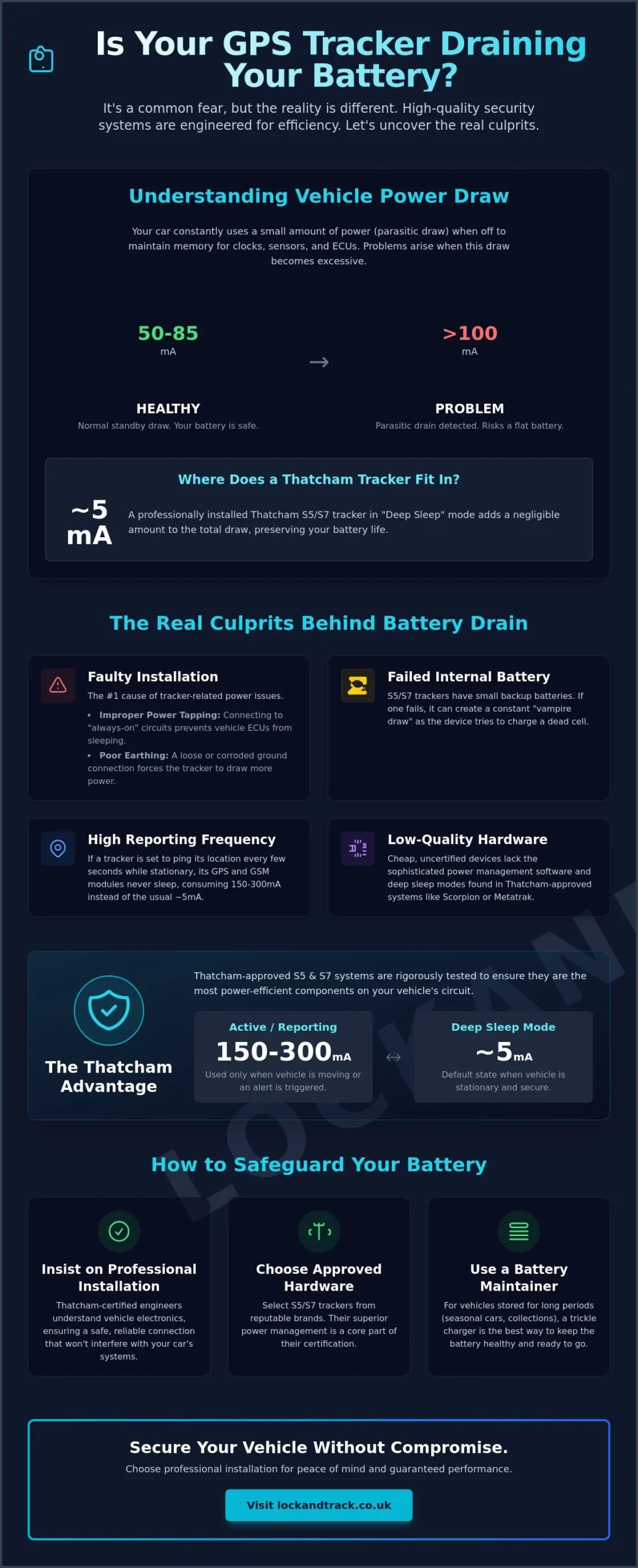
Your vehicle won’t start, and the first thing you suspect is the security system. It’s a common reaction. However, high-quality car trackers are rarely the primary culprit. To solve the problem, you must first distinguish between normal standby draw and genuine parasitic drain. In 2026, a modern vehicle typically has an acceptable parasitic draw of 50 to 85 milliamps (mA). This current maintains your clock settings and keyless entry sensors. When car tracker battery drain issues occur, the draw often exceeds 100mA, preventing the Automotive battery from holding enough charge to crank the engine.
One often overlooked cause is the failure of the tracker’s internal backup battery. Every S5 and S7 device contains a small internal cell designed to power the unit if the main battery is disconnected. If this internal cell reaches the end of its life or fails, the device may attempt to pull a constant high-amperage charge from the vehicle to compensate. This creates a “vampire draw” that never tapers off, even when the car is in deep sleep mode. Additionally, high-frequency reporting intervals can deplete power. If a device is configured to ping its location every few seconds while stationary, the GPS and GSM modules remain active, consuming roughly 150 to 300 mA instead of dropping to a 5mA sleep state.
The Role of Poor Installation in Power Loss
Faulty installation is a leading cause of electrical instability. DIY fitting often involves tapping into “always-on” circuits that interfere with the vehicle’s Controller Area Network (CAN bus). This can prevent the car’s various Electronic Control Units (ECUs) from entering their programmed sleep cycles. If the ECUs stay “awake,” they continue to pull significant power long after you’ve locked the doors. Improper earthing is another common mistake. A loose or corroded ground connection creates electrical resistance. This forces the tracker to work harder to maintain a signal, leading to higher current draw and eventual battery depletion.
Hardware Quality vs. Battery Health
The difference between a cheap, uncertified device and professional Thatcham approved vehicle trackers UK is significant. Low-quality hardware often lacks the sophisticated power management software found in premium systems. In contrast, an S5 Tracker or Scorpion S7 is engineered to monitor the vehicle’s voltage. These devices enter an ultra-low-power mode when they detect the engine is off. They only “wake up” if they sense movement or a security breach. This intelligent monitoring ensures your security remains active without compromising your ability to start the car on a cold morning. The “Vampire Draw” is usually a symptom of poor hardware or bad wiring, not the technology itself.
Understanding Parasitic Draw and Thatcham Security Standards
Parasitic draw is the small amount of electricity your vehicle consumes while the ignition is off. It’s a necessary function. This current maintains the memory for your engine control unit (ECU), radio presets, and security sensors. In 2026, the industry standard for a healthy vehicle is a total draw between 50 and 85 milliamps (mA). If your total consumption stays within this range, your battery will remain healthy for weeks of inactivity. However, when total draw exceeds these thresholds, car tracker battery drain issues begin to surface, leading to a flat battery and potential stranding.
Thatcham Research sets the benchmark for power efficiency in the UK security sector. To achieve S5 or S7 certification, a device must undergo rigorous testing to ensure it doesn’t compromise the vehicle’s electrical system. These standards mandate that approved hardware must utilize “Deep Sleep” technology. When the vehicle is stationary and the ignition is off, the tracker significantly reduces its power consumption, often dropping to as little as 5mA. Professionals experienced in diagnosing battery drain recognize that Thatcham-approved units are engineered to be the most efficient components on a car’s electrical circuit.
Thatcham S5 and S7 Power Efficiency
Modern S5 trackers provide the highest level of protection without sacrificing battery longevity. These high-end systems often feature internal lithium-ion backup batteries. This allows the device to manage its own power needs during high-intensity tasks like signal transmission, rather than pulling constantly from the main battery. Systems like the Scorpion S5 or Metatrak s5 are specifically designed to meet strict insurance mandates while protecting your vehicle’s electrical health. Selecting an insurance-approved device is a direct way to ensure your security system is a silent, efficient guardian.
Smart Battery Management Systems (BMS)
Vehicles manufactured in recent years use complex Battery Management Systems (BMS) to monitor the battery’s state-of-charge. If a tracker is installed incorrectly, it can cause a “Computer Wake-up” trigger. This occurs when the BMS detects an unexpected electrical pulse and wakes up the car’s entire onboard computer network to investigate. This cycle prevents the car from entering its low-power sleep state, leading to rapid depletion. Professional installation ensures the tracker is coded or registered correctly within the vehicle’s ecosystem. If you want to avoid these technical conflicts, choosing a professionally fitted Scorpion S5 Tracker ensures your hardware and vehicle remain in perfect sync.
Diagnostic Steps: How to Tell if Your Tracker is Draining the Battery
Identifying the root cause of car tracker battery drain issues requires a systematic approach. You should never assume the hardware is faulty without evidence. Start with a thorough visual inspection. Look for frayed wiring, loose connections, or signs of heat damage at the power tap. If the installation looks secure, check your dedicated smartphone app. Look for persistent “Low Battery” alerts or check if the reporting frequency is set too high. A device pinging its location every 30 seconds while parked will consume significantly more power than one in a standard sleep cycle.
You must also verify the age and health of your primary battery. Most automotive batteries have a reliable lifespan of 3 to 5 years. As a battery ages, its internal resistance increases and its capacity to hold a charge diminishes. In these cases, a perfectly functioning tracker might be blamed for a failure that is actually due to chemical degradation. If your battery is over four years old, it’s the most likely candidate for your starting issues, and LC Mobile Mechanics Ltd can help you verify its condition with a professional on-site health check.
The Multimeter Test: A Professional Approach
A parasitic draw test is the only way to confirm where your current is going. You’ll need a digital multimeter set to the DC Amps function. Connect the meter in series between the negative battery terminal and the disconnected negative cable. You must wait for the vehicle to enter “Deep Sleep” mode. In modern cars, this process can take between 20 and 60 minutes. During this time, keep all doors shut and the key fobs away from the vehicle. If the reading remains above 85mA after an hour, start pulling fuses one by one. If the draw drops when you pull the tracker fuse, you’ve found your culprit. If it doesn’t, the drain is elsewhere in the vehicle’s electrical system.
Evaluating Other Culprits
Many non-tracker components cause unexpected power loss. Glovebox lights that fail to switch off or incorrectly wired dashcams are frequent offenders. For businesses using fleet tracking solutions UK, short journeys are a major factor. Modern “Smart” alternators often prioritize fuel efficiency over charging. A 15-minute drive is rarely enough to replenish the energy used to start a large van engine. When temperatures drop below 5°C, a battery’s effective capacity can fall by up to 30%. This combination of cold weather and short trips often creates a “deficit” that looks like a parasitic drain but is actually a lack of charging time.
Preventing Battery Drain in Vehicles with GPS Tracking
Prevention is the most effective way to avoid car tracker battery drain issues. If you drive your vehicle daily, your alternator provides ample charge to offset the minimal draw of a Thatcham-approved device. However, vehicles that sit idle for more than a week require a proactive approach. Using a smart battery maintainer or trickle charger ensures your battery stays at peak voltage without overcharging. These devices monitor the state of charge and pulse power only when necessary. This compensates for the natural discharge of the battery and the tracker’s standby current while you’re away.
Matching your security hardware to your vehicle usage profile is a critical step in long-term maintenance. A daily driver can easily support a feature-rich S5 PLUS Tracker with constant monitoring. Conversely, a weekend classic or a vehicle kept in storage might benefit from a device with a more aggressive “Deep Sleep” algorithm. If you know your car will be stationary for long periods, investing in a high-quality AGM-compatible maintainer is a standard professional recommendation. It protects the chemical integrity of your battery while the tracker maintains its vigilant watch.
While managing your vehicle’s electrical health during storage, it’s also worth considering high-end exterior preservation; for instance, Jester Werks allows you to explore Gtechniq Ceramic Coating and Paint Correction to understand how specialized studios provide comprehensive protection for your car’s finish.
You can also manage power through your tracker’s software. Many modern systems allow you to adjust reporting frequencies via a dedicated app. Reducing the “heartbeat” ping interval while the vehicle is parked significantly lowers consumption. Additionally, keep your vehicle’s firmware updated through your local dealership. Manufacturers frequently release patches to fix “phantom” ECU wake-ups. This is where the car’s computer system fails to shut down properly, leading to a drained battery that is often unfairly blamed on the security hardware.
Maintenance for Motorhomes and Caravans
Winter storage presents unique challenges for motorhome trackers. When these large vehicles are parked for months, the leisure battery can deplete quickly due to the sheer number of onboard systems. Solar-assisted charging is an excellent solution for motorhomes kept outdoors. It provides a constant trickle of green energy to keep security systems active and healthy. Be cautious with “Battery Disconnect” switches. While they prevent drain from internal appliances, they may also cut power to your tracker. This leaves your asset vulnerable and could potentially void your insurance coverage.
Battery-Powered Tracker Alternatives
For classic cars or assets without a stable power source, wireless trackers are a viable alternative. These units are completely independent of the vehicle’s electrical system, eliminating any risk of drain. Battery-powered trackers can last up to 3 years without vehicle power. While they lack some real-time features of hardwired units, they provide essential recovery data in the event of a theft. If you are concerned about your vehicle’s electrical health, you can browse our S7 Trackers to find a solution that fits your specific driving habits and security needs.
Why Professional Installation is the Ultimate Battery Safeguard
Professional installation is the definitive solution to the common myths surrounding vehicle security and power loss. While previous sections explored how to diagnose car tracker battery drain issues, the most effective way to prevent them is through expert fitting. Thatcham-approved engineers possess the technical expertise to identify safe power taps that don’t interfere with your vehicle’s sensitive electronics. They use vehicle-specific wiring diagrams to ensure the hardware draws power from circuits designed to handle the load, rather than tapping into “always-on” systems that might prevent the car from sleeping.
Electrical safety is built into every professional install. Our engineers use high-quality connectors and proper fusing to prevent electrical shorts and resistance. Cheap crimps or “vampire clips” used in DIY setups often loosen over time, creating heat and inconsistent current draw. Expertise is also vital when integrating layered security. Connecting car immobilisers alongside a tracker requires precise knowledge of the CAN bus system. A professional ensures these devices communicate correctly without overloading the vehicle’s data network, which is a frequent cause of “phantom” battery depletion.
Lock and Track’s Nationwide Professional Service
Our nationwide mobile installation service prioritizes your vehicle’s long-term health. Before any hardware is fitted, our engineers verify the existing health of your battery and charging system. This pre-install check ensures you aren’t fitting a high-tech device to a failing 12V cell. For owners of modern electric vehicles (EVs), this expertise is even more critical. EVs have complex low-voltage systems that require specific handling to avoid warranty issues. By choosing a certified professional, you also eliminate the risk of insurance claim rejection, as providers often mandate that S5 and S7 systems are installed by qualified technicians to maintain their certification status.
Securing Your Vehicle with Confidence
A high-quality security system is a powerful asset, not a liability for your battery. When you choose a Scorpion S5 or Metatrak s5, you’re investing in hardware designed for 2026 standards of efficiency. These devices provide the peace of mind you need to protect your asset from modern theft techniques without the fear of being stranded. If you’ve experienced recurring power issues or simply want to ensure your new security system is fitted correctly from day one, it’s time to speak with a specialist. You can book a professional health check and installation to guarantee your vehicle remains both secure and reliable. Protect your vehicle today with Lock and Track’s expert installation services and enjoy the tranquility of proactive protection.
Maintain Peak Security Without Power Loss
You now have the knowledge to distinguish between a healthy standby draw and a genuine electrical fault. High-quality security hardware is an ally to your vehicle, not an enemy to its power supply. Most car tracker battery drain issues are the result of aging cells or poor installation practices rather than the technology itself. By choosing Thatcham-certified devices and following simple maintenance routines, you ensure your car remains both protected and ready to drive at a moment’s notice.
Don’t let the fear of a flat battery compromise your vehicle’s safety. Our team of Thatcham-approved engineers provides nationwide mobile installation of S5 and S7 insurance-approved hardware. We verify your vehicle’s health before every fitment to guarantee total reliability and peace of mind. Secure your vehicle with a Thatcham-approved tracker and professional nationwide installation from Lock and Track. Take control of your security with a partner you can trust. You deserve the tranquility that comes with a perfectly protected asset and a reliable engine.
Frequently Asked Questions
Will a car tracker drain my battery if I don’t drive for a week?
A professionally installed tracker won’t drain a healthy battery over a single week of inactivity. Modern devices like the Scorpion S5 are designed with intelligent power-saving modes that minimize consumption when the ignition is off. If your battery is flat after seven days, it’s likely a sign of a failing battery or an underlying vehicle fault. Regular driving ensures the alternator maintains the charge level needed to support these low-draw systems.
How long can a car sit with a tracker before the battery dies?
Most vehicles can sit for two to four weeks with a Thatcham-approved tracker before the battery voltage drops significantly. This duration depends on the battery’s capacity and current health. Older batteries or those in cold climates will deplete much faster. If you plan to leave your vehicle for more than 14 days, we recommend using a battery maintainer to keep the voltage stable and ensure the security system remains active.
Can a faulty car tracker cause a flat battery?
A faulty device or poor installation can lead to car tracker battery drain issues. If internal components fail, the device might fail to enter sleep mode, pulling a constant 150mA to 300mA. This will deplete a standard automotive battery in a matter of days. Professional testing with a multimeter is the only way to confirm if the tracker is the true source of the parasitic draw rather than another module.
Does a Ghost immobiliser drain the car battery?
The Ghost 2 Immobiliser has a negligible impact on your vehicle’s battery. It’s designed to be ultra-efficient, typically drawing less than 1 milliamp when the vehicle is stationary. This makes it one of the safest security additions for classic cars or vehicles that aren’t driven daily. It won’t contribute to power loss even during long periods of storage, providing protection without compromising your starting power or electrical health.
What is the normal milliamp draw for a car tracker?
A standard hardwired tracker typically draws between 10mA and 50mA during regular operation. Once the vehicle enters sleep mode, this should drop to between 5mA and 30mA. These figures are well within the 50mA allowance generally permitted by vehicle manufacturers for all aftermarket accessories combined. Anything consistently higher than this range suggests a configuration error or a hardware fault that needs professional attention from a qualified engineer.
Should I use a trickle charger if I have a GPS tracker installed?
You should use a trickle charger if your vehicle is frequently parked for more than two weeks at a time. While the tracker draw is small, all batteries naturally self-discharge over time. A smart maintainer ensures the battery stays at its optimal state of charge, which is especially important for motorhomes or seasonal motorbikes. This simple step protects the longevity of your battery and keeps your GPS tracking system fully operational.
Can a car tracker damage my car’s electrical system?
A car tracker won’t damage your electrical system if it’s installed by a Thatcham-approved engineer. These professionals use safe power taps and ensure the device doesn’t interfere with the CAN bus or ECU communication. Damage only occurs when uncertified installers use improper wiring techniques or tap into high-voltage circuits. Choosing professional installation is the best way to safeguard your vehicle’s sophisticated electrical architecture and maintain your manufacturer warranty.
How do I know if my tracker’s backup battery needs replacing?
Most modern systems will send a notification to your smartphone app if the internal backup battery is failing. You might also notice car tracker battery drain issues where the device pulls a constant, higher current from the main battery as it attempts to charge a dead internal cell. If your tracker is over three years old and you start seeing frequent “low voltage” alerts, it’s time to book a professional health check.