
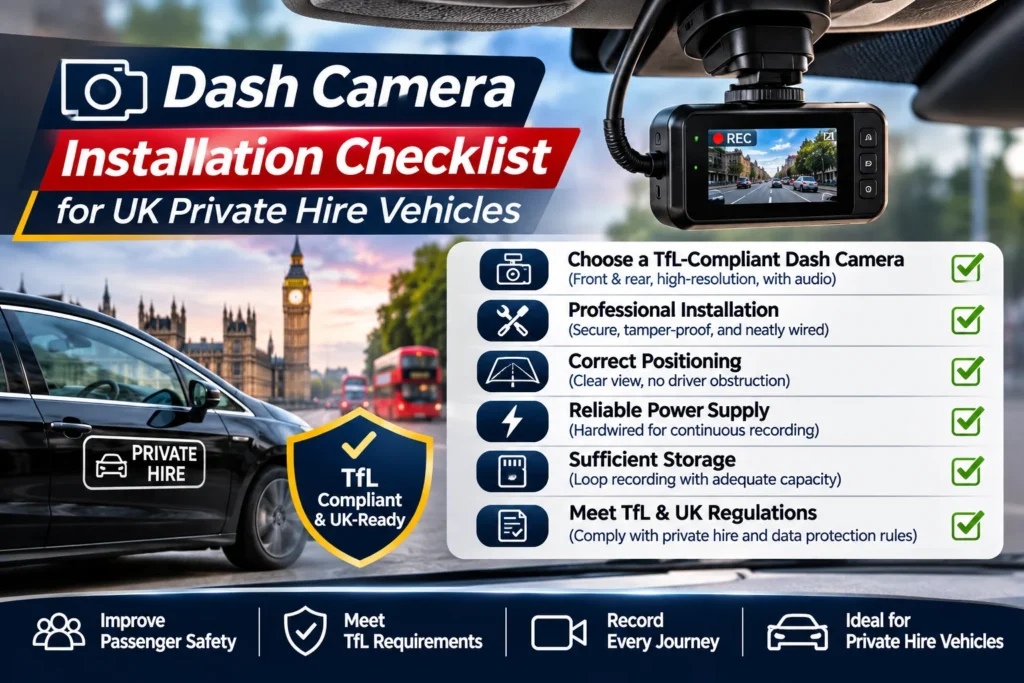
Dash cameras can provide useful evidence when a road traffic accident, insurance dispute or unexpected incident occurs. For private hire drivers, a properly selected and installed camera can support safer working practices and help protect both drivers and passengers.
However, installing a camera in a licensed vehicle involves more than attaching a device to the windscreen. Camera positioning, recording quality, electrical connections, privacy and local licensing requirements should all be considered.
This Dash Camera Installation Checklist for UK Private Hire Vehicles explains the main steps drivers and vehicle operators should review before choosing and installing a recording system.
1. Check Your Local Licensing Authority’s Requirements
Before purchasing a camera, check the rules issued by the local authority responsible for your private hire vehicle licence.
Requirements can differ between licensing areas. Some authorities have specific conditions covering approved equipment, installation certificates, recording functions, signage and the use of audio.
The Dash Camera Installation Checklist for UK Private Hire Vehicles should therefore begin with a review of your licensing conditions.
Check whether your authority requires:
- Approval of the camera model.
- An installation certificate.
- Particular camera specifications.
- Passenger-facing or external-facing recording.
- Visible CCTV notices.
- Restrictions on audio recording.
- Notification when equipment is installed or removed.
Do not assume that a camera accepted by one council will automatically be accepted by another.
2. Choose a Suitable Dash Camera
The right camera depends on your vehicle, operating requirements and local licensing conditions.
Some drivers need an outward-facing camera to record the road, while certain licensed vehicle policies may require a compliant in-cabin CCTV system. These are not necessarily interchangeable.
When following a Dash Camera Installation Checklist for UK Private Hire Vehicles, consider these features:
Video resolution: Choose a camera capable of capturing clear footage in relevant driving conditions.
Night recording: Check whether the camera performs adequately in low-light environments.
Storage capacity: Make sure the recording system supports the retention period required by your licensing authority or operating policy.
GPS functionality: Some systems record location, date and time information alongside video.
Event recording: Look for features that protect relevant footage following a detected impact or sudden movement.
Reliability: Choose equipment designed for regular vehicle use and suitable operating temperatures.
3. Decide Which Camera Views Are Required
Camera positioning determines what information the recording system can capture.
An outward-facing dash camera generally records the road ahead. A multi-camera system may provide additional views, while an approved in-cabin surveillance system may record activity inside the vehicle.
Before installation, establish the exact recording purpose.
The Dash Camera Installation Checklist for UK Private Hire Vehicles should include a review of whether your system needs to capture:
- The road ahead.
- The rear of the vehicle.
- The passenger compartment.
- Selected vehicle areas for security purposes.
Do not install additional cameras simply because they are available. Recording should be necessary and proportionate to the purpose, with privacy considerations addressed.
4. Plan the Camera Position Carefully
Correct positioning is essential for useful recordings and safe driving.
A camera should be mounted securely without obstructing the driver’s view of the road. It should not interfere with airbags, mirrors, controls or the operation of the vehicle.
During the Dash Camera Installation Checklist for UK Private Hire Vehicles, check:
- The camera has a clear view of its intended recording area.
- The windscreen mounting position does not obstruct visibility.
- The camera does not interfere with the driver’s normal operation.
- Cables are secured away from pedals and moving components.
- The installation does not interfere with airbags or safety equipment.
- Any external camera is securely mounted and protected from unnecessary movement.
A professional installer can help identify a suitable position for the specific vehicle and camera model.
5. Check the Electrical Connection
A reliable power supply is important for consistent recording.
Depending on the camera, power may be provided through a suitable vehicle socket, hardwiring kit or another manufacturer-approved connection.
Avoid loose wiring or poorly fitted connections. Incorrect electrical work can cause intermittent recording, battery drain or damage to vehicle systems.
The Dash Camera Installation Checklist for UK Private Hire Vehicles should include confirmation that:
- The power connection follows the manufacturer’s instructions.
- The correct fuse and protection arrangements are used.
- Wiring is secured and insulated appropriately.
- The camera starts and shuts down as intended.
- Parking mode, if fitted, is configured correctly.
- The vehicle battery is protected from excessive discharge.
For hardwired installations, professional fitting is recommended.
6. Configure Recording, Storage and Footage Access
Before putting the camera into regular use, check how it records, stores and protects footage.
A camera may record continuously, save selected event clips or use a combination of recording modes. The correct configuration depends on the system and its intended purpose.
When completing your Dash Camera Installation Checklist for UK Private Hire Vehicles, confirm:
- The date and time are correct.
- The storage card is compatible.
- Recording starts as expected.
- Important event footage is protected from automatic overwriting.
- The retention period is appropriate.
- Footage can be retrieved when legitimately required.
- Access is restricted to authorised people.
If your licensing authority specifies a particular retention period or recording format, follow that requirement rather than relying on a generic recommendation.
7. Address Privacy, Signage and Audio Recording
Dash camera footage can contain personal information, including images of passengers, drivers, pedestrians and other road users.
Private hire operators should establish a clear reason for recording and consider their responsibilities under applicable data protection law.
The Dash Camera Installation Checklist for UK Private Hire Vehicles should include:
- Identifying who is responsible for the recorded information.
- Providing appropriate privacy information.
- Displaying clear notices where required.
- Restricting access to recordings.
- Establishing a retention and deletion policy.
- Explaining how footage requests are handled.
Audio recording requires particular care because it can capture private conversations. The Information Commissioner’s Office advises that audio capability should generally be switched off by default and used only in exceptional circumstances where it can be justified.
Always check your local authority’s rules before enabling audio.
8. Test the Camera Before Returning to Work
A camera should be tested after installation rather than assumed to be working correctly.
Record a short test journey or stationary test, depending on the equipment and installation instructions. Review the footage to confirm that the image is clear and the intended area is visible.
The Dash Camera Installation Checklist for UK Private Hire Vehicles should include the following tests:
- The camera powers on correctly.
- Recording begins when expected.
- The image is clear during daylight.
- Night-time footage is usable.
- The correct camera views are recorded.
- GPS and timestamps work if supported.
- Storage operates correctly.
- Event recording functions as intended.
- No cables or equipment interfere with driving.
Keep a record of the installation and any relevant compliance checks.
9. Keep Installation and Maintenance Records
Private hire vehicles operate regularly, so camera equipment should be inspected periodically.
Check the camera mount, power connections, storage card and recording quality. Review the equipment manufacturer’s maintenance instructions and replace damaged components when necessary.
Keep copies of:
- Purchase information.
- Installation documentation.
- Camera model and serial number.
- Relevant approval details.
- Maintenance records.
- Licensing correspondence.
- Privacy and data-handling procedures.
These records can help demonstrate how the system was selected, installed and maintained.
10. Final Pre-Installation Checklist
Before using the camera for private hire work, review the following points:
- Local licensing requirements have been checked.
- The selected camera is suitable for the intended purpose.
- Recording views meet applicable requirements.
- Camera positioning does not obstruct visibility.
- Wiring and power connections are secure.
- Recording and storage have been tested.
- Audio settings have been reviewed.
- Required passenger notices are displayed.
- Data protection responsibilities are understood.
- Installation records are available.
Completing this Dash Camera Installation Checklist for UK Private Hire Vehicles can help reduce installation mistakes and identify compliance issues before the vehicle returns to service.
Conclusion
A dash camera can be a useful addition to a private hire vehicle, but the equipment must be appropriate for its intended purpose and installed correctly.
Following a Dash Camera Installation Checklist for UK Private Hire Vehicles helps drivers and operators consider camera selection, positioning, wiring, recording quality, privacy and maintenance.
Always check your local licensing authority’s conditions, follow the camera manufacturer’s instructions and seek professional installation where necessary.
Frequently Asked Questions
1. Do private hire vehicles need a dash camera in the UK?
There is no single requirement that applies identically to every private hire vehicle across the UK. Check the conditions issued by your local licensing authority.
2. Can I install my own dash camera? (Dash Camera Installation Checklist)
Some simple cameras can be installed by vehicle owners, but hardwired systems and licensed-vehicle CCTV installations may require professional fitting or specific approval.
3. Where should a dash camera be positioned? (Dash Camera Installation Checklist)
It should provide a clear view of the intended recording area without obstructing the driver’s view, interfering with airbags or affecting vehicle controls.
4. Should a private hire dash camera record audio?
Audio recording is particularly intrusive. The ICO advises that it should generally be switched off by default and used only in exceptional circumstances where properly justified.
5. Do passengers need to know that a camera is recording?
Appropriate privacy information and signage may be required. Follow the applicable data protection guidance and local licensing conditions.
6. How long should private hire dash camera footage be stored?
The required period depends on the applicable licensing conditions and the purpose of recording. Do not assume one retention period applies to every council.
7. Can dash camera footage help with insurance claims?
Yes. Relevant footage may help establish what happened during an incident, although insurers and other authorities will assess the evidence themselves.
8. How often should I check my dash camera?
Check recording quality, storage, mounting and power connections regularly. Follow the manufacturer’s maintenance instructions and investigate any recording faults promptly.