
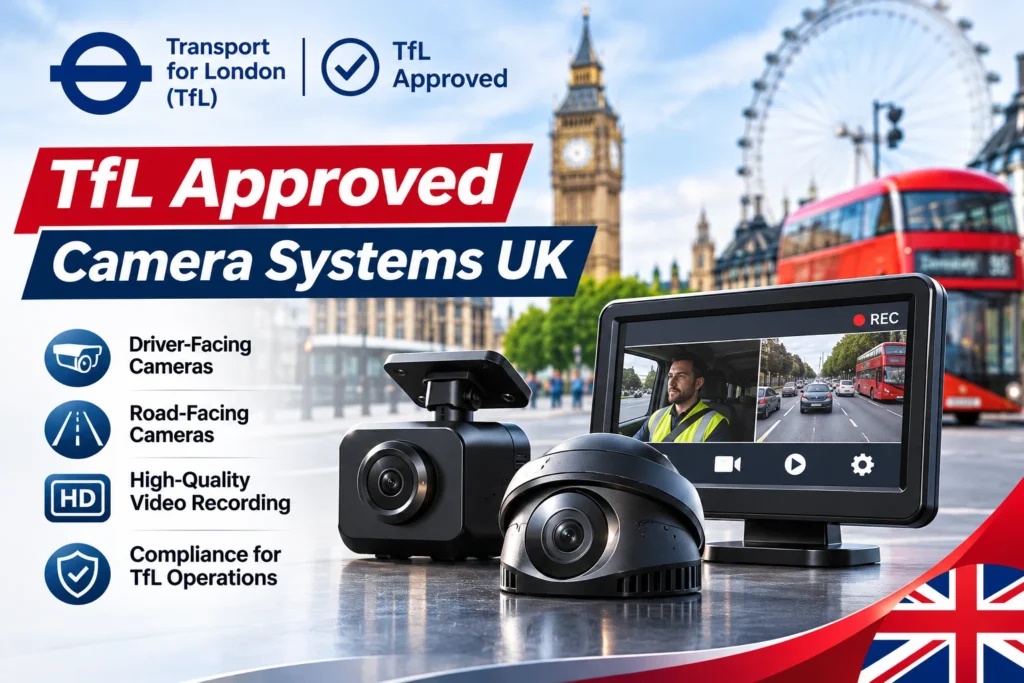
Taxi and private hire drivers have an important responsibility to provide a safe and professional service. Working with passengers every day can involve different situations, including disagreements, accidents, complaints, and unexpected incidents. An in-vehicle camera system can help record relevant events and provide useful evidence when required.
For drivers operating in London, understanding TfL Approved Camera Systems UK is particularly important. Transport for London (TfL) has specific requirements for CCTV equipment installed in licensed taxis and private hire vehicles. Choosing a suitable system involves checking device approval, vehicle compatibility, installation standards, and passenger privacy responsibilities.
Whether you are a licensed taxi driver, private hire driver, or vehicle operator, this guide explains what you should know before purchasing and installing an approved camera system.
1. What Are TfL Approved Camera Systems UK?
TfL Approved Camera Systems UK refers to in-vehicle CCTV and incident recording equipment that meets Transport for London’s requirements for licensed London taxis and private hire vehicles.
These systems are designed to support the safety and security of drivers and passengers. Depending on the approved configuration, they may record the vehicle interior, the road ahead, or other specified areas.
An approved camera system can help with:
- Recording relevant incidents inside the vehicle.
- Providing evidence following passenger disputes.
- Supporting investigations into reported incidents.
- Recording certain road-related events.
- Helping protect drivers and passengers.
- Supporting insurance investigations where relevant footage is available.
TfL has published CCTV guidelines explaining the technical, installation, management, and privacy requirements for these systems.
It is important to understand that not every ordinary dash camera automatically qualifies as a TfL-approved camera system. Drivers should check the official approved equipment list before purchasing a device.
2. Why Do Taxi Drivers Need Approved Camera Systems?
Taxi and private hire drivers regularly interact with passengers from different backgrounds. Although most journeys are completed without problems, unexpected situations can occur.
Installing TfL Approved Camera Systems UK can provide additional security and help create a record of certain incidents.
Protection Against Passenger Disputes
A disagreement may arise over a journey, payment, passenger behaviour, or an alleged incident.
Where the relevant event has been recorded correctly, footage may help establish what happened.
Support During Investigations
If an incident is reported to the police or licensing authority, relevant footage may assist an investigation, subject to applicable legal requirements.
Improved Driver Security
Visible CCTV equipment can act as a deterrent against certain types of inappropriate behaviour.
Assistance With Insurance Claims
Camera recordings may provide useful information when investigating an accident or disputed incident. However, installing a camera does not guarantee an insurance discount or a successful claim.
3. Understand the Different Types of Taxi Camera Systems
When researching TfL Approved Camera Systems UK, it is useful to understand the different camera configurations available.
The correct configuration depends on the approved system and the vehicle in which it will be installed.
Forward-Facing Cameras
A forward-facing camera records the road ahead of the vehicle.
It may help document:
- Road traffic incidents.
- Vehicle movements.
- Driving conditions.
- Certain accident-related events.
Interior-Facing Cameras
An interior-facing camera records activity inside the passenger compartment.
It can provide relevant footage of incidents involving passengers and drivers, subject to the system’s approved configuration and privacy requirements.
Rear-Facing Cameras
Some approved configurations include cameras covering additional areas around or inside the vehicle.
Their purpose and positioning depend on the specific equipment approval.
Combined Camera Systems
Combined systems may use multiple cameras connected to a central recording device.
For example, a configuration may include forward-facing and passenger-facing cameras. Some approved systems also include additional recording functions or emergency controls.
Always check the exact approved configuration rather than assuming every camera model offers the same features.
4. Check the Official TfL Approved Camera List
One of the most important steps when buying TfL Approved Camera Systems UK is checking whether the exact equipment appears on TfL’s approved list.
TfL publishes information about approved suppliers, installers, camera models, and vehicle compatibility.
The approval information can include different vehicle categories, such as:
- TX4 taxis.
- Vito taxis.
- TXe taxis.
- Dynamo taxis.
- Private hire vehicles (PHVs).
Not every approved camera is suitable for every vehicle category.
For example, a camera system listed for private hire vehicles should not automatically be assumed to be approved for every type of London taxi.
Before purchasing, check:
- The camera manufacturer’s name.
- The exact camera model.
- The approved vehicle category.
- The approved camera configuration.
- The supplier or installation provider.
- Whether the current approval information has changed.
The exact model matters. A different version of a camera from the same manufacturer may not have the same approval.
5. Important Features to Consider Before Buying
Although TfL approval should be your first consideration, you should also compare the practical features of available systems.
When researching TfL Approved Camera Systems UK, consider the following features.
Recording Quality
Good image quality can help make recorded footage more useful when reviewing an incident.
Check the camera specifications and whether the approved configuration provides suitable coverage for your needs.
Reliable Storage
The recording device should securely store footage and provide a suitable method of retrieving relevant recordings.
Ask the supplier about storage capacity, recording duration, and how recordings are protected.
Emergency Recording
Some approved systems include incident or emergency recording functions.
Depending on the system, these may allow audio recording to be activated when an incident occurs.
Night-Time Recording
If you regularly work at night, check the camera’s low-light performance and whether the approved interior camera includes infrared recording.
Secure Footage Access
Camera recordings can contain sensitive personal information. Check who can access the recordings, how access is controlled, and how footage can be securely provided when legitimately required.
Installation Quality
A camera system should be installed securely without creating unnecessary risks for the driver or passengers.
The camera position must follow the applicable approval and installation requirements.
6. Understand TfL Camera Installation Requirements
Buying an approved device is only one part of the process. Correct installation is also important.
TfL Approved Camera Systems UK must be fitted in accordance with the applicable TfL guidelines and the approved equipment configuration.
The installation should consider:
- Approved camera positioning.
- Secure mounting.
- Safe electrical connections.
- Suitable recording equipment placement.
- Clear visibility for passengers where required.
- No unnecessary obstruction of the driver’s view.
- Safe operation of the equipment.
TfL’s guidelines also explain that installed CCTV equipment may be inspected during the vehicle’s annual licensing inspection to check that it is safely and securely fitted.
Using an experienced approved supplier or installer can help ensure that the equipment is suitable for the vehicle and installed correctly.
Do not assume that purchasing an approved camera automatically makes an incorrect installation acceptable.
7. Passenger Privacy and CCTV Signage
Passenger privacy is an essential consideration when using TfL Approved Camera Systems UK.
Cameras may capture personal information, including images and, where applicable, audio recordings. Drivers and other responsible parties must understand their obligations when operating a CCTV system.
Display Appropriate CCTV Signs
Passengers should be made aware that CCTV is operating inside the vehicle.
TfL’s guidance requires appropriate signage to be displayed where passengers can easily see it when entering and travelling in the vehicle.
The sign should identify the purpose of the CCTV system and provide information about the responsible data controller, including contact details.
Handle Audio Recording Carefully
Audio recording is particularly privacy-sensitive.
TfL and wider government guidance emphasise that audio recording should be appropriately controlled and not continuously active by default. It should be activated in relevant circumstances, with clear awareness of when recording is taking place.
Protect Recorded Footage
Drivers and responsible operators should ensure that recordings are:
- Stored securely.
- Protected against unauthorised access.
- Accessed only for legitimate purposes.
- Retained only for an appropriate period.
- Handled according to applicable data protection requirements.
Privacy should not be treated as an optional feature. It is an important part of operating an in-vehicle camera system responsibly.
8. How Much Do TfL Approved Camera Systems UK Cost?
The cost of TfL Approved Camera Systems UK depends on the camera model, number of cameras, recording equipment, installation requirements, and additional services.
Some suppliers may offer complete installation packages, while others may quote separately for equipment and fitting.
Before purchasing, compare the following:
- Camera equipment price.
- Installation charges.
- Recording device and storage costs.
- Additional camera costs.
- Maintenance and support.
- Warranty arrangements.
- Optional monitoring or subscription services.
Ask suppliers for a complete quotation rather than comparing camera prices alone.
You should also check whether the quotation includes the exact approved system and configuration required for your vehicle.
There is no single price that applies to every taxi or private hire vehicle.
9. How to Choose the Right TfL Approved Camera Supplier
Choosing a reliable supplier is just as important as selecting the camera itself.
When comparing providers of TfL Approved Camera Systems UK, look for a supplier that understands the relevant TfL requirements and can confirm the exact equipment approval.
Consider these factors:
Experience With Licensed Vehicles
Choose a provider with experience installing camera systems in London taxis and private hire vehicles.
Verified Equipment Approval
Ask for confirmation of the exact camera model and its approved vehicle category.
Professional Installation
Check whether installation is included and whether the provider can explain the approved positioning and fitting arrangements.
After-Sales Support
Ask what happens if the camera stops working, the recording device develops a fault, or you need help retrieving footage.
Clear Pricing
A professional supplier should explain equipment costs, installation fees, warranty conditions, and any ongoing charges.
Documentation
Keep your purchase information, installation details, and equipment documentation for future reference.
Taking these steps can help you make a more informed purchasing decision.
10. Common Mistakes Taxi Drivers Should Avoid
Drivers can make avoidable mistakes when buying or installing in-vehicle camera equipment.
Here are some important mistakes to avoid when choosing TfL Approved Camera Systems UK:
- Purchasing an ordinary dash camera without checking TfL approval.
- Assuming every approved camera fits every taxi model.
- Checking the supplier but not the exact camera model.
- Ignoring the approved camera configuration.
- Using an inexperienced installer.
- Installing equipment in a way that obstructs the driver’s view.
- Forgetting to display appropriate CCTV signage.
- Recording audio continuously without considering privacy requirements.
- Allowing unauthorised people to access footage.
- Failing to check the equipment before the vehicle inspection.
Careful research before purchasing can help prevent unnecessary costs and installation problems.
11. Are TfL Approved Camera Systems Mandatory?
This is an important question for London taxi and private hire drivers.
TfL’s published CCTV guidelines explain which systems can be installed in licensed London taxis and private hire vehicles. The existence of an approved camera list does not, by itself, mean that every licensed vehicle is universally required to have CCTV installed.
Drivers should distinguish between equipment approval and a licensing requirement.
If you are considering installing CCTV, check the latest TfL guidance and any conditions that apply to your particular vehicle licence.
Do not rely on information intended for another local authority or another vehicle category.
12. Benefits of Installing a Suitable Approved Camera System
Choosing an appropriate camera system can provide several practical benefits for drivers and operators.
Better incident documentation: Relevant recordings may help explain what happened during a journey or incident.
Additional driver protection: Visible cameras may discourage some inappropriate behaviour.
Passenger safety support: CCTV can contribute to a safer environment when operated responsibly.
Useful evidence: Recordings may assist police, licensing authorities, or insurers where relevant and lawfully requested.
Professional operation: A correctly installed system can support a responsible approach to vehicle safety and incident management.
Although camera systems can be useful, they cannot prevent every incident or guarantee that an event will be recorded successfully.
Conclusion
Choosing the right TfL Approved Camera Systems UK requires more than comparing camera prices or recording quality. Taxi and private hire drivers should check the exact approved model, vehicle compatibility, installation configuration, and supplier credentials before making a purchase.
It is equally important to understand passenger privacy, CCTV signage, secure footage storage, and responsible audio recording.
By selecting an appropriate approved system and arranging professional installation, drivers can improve their ability to document relevant incidents and support a safer working environment.
Before buying, always check the latest official TfL approved camera list and guidance. This helps ensure that your chosen equipment is suitable for your licensed vehicle and complies with the applicable requirements.
Frequently Asked Questions (FAQs)
1. What are TfL Approved Camera Systems UK?
TfL Approved Camera Systems UK are in-vehicle CCTV and incident recording systems that meet Transport for London’s requirements for installation in licensed London taxis and private hire vehicles.
2. Are TfL-approved cameras mandatory for all taxi drivers?
The existence of an approved camera list does not mean CCTV is universally mandatory for every licensed taxi and private hire vehicle. Drivers should check the current TfL licensing requirements and applicable vehicle conditions.
3. Can I install any dash camera in my TfL-licensed taxi?
No. You should not assume that an ordinary dash camera is suitable. Check the exact camera model and configuration against TfL’s approved equipment information before installation.
4. Do TfL-approved camera systems record inside the vehicle?
Some approved systems include interior-facing cameras that record activity inside the passenger compartment. The recording configuration depends on the specific approved system.
5. Do TfL-approved cameras record audio?
Some approved systems have audio recording capabilities. Audio recording must be handled carefully, with appropriate activation, passenger awareness, and privacy safeguards.
6. Where should I install a TfL-approved taxi camera?
The camera must be installed in the approved position for the specific system and vehicle configuration. Use the supplier’s installation guidance and relevant TfL requirements.
7. Do I need CCTV signs inside my taxi?
Appropriate signage should inform passengers that CCTV is operating. TfL’s guidance explains that signs should be clearly visible and include information about the purpose of the system and the responsible data controller.
8. How much do TfL Approved Camera Systems UK cost?
Prices vary depending on the camera model, number of cameras, recording equipment, installation, and optional services. Request a full quotation from the supplier.
9. Can I use the same approved camera in a taxi and a private hire vehicle?
Not necessarily. TfL approval can depend on the vehicle category and exact equipment configuration. Check the approved list before purchasing.
10. Can taxi camera footage be used as evidence?
Relevant footage may assist police investigations, licensing enquiries, or insurance investigations, subject to applicable legal and data protection requirements.
11. How long should taxi CCTV footage be stored?
There is no single retention period that applies to every system and situation. The responsible data controller should establish an appropriate retention policy based on the purpose of recording and applicable data protection requirements.
12. Where can I find the official list of TfL-approved cameras?
You can consult Transport for London’s published approved CCTV systems and installer information, together with its CCTV guidelines for licensed taxis and private hire vehicles.