
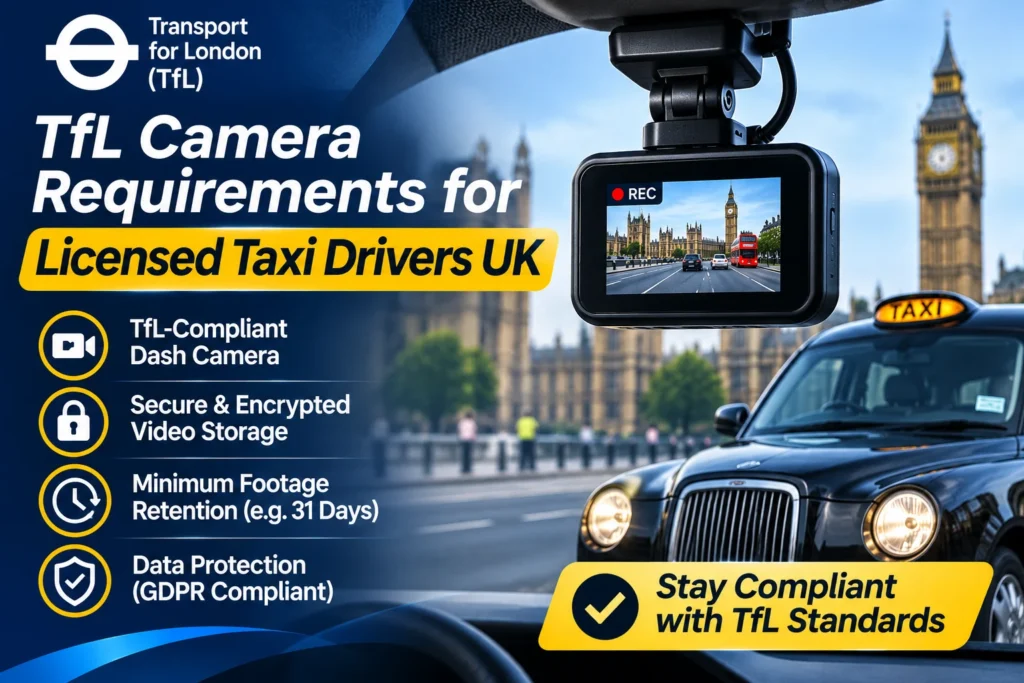
In-vehicle CCTV can help improve safety for taxi drivers and passengers. It may also provide useful evidence when an incident, complaint or dispute occurs. However, drivers and vehicle owners need to understand the applicable licensing and data protection requirements before installing recording equipment.
The TfL Camera Requirements for Licensed Taxi Drivers UK are particularly important for owners and operators of licensed London taxis and private hire vehicles. This guide explains the main considerations, including approved equipment, signage, recording, privacy and installation.
Why Taxi and Private Hire Vehicles Use CCTV
A CCTV system can help create a safer environment by discouraging inappropriate behaviour and providing recordings that may assist investigations.
For licensed London vehicles, Transport for London publishes guidance covering CCTV systems fitted in taxis and private hire vehicles. Drivers researching TfL Camera Requirements for Licensed Taxi Drivers UK should consult the latest official guidance before purchasing or installing equipment.
1. Check Whether the CCTV System Is TfL Approved
TfL’s published CCTV guidance states that systems fitted in licensed London taxis and private hire vehicles must meet its requirements and be approved by TfL.
This means drivers should not assume that an ordinary dashboard camera or generic recording device automatically qualifies.
Before choosing equipment, check the current approved-system information and ask the supplier to confirm that the specific model is suitable. Understanding TfL Camera Requirements for Licensed Taxi Drivers UK before purchase can help prevent unnecessary costs or problems during a vehicle inspection.
2. Understand the Camera’s Recording Capabilities
Taxi CCTV systems may record images from inside or outside the vehicle, depending on the approved configuration and intended purpose.
Drivers should understand:
- Which areas are recorded
- Whether internal passenger areas are covered
- Whether external views are included
- How recordings are stored
- How authorised footage can be accessed
- What happens if the recording equipment develops a fault
The system should be installed and configured in accordance with the applicable TfL guidance. The TfL Camera Requirements for Licensed Taxi Drivers UK should be checked against the exact equipment being considered.
3. Display Appropriate CCTV Signage
Passengers should be informed when CCTV recording is taking place. TfL guidance and vehicle inspection requirements include appropriate signage identifying the recording activity and the person or organisation responsible for the system.
The signage should be easy to see and must not obstruct the driver’s view. Data controller contact details should be completed and legible where required.
Drivers reviewing TfL Camera Requirements for Licensed Taxi Drivers UK should ask the CCTV supplier whether the correct signage is included and where it needs to be displayed.
4. Understand Audio Recording and Privacy
Audio recording raises additional privacy considerations because passengers may have private conversations during journeys.
Drivers should not assume that audio can be recorded continuously simply because a camera supports that feature. The applicable TfL guidance sets specific conditions for audio recording, including transparency and restrictions on when it is activated.
Before enabling audio, review the current official guidance and data protection responsibilities. The TfL Camera Requirements for Licensed Taxi Drivers UK should be considered alongside privacy obligations, not just the camera’s technical features.
5. Follow Data Protection Responsibilities
CCTV footage can contain personal information. The person or organisation deciding why and how the footage is recorded will generally have responsibilities as the data controller.
Drivers and operators should understand:
- Why footage is being collected
- Who can access the recordings
- How footage is stored securely
- How long recordings are retained
- When footage may be shared with authorised parties
- How privacy requests and complaints are handled
TfL’s CCTV guidance includes requirements concerning the management and retention of recorded material. Check the current document for the applicable retention rules and any permitted exceptions.
6. Ensure Safe and Secure Installation
A camera must be fitted securely and positioned so that it does not create a safety risk or obstruct the driver’s visibility.
Poor installation can lead to loose equipment, obstructed views, damaged trim or electrical problems. Choose an installer familiar with licensed taxi and private hire vehicles.
When checking TfL Camera Requirements for Licensed Taxi Drivers UK, make sure the equipment, wiring, camera position and signage are all considered together.
7. Prepare for Vehicle Licensing Inspections
CCTV equipment and its installation may be examined as part of the vehicle licensing inspection process. TfL’s vehicle inspection manual includes checks relating to CCTV signage, including whether the required information is visible, secure and legible.
Drivers should inspect the equipment before presenting their vehicle. Check that the camera is securely fitted, signage is in place and any required data controller details are complete.
The TfL Camera Requirements for Licensed Taxi Drivers UK should be checked against the latest inspection manual, as requirements and inspection procedures can be updated.
Is CCTV Compulsory for Every Licensed London Taxi?
It is important to distinguish between rules governing CCTV systems that are fitted and a universal requirement for every vehicle to have CCTV installed.
TfL’s published guidance sets requirements for CCTV systems installed in licensed London taxis and private hire vehicles. Its 2025 Taxi and Private Hire Action Plan also refers to reviewing and updating in-vehicle CCTV guidance and requirements during 2025/26 and 2026/27, including further consideration of mandating CCTV.
Drivers should therefore check the latest TfL licensing notices and policy before deciding whether installation is compulsory for their particular vehicle or licence.
How to Choose a Suitable Taxi CCTV System
Before buying a system, ask the supplier:
- Is this exact CCTV model approved by TfL?
- Is it suitable for my taxi or private hire vehicle?
- Does it include the required passenger signage?
- How is footage stored and protected?
- What are the audio recording settings?
- Who is responsible for data controller information?
- Can the installer provide documentation and aftercare?
Checking these details helps drivers understand TfL Camera Requirements for Licensed Taxi Drivers UK before committing to equipment or installation.
Frequently Asked Questions
1. Do all London taxi drivers have to install CCTV?(TfL Camera Requirements for Licensed Taxi Drivers UK)
Do not assume that every licensed vehicle is subject to a universal CCTV installation requirement. Check the latest TfL rules and notices for your vehicle and licence.
2. Can I install any dashboard camera?(TfL Camera Requirements for Licensed Taxi Drivers UK)
No. A standard dashboard camera should not be assumed to meet TfL’s requirements for in-vehicle CCTV in licensed vehicles.
3. Does a taxi CCTV system need passenger signage? (TfL Camera Requirements for Licensed Taxi Drivers UK)
TfL guidance and inspection requirements include CCTV signage to inform passengers about recording and identify the data controller.
4. Can taxi CCTV record passenger conversations? (TfL Camera Requirements for Licensed Taxi Drivers UK)
Audio recording is subject to specific restrictions and privacy requirements. Check the latest TfL guidance before enabling it.
5. Who is responsible for CCTV footage?(TfL Camera Requirements for Licensed Taxi Drivers UK)
The person or organisation determining the purpose and manner of recording will generally have data controller responsibilities.
6. Can CCTV footage be used as evidence? (TfL Camera Requirements for Licensed Taxi Drivers UK)
Footage may assist investigations, complaints or insurance matters, subject to lawful access and handling.
7. Will an ordinary CCTV camera pass a TfL inspection? (TfL Camera Requirements for Licensed Taxi Drivers UK)
Not necessarily. The system must meet the applicable TfL requirements and approval conditions.
8. Where can drivers check the latest requirements? (TfL Camera Requirements for Licensed Taxi Drivers UK)
Use TfL’s official taxi and private hire guidance, CCTV documents and vehicle inspection manual before buying or fitting equipment.
Conclusion
In-vehicle CCTV can support safety and provide useful recordings, but choosing the correct system involves more than purchasing a camera. TfL Camera Requirements for Licensed Taxi Drivers UK cover equipment suitability, approval, signage, privacy, recording and safe installation.
Drivers should check the latest official TfL documents before fitting a system, confirm that the exact camera is suitable and make sure their data protection responsibilities are understood. Taking these steps can help avoid preventable problems during vehicle inspections and support responsible CCTV use.