
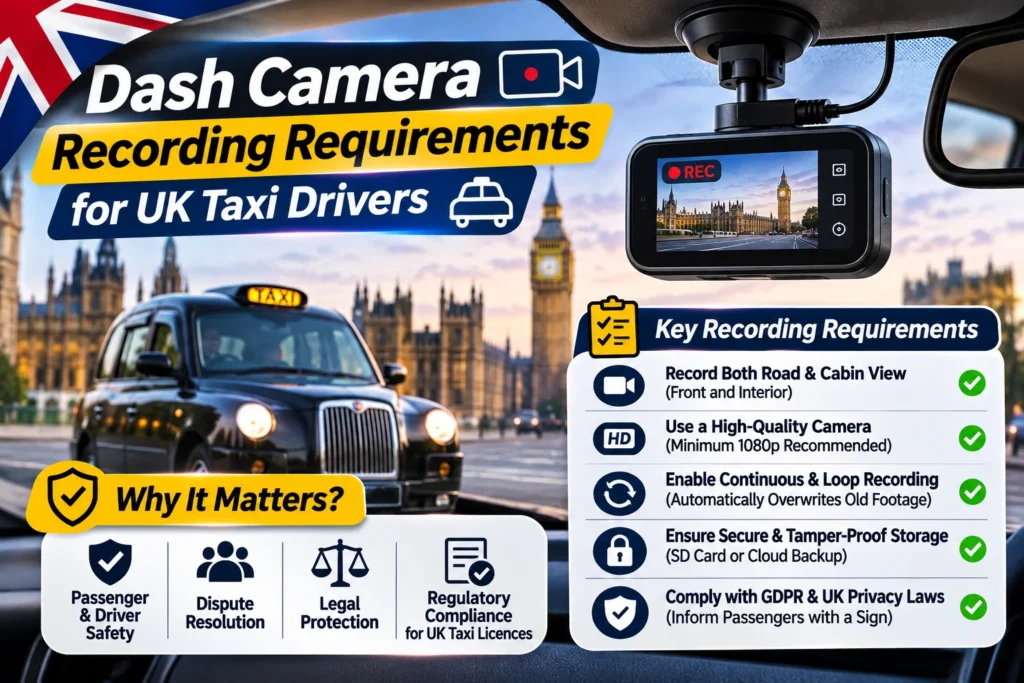
Introduction
Dash cameras are increasingly used in taxis and private hire vehicles across the UK. They can help provide evidence after road accidents, protect drivers against false allegations and support investigations into incidents involving passengers or other road users. However, installing a camera is not simply a matter of choosing a device and switching it on.
Understanding Dash Camera Recording Requirements for UK Taxi Drivers is important because recordings may contain personal information about passengers, drivers, pedestrians and other motorists. Taxi operators must consider privacy, data protection, secure storage and the conditions imposed by their local licensing authority.
This guide explains the main considerations for taxi drivers and vehicle operators who want to use recording equipment responsibly.
1. Understand the Purpose of a Taxi Dash Camera
Before installing a dash camera, identify why you need it. Common reasons include recording road traffic incidents, protecting drivers against false claims, documenting vehicle damage and providing evidence during insurance investigations.
The purpose should determine what the camera records and how long footage is kept. For example, an outward-facing camera may be suitable for recording road incidents without capturing passengers inside the vehicle.
Following Dash Camera Recording Requirements for UK Taxi Drivers begins with choosing a system that records only the information necessary for its intended purpose.
Avoid using cameras for unnecessary monitoring or recording conversations without a properly justified reason.
2. Check Your Local Taxi Licensing Authority’s Rules
Taxi and private hire vehicle licensing conditions are not identical across every UK council. Some authorities have specific requirements for external dash cameras, while others have separate policies for internal CCTV systems.
Before purchasing equipment, check your local authority’s vehicle licensing policy. It may specify:
- Approved camera types or technical standards
- Permitted recording locations
- Internal and external camera requirements
- Audio recording restrictions
- Signage requirements
- Installation and notification procedures
- Footage access and retention arrangements
The Dash Camera Recording Requirements for UK Taxi Drivers in one council area may differ from those in another. Drivers working across multiple licensing areas should check the rules that apply to each licensed vehicle.
Do not assume that a camera permitted by one council will automatically meet another authority’s conditions of Dash Camera Recording Requirements.
3. Follow UK GDPR and Data Protection Principles
Video footage showing identifiable people can count as personal data. This means taxi operators and other responsible parties must consider the UK GDPR and Data Protection Act 2018 when recording, storing or sharing footage.
You should identify a lawful basis for recording and explain the purpose clearly. You should also collect only the information needed for that purpose and protect it against unauthorised access.
The Dash Camera Recording Requirements for UK Taxi Drivers should therefore include a clear approach to data protection, not just the technical installation of a camera.
Depending on how the system is used, the driver, vehicle proprietor, operator or licensing authority may have responsibilities as a data controller. Establish who controls the footage and who handles requests from people recorded.
You should also check whether an ICO data protection fee applies to your organisation or activity.
4. Display Clear Recording Signage
Passengers should be informed when recording takes place. Clear signage helps people understand that a camera is operating, why recording is used and who they can contact with questions.
A suitable notice may explain:
- That video recording is in operation
- The purpose of the recording
- The identity or contact details of the data controller
- Where further privacy information can be obtained
Signage should be easy to read and positioned where passengers can see it. If the camera records inside the vehicle, the information should be provided before or when passengers are recorded, as appropriate.
Under Dash Camera Recording Requirements for UK Taxi Drivers, signage is an important part of transparency. However, a notice alone does not make every type of recording lawful. The system must still have a justified purpose and appropriate safeguards.
5. Understand Audio Recording Restrictions
Audio recording is generally more intrusive than video recording because it can capture private conversations between passengers and drivers.
The Information Commissioner’s Office advises that audio capabilities should normally be switched off by default. Recording sound should only be considered where there is a specific, evidenced need and less intrusive options are insufficient.
Some local licensing authorities prohibit audio recording entirely, while others may permit controlled activation in exceptional circumstances.
When reviewing Dash Camera Recording Requirements for UK Taxi Drivers, check whether your council allows audio recording and whether a trigger or panic switch is required.
Do not assume that a dash camera’s built-in microphone can remain active simply because the device includes that feature. Continuous recording of passenger conversations can create serious privacy concerns.
6. Choose the Correct Camera Type
Different camera systems serve different purposes. Selecting the correct type can help prevent unnecessary recording.
Common options include:
Forward-facing dash cameras: Record the road ahead and may provide evidence following collisions or dangerous driving incidents.
Rear-facing cameras: Capture activity behind the vehicle and can help document certain road incidents.
Internal CCTV cameras: Record the passenger or driver area and may be subject to additional privacy and licensing conditions.
Multi-camera systems: Combine several camera views but require careful configuration to ensure each recording function is justified.
The Dash Camera Recording Requirements for UK Taxi Drivers should be considered before selecting a system, especially when deciding whether internal passenger recording is necessary.
Also check that the camera, wiring and mounting position do not obstruct the driver’s view or interfere with vehicle safety equipment.
7. Store Footage Securely and Set a Retention Period
Recorded footage should be protected from unauthorised access, accidental loss and inappropriate sharing.
Use appropriate security measures, such as:
- Password-protected access
- Encryption where appropriate
- Restricted access for authorised users
- Secure storage and transfer procedures
- Regular checks of recording equipment
- A documented footage retention policy
There is no single UK GDPR retention period that applies to every dash camera recording. The period should be based on the purpose for which the footage is collected. Unneeded footage should be securely deleted.
The Dash Camera Recording Requirements for UK Taxi Drivers should include a process for preserving relevant footage when an accident, complaint or investigation occurs.
Only authorised people should access recordings, and footage should not be uploaded to social media or shared casually.
8. Understand Footage Requests and Data Rights
Passengers, drivers and other identifiable individuals may have data protection rights relating to footage in which they appear. A subject access request may require an organisation to locate and review relevant recordings, subject to applicable legal rules and exemptions.
Police officers, insurers or licensing authorities may also request footage for legitimate purposes. Before providing recordings, verify the requester’s authority and disclose only what is appropriate and lawful.
Good record-keeping makes it easier to identify, retrieve and review relevant footage.
Following Dash Camera Recording Requirements for UK Taxi Drivers means having a clear process for responding to requests rather than relying on the driver to search through recordings without guidance.
9. Check Installation, Maintenance and Driver Training
A properly installed camera should operate reliably without distracting the driver or obstructing visibility. Professional installation may help ensure that wiring, power connections and mounting positions are suitable.
Drivers should understand how to operate the equipment, when recording takes place, how footage is accessed and what to do after an incident.
Vehicle operators should also review their procedures when camera equipment is replaced, moved or reconfigured.
The Dash Camera Recording Requirements for UK Taxi Drivers should be reviewed periodically because local licensing policies and data protection guidance can change.
Taxi Dash Camera Compliance Checklist
Before using a camera in a licensed taxi or private hire vehicle, check the following:
- Confirm your local council’s camera policy.
- Identify the purpose of recording.
- Establish the responsible data controller.
- Check whether an ICO data protection fee applies.
- Display appropriate privacy signage.
- Keep audio recording disabled unless properly justified and permitted.
- Store footage securely.
- Set a suitable retention period.
- Restrict access to authorised people.
- Train drivers on the system and its responsibilities.
Conclusion
Dash cameras can provide useful protection for taxi drivers, passengers and vehicle operators. However, responsible use requires more than installing recording equipment. Privacy, transparency, secure footage management and local licensing conditions must all be considered.
Understanding Dash Camera Recording Requirements for UK Taxi Drivers can help operators select suitable equipment and establish responsible recording procedures. Always check your local council’s latest licensing policy and follow applicable data protection guidance before using a camera in a licensed vehicle.
Frequently Asked Questions
1. Are dash cameras allowed in UK taxis?
Dash cameras may be used in UK taxis, but their permitted use depends on data protection obligations and local licensing conditions. Check your council’s policy before installation.
2. Do taxi drivers need to display camera signage?
Where passengers or other individuals are recorded, appropriate privacy information should be provided. Local licensing policies may specify exactly where and how signage must be displayed.
3. Can taxi dash cameras record passenger conversations?
Audio recording is highly intrusive and should normally be switched off by default. Some councils prohibit it, while others may allow controlled recording in limited circumstances.
4. Is internal CCTV different from a forward-facing dash camera?
Yes. Internal CCTV records people inside the vehicle and can create additional privacy concerns. Some councils have separate requirements for internal CCTV and external dash cameras.
5. How long can taxi dash camera footage be stored?
There is no universal retention period for all UK dash camera footage. The storage period should be limited to what is necessary for the recording purpose.
6. Who is responsible for taxi camera footage?
Responsibility depends on who determines the purpose and means of recording. This may be the vehicle proprietor, taxi operator or licensing authority, depending on the arrangement.
7. Can taxi operators share dash camera footage online?
Footage should not be shared casually or published on social media. Sharing must have a lawful basis and comply with data protection obligations and relevant privacy rights.
8. Should taxi Dash Camera Recording Requirements be professionally installed?
Professional installation can help ensure that the equipment is secure, correctly positioned and does not obstruct the driver’s view. Always follow the manufacturer’s instructions and local licensing conditions.