
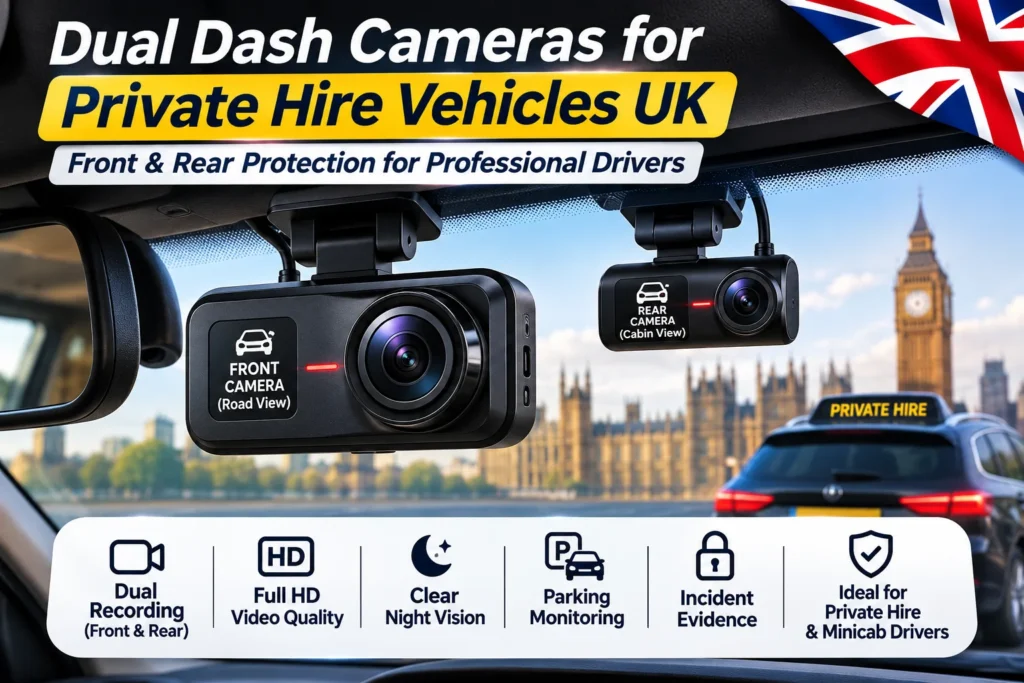
Introduction
Private hire drivers spend many hours on the road, travelling through busy towns, motorways, residential streets and unfamiliar locations. During these journeys, unexpected incidents can happen, including road traffic collisions, disputed insurance claims, dangerous driving and damage to the vehicle. Having a reliable camera system can help drivers keep a record of important events.
Dual Dash Cameras for Private Hire Vehicles UK are designed to capture footage from two different viewing directions, commonly the front and rear of a vehicle. This wider recording coverage can help provide useful evidence when an incident occurs. Depending on the system, drivers may also benefit from features such as GPS tracking, night recording, loop recording and impact detection.
This guide explains the main benefits, important features and practical considerations when choosing a dual dash camera for private hire work.
What Are Dual Dash Cameras?
A dual dash camera system uses two cameras connected to one recording setup. A common configuration includes a front-facing camera that records the road ahead and a rear-facing camera that records the area behind the vehicle.
Some systems use a different arrangement, such as a front camera combined with an interior-facing camera. Therefore, it is important to check exactly what a product includes before purchasing.
For many operators, Dual Dash Cameras for Private Hire Vehicles UK offer a practical way to improve recording coverage without relying on a single forward-facing camera.
A typical system may include:
- A front-facing camera
- A rear-facing or secondary camera
- A recording unit or memory card
- A power connection
- A display or mobile application, depending on the model
- Optional GPS and parking-monitoring features
The right configuration depends on the vehicle, the driver’s requirements and any applicable licensing conditions.
7 Benefits of Dual Dash Cameras for Private Hire Vehicles UK
1. Better Evidence After Road Accidents
One of the main advantages of Dual Dash Cameras for Private Hire Vehicles UK is the ability to record events from more than one direction.
If another vehicle hits your car from behind, a rear-facing camera may capture details that a front camera cannot. Similarly, front footage can help show road conditions, traffic signals and the events leading up to a collision.
This footage may assist when explaining what happened to an insurer or other relevant party. It does not automatically determine liability, but it can provide useful supporting evidence.
2. Protection Against Disputed Claims
Private hire drivers may sometimes face disagreements about how an accident happened. Without reliable evidence, it can be difficult to establish the sequence of events.
A dual camera system can preserve footage that may help clarify the situation. Dual Dash Cameras for Private Hire Vehicles UK can therefore support drivers who want a clearer record of their journeys.
Drivers should ensure that recordings are stored securely and retained only for an appropriate period.
3. Improved Awareness of Surrounding Traffic
A rear-facing camera can help record vehicles approaching from behind, while the front camera captures what is happening ahead.
This wider view can be useful when reviewing incidents involving sudden braking, unsafe overtaking or collisions. It can also help fleet managers understand the circumstances surrounding reported events, provided any monitoring is lawful and proportionate.
4. Support for Insurance Investigations
When an accident occurs, insurers may request information about the circumstances. Clear footage can help explain the location, timing and sequence of events.
Although installing Dual Dash Cameras for Private Hire Vehicles UK does not guarantee a lower insurance premium, some insurers may consider vehicle security and recording equipment when assessing risk. Drivers should check directly with their insurer rather than assume a discount applies.
5. Greater Confidence for Professional Drivers
Driving for long hours can expose private hire drivers to a range of unpredictable road situations. A properly installed camera system provides an additional record of what happens during a journey.
Knowing that important road events may be recorded can give drivers greater confidence when dealing with disputed incidents. However, cameras are a supporting safety measure, not a replacement for safe driving or appropriate insurance.
6. Useful Footage for Fleet Management
Operators managing several private hire vehicles may benefit from consistent camera systems across their fleet.
Depending on the equipment and its settings, footage can help authorised staff investigate collisions, review vehicle damage and respond to complaints. Access should be restricted to people who have a legitimate reason to view recordings.
For fleet operators, Dual Dash Cameras for Private Hire Vehicles UK can form part of a wider vehicle safety and incident-management process.
7. Useful Features for Day and Night Driving
Private hire work often continues after dark, when visibility can be more challenging. A good camera should produce clear footage in different lighting conditions.
Look for suitable low-light performance, automatic exposure adjustment and reliable recording in changing weather. Night vision claims should be checked carefully because image quality varies between camera models.
Important Features to Look For
Before choosing Dual Dash Cameras for Private Hire Vehicles UK, compare the following features:
Video Resolution
Choose a camera with sufficient resolution to capture useful details such as road signs, vehicle shapes and number plates when conditions allow. Higher resolution can improve detail, although it does not guarantee clear footage in every situation.
Wide-Angle Coverage
Check the viewing angle of both cameras. A wider field of view can capture more of the surrounding road, but excessive wide-angle distortion may make distant details harder to identify.
Loop Recording
Loop recording allows the system to overwrite older footage when the memory card becomes full. Important incident recordings may be protected through an event-locking feature, depending on the model.
GPS Functionality
Some systems record location, speed and journey information alongside video. This can help establish where and when an incident happened. Make sure any location data is handled responsibly.
Secure Storage
Choose a system with reliable memory-card support and appropriate recording protection. For professional use, consider how footage can be exported, stored and shared securely.
Data Protection and Private Hire Camera Rules in the UK
Before installing Dual Dash Cameras for Private Hire Vehicles UK, check the requirements of your local licensing authority. Rules can differ between councils, particularly where a system records the inside of the vehicle or captures passengers.
A road-facing front-and-rear dashcam is not necessarily treated in the same way as an in-car CCTV system. Some authorities have specific conditions about camera positioning, audio recording, signage and approved equipment.
If identifiable people are recorded, data protection responsibilities may apply. Drivers and operators should consider:
- Whether recording is necessary for a legitimate purpose.
- Who is responsible for the recorded information.
- Whether clear privacy information or signage is required.
- How long footage should be retained.
- Who can access recordings.
- How footage is securely shared or deleted.
- Whether audio recording should be disabled.
Audio recording is particularly intrusive. The Information Commissioner’s Office advises that audio capabilities should generally be switched off by default and only activated in exceptional circumstances where properly justified.
If your vehicle is used for personal journeys as well as private hire work, consider how recording can be disabled when the vehicle is being used privately, where appropriate.
How to Choose the Right Dual Dash Camera
Choosing Dual Dash Cameras for Private Hire Vehicles UK starts with understanding your recording requirements.
First, decide whether you need front-and-rear road coverage or front-and-interior recording. Then check the system’s resolution, night performance, storage capacity, GPS features and installation requirements.
You should also confirm that the equipment is acceptable under your local private hire vehicle licence conditions. Ask your licensing authority if you are unsure whether a particular camera arrangement is permitted.
Professional installation can help ensure that cables are secured, the driver’s view remains unobstructed and the cameras are positioned correctly.
Common Buying Mistakes to Avoid
Avoid choosing a camera based only on its advertised resolution or low price. Check the quality of real-world footage, reliability of the memory card, warranty and availability of technical support.
Other common mistakes include:
- Buying a front-and-interior camera when you need front-and-rear coverage.
- Ignoring local licensing conditions.
- Leaving audio recording enabled without proper justification.
- Installing cameras where they obstruct the driver’s view.
- Failing to protect important incident footage.
- Sharing recordings publicly or with unauthorised people.
A little research before purchasing can help you select a system that suits your vehicle and professional requirements.
Conclusion
A suitable dual dash camera can provide useful evidence, improve recording coverage and support private hire drivers when dealing with road incidents or disputed claims. The best system will depend on the vehicle, the type of journeys and the recording features required.
Dual Dash Cameras for Private Hire Vehicles UK should be selected with attention to camera positioning, image quality, storage, privacy and local licensing requirements. Before installation, confirm that the system is appropriate for your vehicle and that its use follows relevant data protection guidance.
Frequently Asked Questions
1. What are dual dash cameras for private hire vehicles?
They are camera systems that record from two directions, commonly the front and rear of a vehicle. Some models combine a front camera with an interior-facing camera.
2. Are Dual Dash Cameras for Private Hire Vehicles UK?
Yes. They can provide additional footage of road incidents, support insurance investigations and help clarify disputed events.
3. Do there is need of front and rear Dual Dash Cameras for Private Hire Vehicles UK?
There is no single nationwide requirement that every private hire vehicle must have this exact setup. Check the conditions set by your local licensing authority.
4. Can dash camera footage help with an insurance claim?
It may provide useful evidence of the circumstances surrounding an accident. The insurer will assess the footage alongside other available information.
5. Should private hire dash cameras record passengers?
Interior recording raises additional privacy considerations. Check local licensing conditions and data protection requirements before using an inward-facing camera.
6. Is audio recording allowed in private hire vehicles?
Audio recording is more intrusive than video recording. The ICO advises that it should generally be switched off by default and used only in exceptional, justified circumstances.
7. What features should I look for in a dual dash camera?
Consider video quality, night performance, viewing angles, loop recording, secure storage, GPS functionality and reliable installation.
8. Can a dual dash camera reduce private hire insurance costs?
Some insurers may consider recording equipment when assessing risk, but a discount is not guaranteed. Confirm any potential benefit with your insurer.