
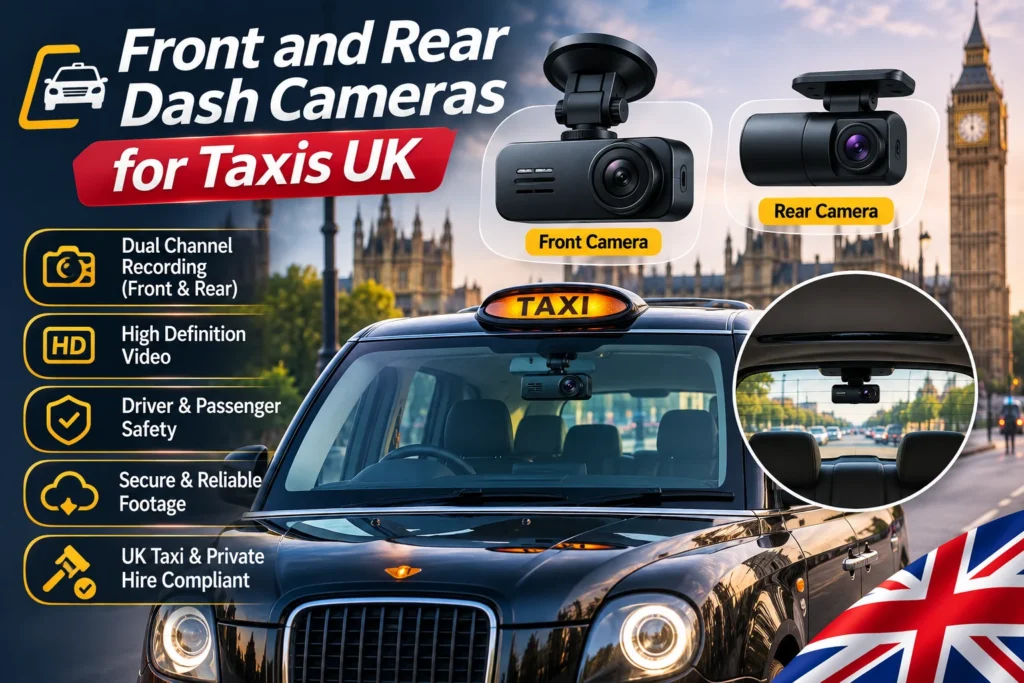
Taxi and private hire drivers spend long hours on the road, often carrying passengers through busy streets, residential areas and unfamiliar locations. A suitable dash camera system can provide useful video evidence in the event of an incident, help document journeys and offer additional reassurance for drivers and passengers.
Choosing Front and Rear Dash Cameras for Taxis UK involves more than selecting a camera with a high-resolution recording feature. Drivers should consider camera positioning, recording quality, storage, installation, privacy and the requirements of their local licensing authority.
Why Do Taxi Drivers Need Front and Rear Cameras?
A front-facing camera records the road ahead, including traffic conditions, potential hazards and incidents in front of the vehicle. A rear-facing camera can provide additional footage of activity behind the car or inside the passenger compartment, depending on the camera design and installation.
The benefits of Front and Rear Dash Cameras for Taxis UK may include:
- Recording incidents on the road
- Providing video evidence for insurance enquiries
- Documenting events involving other road users
- Supporting driver safety procedures
- Recording relevant activity inside or around the vehicle, where permitted
A camera system should be selected according to the driver’s actual requirements and the rules that apply to the vehicle’s licence.
1. Choose the Right Camera Configuration
Not every taxi needs the same camera arrangement. Some systems record the road ahead and behind the vehicle, while others include an additional internal camera to record the passenger area.
Before purchasing Front and Rear Dash Cameras for Taxis UK, decide which areas need to be recorded. Check whether the system has two separate external cameras, a front camera with an interior lens or a dedicated multi-channel recording unit.
Make sure the camera configuration is suitable for your vehicle and does not obstruct the driver’s view.
2. Check Video Resolution and Night Recording
Video quality is important when footage may be needed to review an incident. Look for clear recording, reliable exposure adjustment and useful performance in changing light conditions.
Night recording is particularly relevant for taxi drivers who work evening and overnight shifts. Headlights, street lighting, reflections and dark roads can all affect image quality.
When comparing Front and Rear Dash Cameras for Taxis UK, review sample footage rather than relying only on advertised resolution. Check whether number plates and important details are readable in realistic driving conditions.
3. Consider Storage and Recording Features
A camera needs suitable storage to retain footage. Some systems use removable memory cards, while others may offer cloud-connected features or dedicated recording units.
Check the maximum supported storage capacity, recording loop settings and how protected footage is saved. Loop recording normally replaces older unprotected recordings when storage becomes full, so important footage should be saved promptly.
Also ask how footage can be exported and whether the system records continuously, when the ignition is on or when an event is detected.
4. Arrange Professional Installation
Correct installation helps ensure that cameras remain secure and record the intended areas. Poorly routed cables can create clutter, interfere with vehicle controls or become a distraction.
A professional installer should consider camera positioning, wiring routes, power supply and the location of the recording unit. They should also check that the cameras operate correctly before handing the vehicle back.
Professional fitting of Front and Rear Dash Cameras for Taxis UK can be particularly useful when a system includes several cameras or needs to be integrated neatly into a working taxi.
5. Understand Privacy and Licensing Requirements
Taxi camera requirements can differ between licensing authorities and vehicle categories. Some authorities may specify camera standards, positioning, signage, recording arrangements or approved equipment.
Drivers should check the current rules issued by the authority that licences their vehicle. Do not assume that a camera system accepted in one area automatically meets the requirements in another.
Recording passengers also raises privacy and data protection responsibilities. Drivers and operators should understand what is recorded, why recording takes place, who can access footage and how long it is retained.
Before installing Front and Rear Dash Cameras for Taxis UK, check whether audio recording is permitted or restricted under the applicable rules. Avoid recording more information than is necessary for the stated purpose.
6. Test the System Before Returning to Work
After installation, test every camera and check that the footage is clear. Confirm that the date and time are correct, storage is working and the recording unit saves video as expected.
Ask the installer to demonstrate how to:
- View recorded footage
- Save an important recording
- Export a video file
- Check memory card status
- Adjust permitted recording settings
A clear handover makes it easier to use the system properly when an incident occurs.
How to Choose a Taxi Camera Installer
Compare installers based on their experience with taxis and private hire vehicles. Ask whether they understand the requirements of your licensing authority and whether they can provide documentation about the equipment fitted.
When comparing Front and Rear Dash Cameras for Taxis UK installation services, ask for a written quote covering the camera equipment, labour, wiring, storage and any additional accessories.
Also check the warranty, technical support and process for dealing with faults. A professional installer should explain the system’s limitations rather than promising that a camera will prevent every dispute or incident.
Frequently Asked Questions
1. Do taxis need front and rear dash cameras?
Requirements depend on the licensing authority and the type of taxi or private hire licence. Check the current local rules before purchasing equipment.
2. Can a taxi camera record inside the vehicle?
Some systems include an interior-facing camera. Whether it should be used depends on licensing requirements, privacy responsibilities and the purpose of recording.
3. Is professional installation recommended?
Professional fitting can help with secure positioning, wiring and system testing, particularly for multi-camera installations.
4. Do taxi dash cameras record when the vehicle is parked?
Some systems offer parking mode, but this depends on the camera, power arrangement and settings. Confirm how the feature works before buying.
5. How long should taxi footage be stored?
Retention requirements and appropriate storage periods depend on the applicable licensing rules and data protection obligations. Keep footage only as long as necessary for its stated purpose or legal requirements.
6. Can I use my own dash camera in a licensed taxi?
Possibly, but the equipment and installation must meet the relevant licensing authority’s requirements. Check before fitting it.
7. Should I choose a camera with audio recording?
Audio recording raises additional privacy considerations. Check the relevant rules and obtain appropriate advice before enabling it.
8. How do I choose Front and Rear Dash Cameras for Taxis UK?
Compare camera coverage, recording quality, storage, reliability, installation support and compliance with your local licensing authority’s requirements.
Conclusion
A suitable camera system can help taxi drivers document road incidents and manage vehicle security more effectively. However, choosing the right equipment requires careful attention to camera coverage, recording quality, installation and privacy.
When comparing Front and Rear Dash Cameras for Taxis UK, check your local licensing requirements before purchasing. Choose a reliable installer, test every camera and understand how footage should be stored and accessed. These steps can help you make a more informed decision about taxi camera equipment.