
A vehicle is stolen every three minutes in England and Wales. While that statistic is sobering, the reality of modern theft is even more calculated. Over 70% of these crimes now involve keyless relay attacks. This means your factory-fitted security might not be the shield you think it is. When you’re weighing up a tracker vs immobiliser for car security, you aren’t just choosing a gadget. You’re choosing a philosophy of protection.
It’s natural to feel anxious about key cloning and relay devices, especially when insurers are tightening their requirements for high-value assets. You want a solution that works without the technical headache. Discover the critical differences between vehicle trackers and immobilisers to build a security strategy that actually stops modern thieves. We will explain how these systems function independently and why a layered approach is the only way to achieve total peace of mind in 2026.
Key Takeaways
- Identify the core technical differences between proactive engine immobilisation and reactive GPS recovery systems.
- Evaluate the tracker vs immobiliser for car security debate to see which technology aligns with your specific insurance and protection needs.
- Recognise the limitations of factory-fitted security and how to shield your vehicle from modern relay attacks and key cloning.
- Clarify Thatcham S5 and S7 grading systems to ensure your asset is fully compliant with 2026 insurance mandates.
- Learn how a layered security strategy provides both immediate theft prevention and a high-tech recovery path if the unthinkable happens.
What is the Difference Between a Car Tracker and an Immobiliser?
Understanding the tracker vs immobiliser for car security debate starts with a clear distinction between prevention and recovery. These two technologies are often confused, yet they operate on entirely different principles. An immobiliser is a proactive barrier. Its primary job is to stop a thief from driving the vehicle away in the first place. A car tracker is a reactive recovery tool. It assumes the theft has already occurred or is in progress, providing the real-time location data necessary to get the vehicle back. While their methods differ, they share a singular, uncompromising goal: the preservation of your asset.
In 2026, the gap between these two technologies is narrowing. Modern security suites, such as S5 PLUS Trackers, now offer hybrid capabilities that combine both functions into a single installation. However, to build an effective defence, you must first understand how each component stands its ground against modern criminal tactics.
The Core Function of a Vehicle Immobiliser
A vehicle immobiliser is an electronic security device designed to prevent the engine from running unless the correct digital handshake is performed. Traditional factory-fitted systems often rely on a chip inside the key fob. Unfortunately, thieves now use relay devices to clone these signals in seconds. This has led to the rise of secondary, aftermarket systems like the Ghost 2 Immobiliser.
These advanced units don’t transmit radio signals that can be intercepted. Instead, they integrate directly with the vehicle’s CAN bus system and communicate with the Engine Control Unit (ECU). They work by interrupting the ignition, fuel, or starter circuits. The ‘No PIN, No Start’ philosophy is the gold standard here. Even if a thief has your keys, the car will not start until a unique sequence of buttons is pressed on the steering wheel or dashboard. It is a silent, invisible, and highly effective deterrent.
The Core Function of a GPS Vehicle Tracker
A car tracker provides the high-tech pursuit and restoration of your vehicle after it has been moved. Using a combination of GNSS (Global Navigation Satellite System) and cellular technology, these devices offer 24/7 monitoring. Unlike a basic GPS, a Thatcham-approved system like the Scorpion S7 Tracker or Scorpion S5 Tracker is linked to a Secure Operating Centre (SOC).
When the system detects unauthorised movement or the battery is disconnected, it triggers an immediate alert. The SOC then takes over, tracking the vehicle’s precise movements and coordinating directly with the police. The focus here is on the resolution phase. While an immobiliser stops the engine, a tracker ensures that if the vehicle is towed or lifted onto a low-loader, it doesn’t simply vanish. When evaluating a tracker vs immobiliser for car security, remember that the tracker is your insurance policy for recovery, while the immobiliser is your front-line guard.
Choosing between a tracker vs immobiliser for car security requires you to weigh two distinct philosophies: prevention and recovery. One acts as an active barrier. The other serves as a reactive failsafe. For high-value assets, prevention is always the first line of defence. It stops the crime before your vehicle leaves the driveway. Recovery, however, is the safety net that ensures resolution if professional thieves bypass physical barriers.
Immobilisers are active systems. They require a specific action, like entering a PIN, to authorise the engine. Trackers are largely passive. They monitor in the background, only springing into action once unauthorised movement is detected. This distinction is vital for insurance compliance. While Thatcham Category 2 immobilisers are often standard on modern cars, they rarely provide the recovery data insurers demand for high-risk vehicles. The psychological reassurance of knowing your car cannot be driven away is a primary benefit of immobilisation, but it doesn’t solve the problem of a vehicle being towed.
When Prevention is the Priority
Prevention is the best strategy against modern relay attacks and key cloning. Thieves now use electronic devices to trick your car into thinking the key is present. A Ghost 2 Immobiliser counters this by remaining silent. It doesn’t broadcast a signal for thieves to intercept. This tech provides immense psychological reassurance. You don’t have to worry about your keys being cloned while you sleep. It’s the ultimate deterrent for joyriders and opportunistic thieves who want a quick, easy getaway. If they can’t start the engine, they usually move on to an easier target.
When Recovery is the Priority
Recovery becomes the priority when dealing with professional gangs. These criminals don’t always try to start the engine. They may use low-loaders or towing equipment to remove the vehicle physically from your property. In these scenarios, car trackers are your only hope for restoration. Thatcham S5 trackers can locate vehicles even if they are hidden in shipping containers or “chop shops” by using advanced signal technology. This high-tech pursuit facilitates a rapid police response, significantly increasing the chances of asset recovery before the vehicle is stripped or exported.
For these systems to be effective, they must be hidden correctly within the vehicle’s complex wiring. This is why professional installation is non-negotiable. A poorly fitted device is easily found and discarded by a seasoned thief. You can view our security solutions to see how expert fitting ensures your protection remains invisible to the trained eye, providing the tranquil security you deserve.
The Factory-Fitted Myth: Why Your Car’s Built-in Security Isn’t Enough
Many car owners believe their modern vehicle is a digital fortress. It’s a dangerous assumption. Professional thieves now use electronic devices costing as little as £20 to bypass standard factory-fitted immobilisers in seconds. These tools are readily available online and require zero mechanical skill to operate. When comparing a tracker vs immobiliser for car security, it’s vital to recognise that factory systems are standardised. Every Land Rover or BMW of a certain model year has the same security architecture. This predictability is a thief’s greatest advantage. They know exactly what they’re fighting before they even arrive at your driveway.
OBD port hacking is another common method where criminals gain physical entry and plug a device into the vehicle’s diagnostic port. Within moments, they can program a blank key fob and drive away as if they owned the car. Aftermarket security provides “security through obscurity.” Because these systems are hidden and unique to each installation, a thief doesn’t know the hardware exists until they’ve already failed to start the car. By then, their window of opportunity is closing fast.
Relay Attacks and Key Cloning Explained
A relay attack is a sophisticated but silent process. One thief stands near your front door with a signal booster, while another stands by your car. The booster “grabs” the signal from your key fob inside the house and beams it to the car. The vehicle thinks you’re standing right next to it with the key. It unlocks the doors and primes the ignition instantly. While a faraday pouch is a good start, an aftermarket car immobiliser is the real solution. High-end brands like Land Rover, BMW, and Audi are frequent targets because their keyless systems are often the most exploited. These systems rely on a signal that is always “on,” making them easy targets for anyone with a booster.
CAN-bus Injection: The New Frontier of Car Theft
The newest threat in 2026 is CAN-bus injection. Thieves no longer need your key signal. They access the car’s “brain” through external wiring points, such as the back of a headlight or a wheel arch sensor. By injecting malicious code directly into the vehicle’s internal network, they can tell the doors to unlock and the engine to start. Secondary immobilisation that requires a physical PIN input is the only way to counter this. Using hardware that aligns with official Thatcham security definitions ensures your vehicle has been tested against these exact digital intrusions. These certified systems provide a layer of protection that factory software simply cannot match. It’s the difference between a standard lock and a vault door.
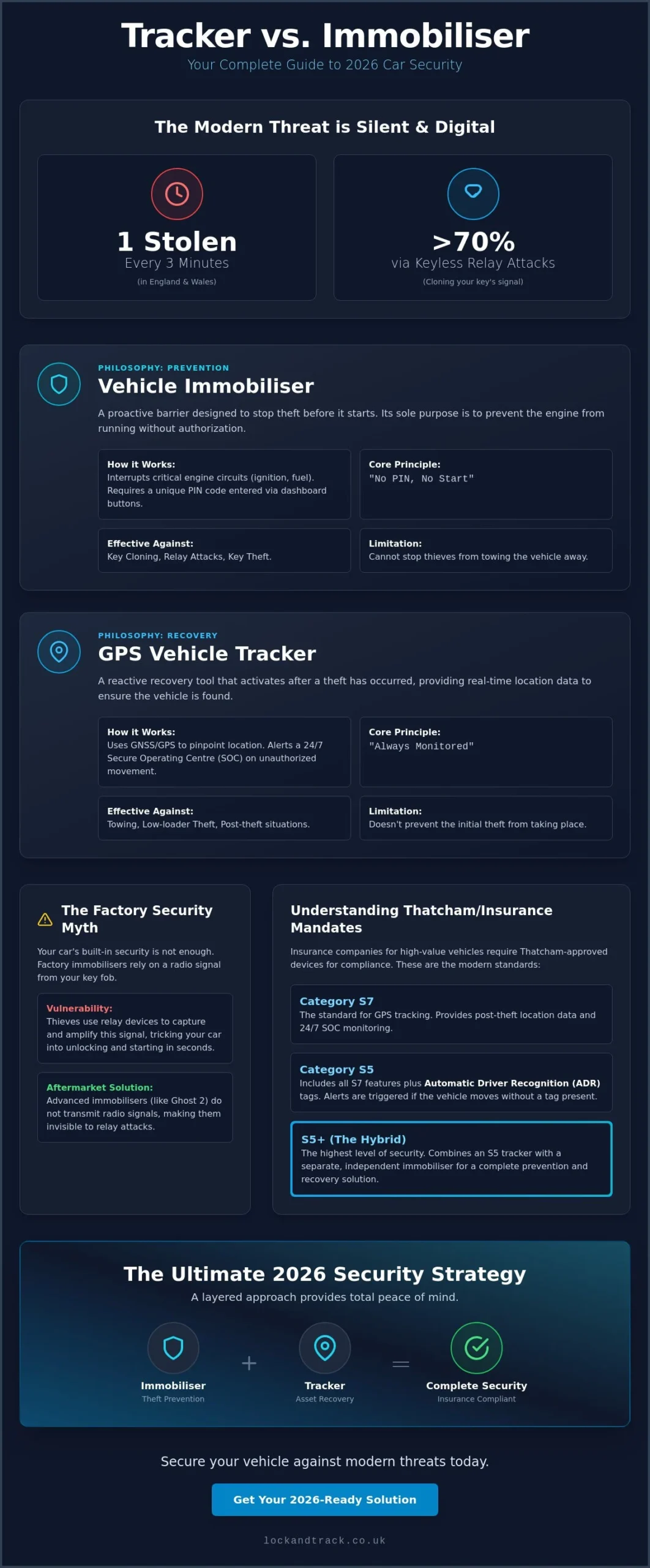
Insurance Requirements: Thatcham S5, S7, and Category 2 Explained
Thatcham Research sets the benchmark for vehicle security in the UK. Their grading system determines whether your security strategy meets the strict criteria of your insurance provider. When you’re deciding on a tracker vs immobiliser for car security, you must align your choice with these industry standards. Most insurers now mandate specific hardware based on the vehicle’s market value and theft risk. Failing to meet these requirements can result in a voided policy or a rejected claim if the unthinkable happens.
Category 2 refers to electronic immobilisers. While most cars built after 1998 have these factory-fitted, they often lack the digital sophistication to stop modern relay attacks. For older vehicles or those without standard protection, upgrading to a Category 2 system is a foundational step. However, for modern high-value assets, insurers usually demand a combination of Category 2 immobilisation and a Thatcham-approved tracking system.
Thatcham S7 vs S5: Which Tracker Do You Need?
The choice between S7 and S5 often comes down to your car’s value. For vehicles valued over £40,000, an S5 tracker is typically a non-negotiable requirement for cover. S7 trackers are the entry-level standard for post-theft recovery. They provide 24/7 monitoring but lack proactive theft detection. S5 systems are the industry standard for 2026 insurance policies on luxury and performance cars. While S5 systems carry higher hardware costs and subscription fees, they often lead to premium reductions of 5% to 20%. This makes the S5 a smarter financial decision for high-end assets.
The Role of ADR (Automatic Driver Recognition) Tags
ADR tags are the defining feature of S5 security. These small, discreet fobs identify the authorised driver. If the car starts or moves without a tag present, the Secure Operating Centre (SOC) receives an immediate alert. This is the ultimate counter to key theft. Even if a thief steals your actual keys from your house, they won’t have the ADR tag. The SOC will track the vehicle and notify the police before the thief even leaves your neighbourhood.
For these systems to be valid, you must have a professional, Thatcham-approved installation. DIY fitting voids the certification and will likely invalidate your insurance policy. If you need to secure your vehicle for a new policy, book your Thatcham-approved installation today to ensure your asset is fully protected and compliant.
The Ultimate 2026 Security Strategy: The Hybrid Approach
Building a foolproof defence in 2026 requires more than a single piece of hardware. Relying solely on one device leaves gaps that sophisticated criminal gangs are ready to exploit. The most effective strategy is the ‘S5 PLUS’ or ‘Tracker + Immobiliser’ combination. This hybrid approach ensures you’re never reliant on a single point of failure. When evaluating a tracker vs immobiliser for car security, the most secure answer is to integrate both into a unified, layered shield.
A layered system provides immediate prevention while maintaining a fail-safe recovery option. If an immobiliser stops a thief from starting the engine, they may attempt to tow the vehicle. This is where the tracker takes over. When you deploy a tracker vs immobiliser for car security as a combined unit, you eliminate the weaknesses of standalone devices. Lock and Track specialises in integrating these complex systems seamlessly, ensuring your vehicle remains protected from every possible angle of attack. Our nationwide mobile installation service brings this elite technology directly to your driveway at your convenience.
Why One Device is Rarely Enough
Security professionals often refer to the ‘Swiss Cheese’ model. Every individual security system has potential holes or vulnerabilities. By stacking multiple layers, you ensure the holes in one system are covered by the solid strengths of another. A Ghost 2 Immobiliser is exceptional at stopping a drive-away theft by requiring a unique PIN. However, it cannot alert you if the car is lifted onto a low-loader. A Scorpion S5 tracker handles the ‘towed-away’ scenario by providing real-time location data and SOC monitoring. The hybrid approach is the strategic integration of digital engine blocking and real-time GPS tracking to create a comprehensive safety net.
Choosing Your Custom Security Package
Your security strategy should be as unique as your asset. A high-value performance car requires different protocols than a leisure vehicle. For instance, motorhome trackers often include specific sensors for habitation areas that standard car systems lack. Business owners protecting multiple assets should consider fleet tracking solutions to monitor location and driver behaviour across an entire organisation. Every installation we perform is tailored to the specific vulnerabilities of the vehicle and the requirements of your insurance policy.
Don’t leave your asset to chance. A professional security audit is the first step toward total tranquility. Contact Lock and Track today for an expert consultation and to arrange your nationwide fitting. We provide the technical expertise and proactive monitoring you need to stay one step ahead of modern car thieves.
Protect Your Vehicle with a 2026 Ready Security Strategy
Modern vehicle theft is a fast-paced digital race. Relying on factory-fitted security is no longer enough to stop professional gangs equipped with relay boosters and CAN-bus injection tools. The choice between a tracker vs immobiliser for car security isn’t about picking one over the other; it’s about integrating them into a layered defence. While an immobiliser provides the essential ‘No PIN, No Start’ barrier, a Thatcham-approved tracker ensures you have a high-tech recovery path if your car is towed or moved without authorisation.
Our Thatcham-approved engineers are specialists in Ghost 2 and Scorpion S5 technology. We provide nationwide mobile installation at your home or workplace, ensuring your security is fitted discreetly and professionally. This hybrid approach delivers the psychological reassurance you need and the insurance compliance your policy demands. Don’t wait for a vulnerability to become a loss.
For travellers who prefer the peace of mind of leaving their vehicle safely at home rather than in a public car park, you can visit Airlink Transport Ltd for professional airport taxi services throughout London.
Secure Your Vehicle Today with Nationwide Installation from Lock and Track. Take control of your car’s safety and enjoy the tranquility of knowing your asset is guarded by the best technology available today.
Frequently Asked Questions
Is an immobiliser better than a tracker for preventing car theft?
An immobiliser is superior for immediate prevention, while a tracker is essential for post-theft recovery. An immobiliser like the Ghost 2 ensures the engine won’t start without a unique PIN, effectively stopping thieves at your driveway. A tracker provides the high-tech pursuit capability needed if a vehicle is moved by other means, such as towing. The most effective strategy is a layered approach using both.
Does a car tracker reduce my insurance premium in the UK?
Yes, fitting a Thatcham-approved tracker can reduce your insurance premiums by 5% to 20% depending on your provider. Many UK insurers now mandate these systems for high-value vehicles before they will even offer cover. By choosing a certified system, you satisfy professional industry standards and gain significant financial benefits while securing your asset against modern threats.
Can thieves bypass a Ghost 2 immobiliser?
The Ghost 2 Immobiliser is designed to be virtually bypass-proof because it does not transmit radio frequency signals. Unlike factory systems, it cannot be defeated by relay attacks or signal grabbing. It integrates directly into the vehicle’s CAN bus system. This means there are no obvious wires for a thief to cut and no physical keys for them to clone.
What happens if my car is towed? Will an immobiliser still work?
An immobiliser will remain active, but it cannot prevent the physical movement of a towed vehicle. If your car is lifted onto a low-loader, the immobiliser will still prevent the engine from starting, but the asset is still gone. This is why weighing up a tracker vs immobiliser for car security usually leads to a hybrid solution that covers every theft scenario.
Do I need to pay a subscription for both a tracker and an immobiliser?
You typically only pay a subscription for the tracking service. Devices like the Ghost 2 Immobiliser are standalone units with no ongoing fees after the initial installation. Thatcham-approved trackers, such as the Scorpion S5 or S7, require a subscription to maintain the 24/7 monitoring service provided by a Secure Operating Centre, which is vital for insurance compliance.
Will installing an aftermarket immobiliser or tracker void my car’s warranty?
No, a professionally installed aftermarket system will not void your vehicle’s warranty. Under UK law and Block Exemption regulations, you have the right to fit third-party parts to your vehicle. As long as the work is carried out by a certified professional, your manufacturer’s warranty remains intact while your level of protection increases significantly against sophisticated theft methods.
How long does it take to install a tracker and immobiliser package?
A professional installation for a combined tracker and immobiliser package typically takes between two and four hours. Our engineers hide the hardware deep within the vehicle’s complex wiring to ensure it is invisible to thieves. We offer nationwide mobile installation, allowing the work to be completed at your home or workplace for your total convenience.
What is an ADR tag and do I really need one?
An ADR (Automatic Driver Recognition) tag is a small, discreet fob that identifies you as the authorised user. It is a mandatory component of Thatcham S5 systems. If the vehicle moves without the tag present, an alert is sent instantly to the monitoring centre. This technology is the most effective way to protect your vehicle against actual key theft.